
August 5, 2026 - PBS News Hour full episode
8/5/2026 | 57m 46sVideo has Closed Captions
August 5, 2026 - PBS News Hour full episode
August 5, 2026 - PBS News Hour full episode
Problems playing video? | Closed Captioning Feedback
Problems playing video? | Closed Captioning Feedback
Major corporate funding for the PBS News Hour is provided by BDO, BNSF, Consumer Cellular, American Cruise Lines, and Raymond James. Funding for the PBS NewsHour Weekend is provided by...
August 5, 2026 - PBS News Hour full episode
8/5/2026 | 57m 46sVideo has Closed Captions
August 5, 2026 - PBS News Hour full episode
Problems playing video? | Closed Captioning Feedback
Where to Watch PBS News Hour
PBS News Hour is available to stream on pbs.org and the PBS app.
Providing Support for PBS.org
Learn Moreabout PBS online sponsorshipGEOFF BENNETT: Good evening.
I'm Geoff Bennett.
AMNA NAWAZ: And I'm Amna Nawaz.
On the "NewsHour" tonight: Progressive challenger Abdul El-Sayed defeats moderate Haley Stevens in Michigan's contentious Democratic Senate primary.
GEOFF BENNETT: A Russian attack on Kyiv kills at least 17 people and exposes major deficiencies in Ukraine's air defense systems.
AMNA NAWAZ: And 150 years after the Battle of the Little Bighorn, we examine how the conflict reshaped government policy toward indigenous people.
NED BLACKHAWK, Author: These are the most misunderstood subject of American history, and we need to understand them to understand ourselves more fully.
(BREAK) AMNA NAWAZ: Welcome to the "News Hour."
We begin tonight in Michigan, where a progressive who has never held elected office defeated an establishment-backed congresswoman in the Democratic primary for U.S.
Senate.
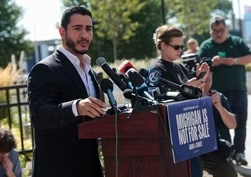
GEOFF BENNETT: Abdul El-Sayed won the Democratic nomination, defeating moderate Haley Stevens in a closer-than-expected race that exposed divisions within the party.
Outside groups poured more than $60 million into advertising, backing Stevens, making it one of the most expensive primaries in the country.
El-Sayed made that spending a central issue throughout his campaign, casting it as a symbol of outside influence.
And he returned to it in his victory speech today.
ABDUL EL-SAYED (D), Michigan Senatorial Candidate: What we showed is that the power of our many is greater than the power of their money.
What we showed is that if you're willing to build a movement brick by brick, if you're willing to go and travel your state and have the conversations in rooms big and small, starting in moments when people aren't even paying attention to an election, but are paying attention to the price of gas and the price of groceries and the price of housing and the price of health care, that you can build a conversation that builds into a movement that defeats Goliath.
GEOFF BENNETT: El-Sayed will face off against Republican nominee Mike Rogers in the fall.
To discuss those results and more, we turn now to Democratic strategist Lis Smith.
She worked for the campaign of another Democrat, Mallory McMorrow, who dropped out of the race last month.
Lis, it's always great to see you.
So let's start with the headline here.
El-Sayed, he faced a nearly 9-1 spending advantage held by his rival.
He was opposed by the sitting governor, popular Governor Whitmer, and he embraced many positions that until recently Democrats considered politically toxic, and yet he wins this Senate primary in a swing state.
What's the lesson from that?
LIS SMITH, Democratic Strategist: I think what it tells us is less maybe about the ideology and more about the mood of where Democrats are.
After the 2024 election, Democrats are pretty angry at the establishment.
They're pretty angry about what happened with Joe Biden, and they're really angry that we lost to Donald Trump a second time.
And they want something different.
And that was what Abdul El-Sayed was offering in this race.
And as much as we can talk about it as a victory for El-Sayed, I think we need to look at it as a massive loss for the establishment that, as you said, went in with over $65 million in spending on Haley Stevens' behalf, tried to win ON the field for her, and picked her out because she had the traditional political biography, had been in Congress for a long time, could raise a lot of corporate cash, had all the right insider connections.
Twenty years ago, that type of candidate may well have won this primary.
In this environment, it was the exact wrong resume.
GEOFF BENNETT: And El-Sayed, he also made U.S.
policy toward Israel and the role of outside spending, particularly by AIPAC, a defining issue in this race.
How much of his victory reflects Democratic views on the war in Gaza and U.S.
support for Israel?
LIS SMITH: That was definitely a big part of it.
And 10 years ago, where Haley Stevens stood on the -- stands on the issue of Israel, which is giving them unconditional aid, was the standard position for people in the Democratic Party.
But, today, where Abdul El-Sayed is, saying we should not be giving a blank check to Netanyahu's government -- you know, he calls it a genocide.
A lot of -- not everyone does.
But I think where he stands on this issue is much closer to where the median Democratic voter stands.
But another thing I would say is, yes, he went out and he attacked AIPAC regularly.
But, in some ways, in a lot of these Democratic primaries, an attack on AIPAC isn't really just a foreign policy conversation.
It signals that you are willing to take on powerful interests.
You are willing to take on the big money that can get behind sort of corporate establishment Democrats and establish your independence.
And that was a key part of his message too.
GEOFF BENNETT: How can a message that won a Democratic primary also build the broader coalition needed to bring in independents and swing voters in November?
LIS SMITH: Well, Geoff, that's the million-dollar question.
And that is the hard work that Abdul El-Sayed needs to start today, because I watched that campaign, and I would have loved to have seen him close it on a broader note, a more conciliatory note.
But, instead, at the end, he was still really running a very far leftist campaign, inviting far left members of the Democratic Party media in to campaign for him.
And that's going to have to change between now and November.
Because the reality is this.
Michigan's a purple state.
And so he's going to have to figure out, how do I build the tent?
And I will just say some of his tone in this campaign has been my way or the highway.
You're either with me or you're bought off.
And I just don't think that's going to work if you want to win people over.
GEOFF BENNETT: And big picture, we should say that, yes, progressives scored notable victories last night, but elsewhere you have establishment-backed candidates prevailing, like Wesley Bell's win over Cori Bush in Missouri.
So, taken together, what do what do all of these victories say about where the Democratic Party is headed?
LIS SMITH: What it says is that the Democratic Party is in the middle of a post-2024 reckoning.
Call it an identity crisis.
Call it an interparty debate.
And I think we're trying to figure out, do we move on ideology?
How hard do we fight?
How do we talk about the role of money in our party, corporate money, the millions of dollars that organizations like AIPAC are funding?
And how do I view the establishment and the leadership of our party?
Democratic voters have said post-2024 that the Democratic leadership is too old, they are out of touch, and we want new leaders, and we want new leadership.
And so I think all of these right now are questions that are being litigated in this election.
And we will have a better idea about all of these things after November.
GEOFF BENNETT: Democratic strategist Lis Smith, always good to see you.
Thanks for making time for us.
LIS SMITH: Yes, thank you for having me, Geoff.
AMNA NAWAZ: In the day's other headlines: The Senate confirmed Dr.
Erica Schwartz as the new director of the Centers for Disease Control and Prevention today.
MAN: On this vote, the yeas are 51, the nays are 44.
The nomination is confirmed.
AMNA NAWAZ: The former deputy surgeon general takes over at a delicate time for the agency, as it grapples with political interference and low morale.
Last month, she faced questions from a Senate committee about her approach to vaccines and the ongoing cyclospora outbreak.
The CDC said today that the outbreak of the intestinal illness has spread to six additional states, bringing the total to 15 states.
Separately, Chipotle says it's removed jalapenos from some of its locations as health officials investigate a possible link to a salmonella outbreak.
In Washington, D.C., federal aviation officials are investigating an incident involving President Trump's helicopter and a commercial aircraft.
They say a jet took off yesterday afternoon from Reagan National Airport just as Marine One left the White House with the president on board.
The two aircraft did not come close to each other, and officials say Trump was never in any danger.
But the incident appeared to violate safety protocols put into place after last year's midair collision between an airliner and an Army helicopter near the airport.
Turning now to the Middle East, Iran says it's in the final stage of drafting a deal with Oman that would reopen the Strait of Hormuz.
Regional officials tell the "News Hour" that, under the terms of the deal, ships would enter the Persian Gulf through Iranian waters and exit through Omani waters.
Neither would charge fees.
The U.S.
and Iran would once again enter a cease-fire and restart larger negotiations, including over Iran's nuclear program.
Today, Iranian officials warned the deal would only go through if -- quote -- "certain third parties do not interfere."
Meantime, in Southern Lebanon today, officials said that Israeli strikes killed at least one person and injured roughly a dozen others.
The Israeli military says the attacks were in response to what it called a blatant violation of the cease-fire by Hezbollah, the Iran-backed militant group based in Southern Lebanon.
They come as Lebanese and Israeli negotiators met for a second day in Rome.
Millions of people across parts of Europe and Northeast Asia are slogging through punishing heat waves.
In Rome, the sun bore down on tourists as they flocked to St.
Peter's Square.
The Vatican moved Pope Leo's weekly general audience indoors to offer some relief.
At least 25 cities in Italy spent the day under the country's highest heat alert.
In the meantime, in South Korea, the country's president has called a heat wave there a national disaster, with professional baseball games canceled for today and tomorrow after two fans fainted.
Residents in the capital city of Seoul say the heat is taking its toll.
KIM JONG GWON, Seoul, South Korea, Resident (through translator): Every year, I think, this is the hottest summer yet, but I really do think this year is the hottest.
JEONG SEO YUN, Seoul, South Korea, Resident (through translator): I'm just trying to get through the summer by staying in cafes as much as possible or coming out to places like Cheonggye Stream to cool off by dipping my feet in the water.
AMNA NAWAZ: Climate scientists warn that the worst could still be ahead.
They say human-caused global warming combined with a strengthening super El Nino could make 2026 the hottest year on record.
In the U.K., authorities arrested a woman after four people were stabbed today in Covent Garden, a busy area in central London.
Police say four men were injured, aged 34 to 52, and were taken to a nearby trauma center.
Two have since been discharged.
The others are being treated for non-life-threatening injuries.
Officials say the 47-year-old suspect was arrested on suspicion of weapon possession and assault.
They described the attack as -- quote -- "an isolated mental health-related incident," adding that scissors were recovered at the scene.
On Wall Street today, stocks ended mixed after notching new all-time highs yesterday.
The Dow Jones industrial average added more than 250 points on the day, but the Nasdaq lost ground, giving back nearly 1 percent.
The S&P 500 also closed in negative territory.
And the boyhood home of astronaut Neil Armstrong is on the market.
The two-story structure in Wapakoneta, Ohio, is where the first man to walk on the moon developed his early love of flight, launching model airplanes out of his bedroom window.
Today, that same room is decorated with autographed photos of astronauts who visited the site over the years.
A retired history teacher has owned the home for nearly 40 years.
She hopes any buyer would then donate it to Armstrong's nearby museum.
The listing price for this piece of American history, $430,000.
And legendary Canadian broadcaster Lloyd Robertson has died.
LLOYD ROBERTSON, Canadian Broadcaster: And that's the kind of day it's been this Thursday, September the 1st.
For all of us at CTV News, good night.
AMNA NAWAZ: He signed off with that signature phrase, "And that's the kind of day it's been," in September of 2011, after nearly three decades as chief anchor of CTV National News.
Across generations, he chronicled the defining moments in history with authority, poise, and compassion.
Robertson was consistently named one of Canada's most trusted journalists and won numerous awards.
CTV News confirmed his death yesterday.
Lloyd Robertson was 92 years old.
Still to come on the "News Hour": a SpaceX rocket unintentionally slams into the moon,why the event could be a gift to scientists; Tennessee's secretary of state discusses election security ahead of the state's primaries and new research offers a better understanding of the origins of ovarian cancer that may help reduce risk.
GEOFF BENNETT: A massive Russian missile attack killed nearly two dozen people across Ukraine overnight.
Such strikes have become almost routine this summer, as Moscow looks to exploit a critical air defense shortage in Ukraine.
AMNA NAWAZ: That shortage is of the U.S.-made Patriot interceptor, the only air defense weapon capable of shooting down a Russian ballistic missile.
Stephanie Sy has our report.
STEPHANIE SY: Overnight, a towering inferno.
Firefighters worked all night long to put out the fires of Russia's latest deadly ballistic missile attack on Ukraine's capital city.
Moscow says its targets were warehouses and businesses with military ties.
Ukrainian President Volodymyr Zelenskyy said the sites had nothing to do with the war, sites like this train station platform, now strewn with body bags.
The U.N.
said at least 20 people were killed across Ukraine, most of them in and around Kyiv.
For many, it was yet another night of terror.
WOMAN (through translator): We haven't slept for five years now.
There's no sleep.
People live in constant fear, constant fear.
We live day to day.
That's all.
STEPHANIE SY: Ukraine has been launching its own strikes into Russia, long-range drones hitting warehouses belonging to Wildberries, Russia's biggest online retailer.
Ukraine targeted over a dozen Wildberries facilities in just the last three weeks, accusing it of supplying the Russian military.
Meanwhile, Russian state media says the director of one of its major drone suppliers was gravely injured in a car explosion.
In the past, Moscow has blamed Ukraine for such attacks.
Meeting today with British allies, President Zelenskyy warned of Russia's ballistic missile capabilities.
VOLODYMYR ZELENSKYY, Ukrainian President: They don't want to stop, and I think that they want to continue and increase escalation using the ballistic missiles.
STEPHANIE SY: The most recent missile barrage shows the vulnerability of Ukraine's depleted air defenses.
None of the Russian missiles were intercepted overnight.
Ukraine's supply of Patriot missile interceptors has been especially tight this year, with the U.S.
supplying only one-third of the Patriots it gave Kyiv last year.
DONALD TRUMP, President of the United States: We will give them the right to make Patriots.
We will show them how to do it.
STEPHANIE SY: And after promising Ukraine the ability to build Patriot missiles, President Trump backtracked on that last week.
DONALD TRUMP: We have, in the case of President Zelenskyy, he'd like to have some Patriots, he'd like to have some Tomahawks.
We have not agreed to that.
We're talking about it.
But it's a hard thing to give away that kind of technology.
And I don't think this would ever happen.
But those people that you give that technology, they can someday turn on you.
STEPHANIE SY: Reuters reports the Pentagon has exhausted virtually all of its long-range precision missiles, including nearly half of its Tomahawks, during the war with Iran.
President Trump has said in the past that the U.S.
needs to be judicious with its missile supplies, but forcefully disputed the Reuters report, saying: "With regards to munitions, the military has far more than we need."
For the "PBS News Hour," I'm Stephanie Sy.
AMNA NAWAZ: Well, for more on the missile shortage in Ukraine and how it impacts the country's ability to defend itself, we're joined by retired Army Colonel Robert Hamilton.
He's now president of the Delphi Global Research Center.
That's a military consulting firm.
Colonel, welcome.
Thanks for being here.
COL.
ROBERT HAMILTON (RET.
), Delphi Global Research Center: Thanks for having me on.
Good to be with you.
AMNA NAWAZ: So we have heard President Zelenskyy say that Ukraine cannot properly defend itself.
It doesn't have enough of those Patriot defense missiles.
The U.S.
has had to divert its own supplies because of the ongoing war in Iran.
The big question we hear again and again is, why can't the European allies step in.
What do you say to that?
COL.
ROBERT HAMILTON (RET.
): Well, I guess there's two reasons.
First of all, the Patriot really is the only system made in large numbers that has the capability to knock down Russian ballistic missiles effectively at high rates.
And then, secondly, our European partners and allies, some of them have the Patriot, but they have even fewer remaining than the U.S.
does because they have given so many to Ukraine in the early years of the war.
AMNA NAWAZ: And when it comes to production models, what are we looking at there?
COL.
ROBERT HAMILTON (RET.
): So, right now, the U.S.
produces about 600 Patriot missiles a year.
The U.S.
is one of three countries that produces the Patriot.
We have licensed it to Germany and Japan.
They produce far less than we do.
There is a $58 billion contract to scale up Patriot production to 2,000 a year, but the first missiles off that contract don't arrive until early 2029, and the contract is not fulfilled until 2032.
So this is a six-or-seven-year effort just to get from 600 a year to 2,000 a year.
AMNA NAWAZ: So, when it comes to what we have heard from President Zelenskyy after meetings with European leaders, we saw his tweet today about the NATO secretary-general, Mark Rutte.
And he said in that tweet: "We coordinated our efforts regarding countries that have the necessary missiles and the capacity to help."
What is he talking about there, and how much of a difference can that make for Ukraine?
COL.
ROBERT HAMILTON (RET.
): Well, there is a program called the PURL, the Prioritized Ukraine Requirements List, that allows our NATO allies and partners to buy things from the U.S.
on Ukraine's behalf and then give them to Ukraine.
Patriots, I think we're arriving through that process.
The problem, as you noted at the outset, is that the U.S.
has expended so many Patriot missiles in the Gulf War, in the war against Iran.
The numbers I'm seeing are from about 2,330 before the war.
We're down to about 800 right now.
So we have expended almost two-thirds of our Patriots.
We don't have them to give because we need them.
The U.S.
has got to preserve them for other theaters, for the Middle East, for the Indo-Pacific, as well as for Europe, and our European -- and so therefore we have been even been diverting missiles that our European partners and allies had bought and paid for to restock U.S.
supplies.
So it's a supply chain issue more than anything at this point.
AMNA NAWAZ: When it comes to how those Patriots are being used, I mean, from our reporting and others, we have heard, in Ukraine, there's pretty much a one-to-one deployment when it comes to the Patriot defensive missiles.
When you talk about the use of those same missiles by the U.S.
and by Gulf allies, are they as judicious when it comes to the deployment of those defensive missiles?
COL.
ROBERT HAMILTON (RET.
): Well, the only real good evidence we have for this is the remarks of Ukrainian specialists who actually deployed to help our partners and allies in the Gulf shoot down Iranian missiles at the beginning of the Iran war.
And the short answer is, it doesn't look like they are being as judicious.
Ukraine only had -- has only been given about 600 missiles total, 600 Patriots for 4.5 years of war.
So the Ukrainians have gotten very effective at one missile knocking down one missile.
What we're hearing from Ukrainian specialists who've come back from the Gulf is that some of our allies and partners, because they had larger stocks and because they had less experience, were firing four to eight Patriot interceptors at a single Iranian ballistic missile.
AMNA NAWAZ: For all the focus on the Patriot defensive system, are there other defensive systems, drone production or the like, that the U.S.
or allies could also be ramping up that would step in to help Ukraine at this time?
COL.
ROBERT HAMILTON (RET.
): So there are a couple of initiatives under way that won't produce interceptor missiles immediately, but over time, months and years, they will help fill this Patriot gap.
There's a joint U.S.-Ukrainian effort going on to essentially retrofit or upgrade the old S-300 missiles or a newer variant of the S-300 and give it better capabilities.
And so that should come online near the end of this year.
But, again, we're talking 100 or a couple of hundred a year that could be produced.
And then there's a French-Italian system called SAMP/T that is Patriot-like, that the French have just announced they're going to give two batteries of those to the Ukrainians this year.
So that will help plug that gap.
And then there's a longer-term project on behalf of France and Italy to give more of these SAMP/T launchers and missiles to Ukraine.
AMNA NAWAZ: I hear you're largely saying, though, months or years for many of the ramping up of production of these.
COL.
ROBERT HAMILTON (RET.
): Months and years, yes.
Yes.
AMNA NAWAZ: While we have you, I want to ask you about something else Stephanie Sy reported there about the reporting this week about a different missile system.
I want to be clear, the offensive long-range precision missiles like ATACMS, Tomahawks and the like, and the headlines that virtually all of the Army stockpiles of those have been depleted in the Iran war.
We have heard from the administration, and they refute that characterization.
But if that is true, how concerning is that?
COL.
ROBERT HAMILTON (RET.
): Well, it's not just ATACMS.
And I'm reading and hearing the same thing that the U.S.
Army has expended essentially all of its ATACMS stockage.
Those can be produced at greater rates than things like Patriot.
And the Army actually has a follow-on mission to the ATACMS called the PrSM, which is -- which is the next generation.
It's a little more capable, but we have expended some nearly half of those stockages as well.
So it is concerning.
What you will hear people say is, it's the theater tax.
The war in the Gulf is imposing a tax on other theaters where the U.S.
may have to fight, like Europe or like the Indo-Pacific, because so many of these high-demand, low-density weapons are being used in the Gulf that they're just not available in the quantities we need them in other theaters.
AMNA NAWAZ: And 30 seconds or so we have left, does all of that put the U.S.
at greater risk of defending itself if it needs to?
COL.
ROBERT HAMILTON (RET.
): It does.
I mean, the U.S.
military is nightmare and the thing it's always prepared for is multiple simultaneous conflicts.
What I think we can say is the usage, the expenditure rate in the Gulf has put us at risk if we get ourselves into a situation where we're fighting multiple simultaneous conflicts.
AMNA NAWAZ: All right, that is retired Army Colonel Robert Hamilton joining us tonight.
Colonel, thank you so much.
COL.
ROBERT HAMILTON (RET.
): Thank you.
GEOFF BENNETT: Scientists say a large piece of a SpaceX rocket today crashed into the moon.
The four-ton upper stage of the rocket is believed to have hit the moon at more than 5,000 miles per hour.
The SpaceX rocket launched a pair of lunar landers last year, but the company's scientists say a combination of solar activity and gravity put it on a collision course with the moon.
For more on why scientists are paying attention amid larger concerns about so-called lunar litter, we turn now to our science correspondent Miles O'Brien.
So, Miles, tell us exactly what crashed into the moon and why.
MILES O'BRIEN: Well, Geoff, you're taking a look at a Falcon 9 rocket on the launchpad.
This is the one that was headed toward the moon.
It launched in January of 2025, two commercial lunar landers on board.
And this is the portion right here.
That is the upper stage, which lights after the rocket gets into orbit and takes the payload on its way to the moon.
If they wanted to, they could have put a little extra bit of fuel on it to nudge it into a solar orbit, but they didn't do that.
And that's why it is headed or has headed and plowed into the moon, or so we presume.
GEOFF BENNETT: So this rocket was on a collision course.
What did scientists predict might happen?
MILES O'BRIEN: They expected it to arrive at the Einstein crater of the moon, western edge of the moon, from our perspective.
And what you're seeing is the location here.
The idea was that it would hit just on our side, the Earth-facing side of the moon, and kick up a plume of dust on the order of 30 miles in height.
Now, scientists really get excited about plumes, Geoff, because they can tell them -- gives them an opportunity to see what the moon is made of, so to speak.
And so what they did was, they projected all of these plume heights and considered the possibilities.
Now, what has happened, we haven't seen actually an image yet.
But scientists tell us, using spectrometry data, that they have found traces of lithium and sodium in this cloud.
But other than that, we haven't seen actual images because it's very difficult to get an image of something this small on the edge of the moon.
Which, after all, is very bright.
GEOFF BENNETT: And that's interesting because, as I understand it, NASA has done this deliberately in the past, and this would explain why.
MILES O'BRIEN: This is 2009.
This is actually one of the cooler missions that NASA has ever done, Geoff.
They flew a spacecraft and deliberately plowed in its upper stage into the moon, kicking up a huge cloud of dust.
And then the instruments on board the spacecraft that was flying along with it captured all kinds of data as it flew through that cloud of dust, and discovered, among other things -- and this is very significant -- water ice.
And this is exactly how NASA has decided to fly its Artemis missions to the south pole of the moon, because they discovered water ice, and that was a big deal.
GEOFF BENNETT: And lots of other big rocket casings have hit the moon, too, right?
MILES O'BRIEN: Yes, that's Apollo 14.
That's its Apollo casing, its casing -- the upper stage, I should say.
And this is what it left behind.
And this is also interesting to scientists as well.
Even if they didn't get a chance to see the plume in real time, as satellites fly overhead like this one did, this is ejecta, which came from deep inside the moon.
They can analyze it and also learn some things.
So it's very interesting.
When you start perturbing things, you're able to determine what things are made of.
Whether they will find any more water here, probably highly unlikely.
But, then again, you never know.
GEOFF BENNETT: Yes, so I hear you say that there is scientific value to all of this, but as more space debris enters low-Earth orbit, it seems like it doesn't really bode that well for the moon as more missions are launched.
MILES O'BRIEN: Well, this is our planet.
I mean, there are thousands and thousands of tracked pieces of space debris.
This is a depiction from NASA which shows just some of the debris that is swarming around our planet.
It's a real problem in low-Earth orbit, which needs to be addressed somehow.
And as NASA, as SpaceX, as humanity starts thinking about flying many more missions to the moon, we should think about this.
The consequences of not handling space debris well are this, and probably this is an opportunity now for the smart people who are designing all these missions to think about space debris around the moon now.
GEOFF BENNETT: Miles O'Brien, we learn so much when we speak with you.
Thanks again for your time.
MILES O'BRIEN: You're welcome, Geoff.
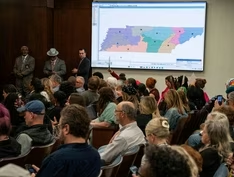
AMNA NAWAZ: Hundreds of thousands of voters head to the polls in Tennessee tomorrow, the only state in the nation to hold Thursday primary elections.
This year's come after the Supreme Court cleared the way for Tennessee to redraw its congressional maps, which will be used for the first time statewide.
But even as election officials are making final preparations, President Trump continues to question election integrity across the country, potentially undermining voter confidence.
Joining us now is Tennessee's Secretary of State Tre Hargett, who's overseen the state's elections since 2009.
Secretary, welcome to the show.
Thanks for being with us.
TRE HARGETT, Tennessee Secretary of State: Well, thank you.
Thank you for the opportunity to visit with you.
AMNA NAWAZ: So you have got big primary elections tomorrow for governor, one U.S.
Senate seat, nine congressional districts, most of the state legislature.
And, as we noted, Tennessee quickly redrew those congressional maps after the Supreme Court decision.
So all nine congressional districts were redrawn.
The map eliminated one Democratic district, I understand, and you have only had three months between the redrawing of those maps and these primaries.
So how do you know that voters have all the information they need about the maps and the precincts?
TRE HARGETT: Well, I would say it's probably the most widely covered redistricting in the history of our state.
Everywhere you look, we have been putting out information about where people could find, what district they were living, what they what district they now live in.
You know, we provided maps.
We have - - we have a GoVoteTN app where you can look up your district information.
And if your voting district changed, then you have got a postcard from your local election commission letting you know your new congressional district.
So every voter has been notified if their district is changed.
AMNA NAWAZ: So you're confident voters have the information they need for tomorrow; is that right?
TRE HARGETT: Absolutely.
If you don't have the information you need, it's because you haven't -- you haven't looked.
AMNA NAWAZ: There's another story that's been widely covered I want to ask you about, and that's related to the Department of Justice suing at least 30 states that didn't share complete voter registration lists.
That includes some Republican-led states, we should note.
And your state did turn over your voter information willingly.
Were you behind that decision?
And, if so, can you tell us what the reasoning was for that?
TRE HARGETT: Well, we consulted with our counsel, and they told us that they believed that the DOJ have a right to that information.
And so I wouldn't say we willingly did it.
I wasn't excited about it, but I tend to listen to my lawyers.
When my lawyers say, you need to give it to them, we did.
AMNA NAWAZ: I wonder how you look at that now, though, because, as you and I speak, the Department of Justice is now zero for nineteen in the court cases that have been decided on this so far.
The judges have been calling some of these moves unprecedented and illegal in one case.
In another one, they called the move to get the voter rolls a fishing expedition.
Was it, in your view now, a mistake to hand over all that voter information, when judges are consistently saying the government doesn't have a right to it?
TRE HARGETT: Well, I relied on advice of counsel.
And at the same token, I'm not sitting here Monday-morning quarterbacking what the last Super Bowl looked like either.
I mean, I'm looking forward to how we're going to run elections.
We're number one on election integrity now for five years in a row.
And if every state did it like Tennessee did it, we'd have a much better electoral system.
AMNA NAWAZ: We're talking about very sensitive voter information here, though, right, last four of Social Security numbers, driver's licenses numbers.
Now the judges are saying the government doesn't need to have that.
Are you worried about how that information might be used?
TRE HARGETT: Well, no, I'm not.
I'm not worried about that.
And, frankly, we have worked together with the federal government through the SAVE system to make sure that only U.S.
citizens and Tennessee citizens are on our voter rolls.
And those last four the Social Security number, we used to as part of that.
AMNA NAWAZ: Can I ask you about that citizenship verification?
Because Tennessee is one of the strictest states in the nation when it comes to voter I.D.
You're one of only 10 states in the country that got a perfect 20 out of 20 score from The Heritage Foundation when it comes to voter I.D.
law.
And the studies have shown that noncitizen voting doesn't seem to be a problem in Tennessee.
So why is that a concern for you?
TRE HARGETT: Well, maybe it's not a problem in Tennessee because of how we run elections here, because of the photo I.D.
law that we have, because of our work across state and federal boundaries to make sure that only Tennessee citizens and U.S.
citizens are on our voter rolls.
AMNA NAWAZ: So, when it comes to elections in Tennessee, I'm sure you heard the president in his prime-time speech last month talk about foreign interference and hacking in our election systems.
I'm curious how many times you, as a secretary of state in Tennessee, have heard from officials at CISA, the government agency responsible for securing those elections and protecting against that hacking.
Have you had reach-out from them, guidance from them, them calling you or offering briefings?
TRE HARGETT: Well, that's a lot of questions to unpack right there.
So, certainly we have talked to CISA in the past.
CISA has offered different recommendations at times.
It doesn't mean we take all of those.
Some of them, we may have already been doing to start with.
So you have got a lot of questions right there.
The bottom line is, is that we work very well with our state Department of Homeland Security.
We work well with the United States Department of Homeland Security to make sure that we protect the physical and the cybersecurity of our elections here in Tennessee.
AMNA NAWAZ: Have you had any briefings from CISA specifically related to the concerns the president brought up in his prime-time speech related to this election?
TRE HARGETT: Well, I have not had one recently, no.
AMNA NAWAZ: No.
And are there any plans to have one?
TRE HARGETT: I don't have anything on my calender right now.
AMNA NAWAZ: OK.
Before I let you go, I want to ask about your voter turnout, because, as you well know, Tennessee has one of the lowest voter turnout rates in the nation, both in general and primary elections.
I'm wondering what you think is behind that and how you can encourage more voter participation.
TRE HARGETT: Well, we are like the cooks.
We open the restaurant, we prepare the food.
We can't make people eat it.
And what drives turnout are competitive races, candidates and parties being competitive.
And, frankly, there's just not been a lot of competitive races here in Tennessee in recent years.
But, also, people have to be willing to talk about politics.
And what really drives turnout, in addition to competitive races, is having friends and neighbors who are willing to talk to one another about politics and encourage people to go vote.
Sometimes, people will say it's hard to vote.
And when they tell me that, I'm like, we have got 14 days of early voting.
We have got 12 hours on Election Day, and they will say it's not convenient for them.
But if we tell people that there's a new iPhone coming out, then they will gladly go stand in line for several hours to go get a new iPhone.
So it's about what you prioritize.
AMNA NAWAZ: Mr.
Secretary, we know it's a busy time for you.
You have a big day tomorrow.
We're grateful to you for making the time.
That's the Tennessee secretary of state, Tre Hargett, joining us.
TRE HARGETT: Thank you, ma'am.
GEOFF BENNETT: New breakthroughs are changing how doctors understand one of the deadliest cancers affecting women.
AMNA NAWAZ: Researchers now know that almost all fatal ovarian cancers begin in the fallopian tubes, not the ovaries.
Stephanie Sy is back now to tell us more about how this new understanding is impacting patient care.
STEPHANIE SY: Ovarian cancer has a poor prognosis, with most women finding out about it when it's already advanced.
Now cancer prevention groups are touting a relatively new prevention, removing the fallopian tubes when a patient who isn't planning to have more children may already be undergoing surgery for something else, such as a hernia repair.
One of the advocates of this approach is Dr.
Rebecca Stone, a professor in the Johns Hopkins Medicine Department of Gynecology and Obstetrics.
Dr.
Stone, thank you so much for joining the "News Hour."
First of all, tell me how this works and why it's so important that doctors and patients are aware of it as an option.
DR.
REBECCA STONE, Johns Hopkins Medicine Department of Gynecology and Obstetrics: Back in the early 2000s was the discovery that the most common and deadly type of ovarian cancer actually by far and large comes from the fallopian tube.
And salpingectomy, or fallopian tube removal, decreases the risk of tubo-ovarian cancer then significantly, we know by at least 50 percent, and the data tracking out of B.C., Canada, indicate that it may be upwards of 80 percent risk reduction of the most common deadly type of ovarian cancer when you undergo fallopian tube removal.
STEPHANIE SY: So, my understanding of the way this works, Dr.
Stone, is that a patient who may already have some sort of abdominal surgery they have planned, such as a C-section or a hernia repair, can then ask their doctor if they're done having children to remove the fallopian tubes, right?
Why aren't more people doing this?
DR.
REBECCA STONE: There has not been mass public awareness about this discovery and about the role of fallopian tube removal in the prevention of tubo-ovarian cancer.
And it is not a universally covered option on insurance health plans.
So the average woman, person watching this news segment can't be sure that their health plan covers fallopian tube removal, for instance, as an alternative to tubal ligation, which is the most common scenario when a woman might consider fallopian tube removal.
STEPHANIE SY: Given how much it can lower risk for women, which women really should be talking to their doctors about doing this?
How do you know how great a risk you're at for ovarian cancer?
DR.
REBECCA STONE: The goal is universal awareness of this discovery and of the benefit of fallopian tube removal for tubo-ovarian cancer prevention among women who have finished childbearing or family planning, don't need fallopian tubes for future fertility, however you want to define it.
And when you think about the -- everyone, I sort of think about two groups of women, people who have average risk, so average lifetime risk of developing ovarian cancer of 1 to 2 percent.
That's the general population.
And then you have people who are higher than average risk, so people who have a moderate to high risk, either due to a family history of tubo-ovarian cancer or due to germ line genetic testing that has revealed a genetic change that increases someone's risk for developing the cancer over the course of their lifetime to anywhere between 5 to 40 percent in the case of women who have a BRCA1 genetic change.
STEPHANIE SY: What are the risks and/or side effects of the surgery?
DR.
REBECCA STONE: When you choose to undergo fallopian tube removal at the time of another planned operation, the risk and the time in the operating room is already attributable to the primary operation.
So, when you have this as an add-on procedure, for instance, to a hysterectomy or hernia repair or a gallbladder removal, so this does not add substantial risk and takes on average about eight minutes, and it doesn't change recovery.
The recovery is related to the primary procedure as well.
So that's why it's such a compelling prevention option for a cancer that is in the top five to six most deadly cancers that we face as a human race, a cancer for which there is no screening and no reliable treatment or cure.
That's why prevention is so important.
We have really focused on ovarian removal for the prevention of tubo-ovarian cancer, what we called ovarian cancer, but that's not such a great risk reduction strategy, the idea of removing the ovaries, because the ovaries are not only a reproductive or fertility organ.
They are also an endocrine organ that almost certainly have important function even after a woman goes through menopause,whereas the fallopian tube doesn't affect how we look or how we feel.
It doesn't have any known function once its role in reproduction or fertility is over.
STEPHANIE SY: Dr.
Stone, how many lives might be saved if there was more awareness and insurance coverage around this option?
DR.
REBECCA STONE: So if there was universal awareness and access to the benefit of fallopian tube removal at the time of hysterectomy, and as alternative to tubal ligation, it's projected that we would save almost 2,000 lives a year from tubo-ovarian cancer in this country.
And if care about the dollars and cents of it, that is equivalent to about half-a-billion health care dollars annually.
STEPHANIE SY: That is Dr.
Rebecca Stone with Johns Hopkins University joining us.
And for more information on ovarian cancer, you can go to outsmartovariancancer.org.
DR.
REBECCA STONE: Thank you so much for caring about this on behalf of all women.
AMNA NAWAZ: It's been 150 years since the Battle of the Little Bighorn, one of the most famous and enduring events in American history.
While Native Americans were victorious, Judy Woodruff reports on how the battle reshaped the government's policy towards indigenous people, and why it still resonates so deeply for so many today.
It's part of her series Crossroads: America at 250.
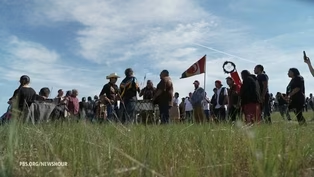
JUDY WOODRUFF: Along this stretch of sweeping prairie on the Crow Reservation in Montana, members of more than a dozen Native American tribes have gathered for what's known as a Victory Ride.
It commemorates the end of the Battle of the Little Bighorn in 1876, or what Native Americans here often refer to as the Battle of the Greasy Grass.
TRINA LONE HILL, Oglala Sioux Tribe: I still look at it as a moment in history that we should be proud of.
They're the last ones to surrender.
They're the last ones to come onto the reservations and accept our new fate, basically.
JUDY WOODRUFF: Trina Lone Hill, a member of the Oglala Sioux tribe in South Dakota, helped organize the Victory Ride.
She says she's been coming to this annual event for more than 30 years and hearing stories of her ancestor Susie Shot-In-the-Eye.
TRINA LONE HILL: My great-great-great-grandmother fought here alongside her husband and her sons.
And so I continue to tell that to my children.
This is why we're here.
This is why we fight.
MAN: This is the 150th anniversary, and it's good to see everybody here.
JUDY WOODRUFF: One hundred and fifty years later, it's an especially poignant moment for Native Americans, as the nation celebrates its own anniversary, 250 years since the signing of the Declaration of Independence, the founding document that culminates with a list of grievances against the British crown and refers to Native Americans as merciless Indian savages.
NED BLACKHAWK, Author: One of the things about the founding is that, when you establish something, it creates enduring legacies.
JUDY WOODRUFF: Ned Blackhawk is an historian at Yale University and the author of "The Rediscovery of America: Native Peoples and the Unmaking of U.S.
History."
NED BLACKHAWK: That grievance is something obviously that Native Americans have a lot of trouble with, myself included, because it is vilifying and homogenizing and representing indigenous Americans as if they were other than American.
JUDY WOODRUFF: It's a giant contradiction.
NED BLACKHAWK: It's a giant contradiction.
It's an enormous paradox that sits at the heart of America.
These are the most misunderstood subject of American history, and we need to understand them to understand ourselves more fully.
DONOVAN TAYLOR, Researcher: We're still here today.
We persevered the Europeanism and colonialism and we're adapting.
JUDY WOODRUFF: Donovan Taylor is a Northern Cheyenne tribal member and a researcher for "The History They Tell," an oral history project that interviewed hundreds of descendants of Native Americans and First Nations people who fought at the Battle of the Little Bighorn.
LEON EAGLE TAIL, Gros Ventre Tribe: This battlefield is just a reminder of what we can accomplish if we all get together.
JUDY WOODRUFF: Leon Eagle Tail and Chester Whiteman traveled from Washington state and Oklahoma to be here.
They joined thousands of other Native Americans from across the country who set up camps and teepees along the banks of Montana's Little Bighorn River.
CHESTER WHITEMAN, Cheyenne Tribe: We have always been like a second-class citizen.
We weren't citizens until 1924.
But we were here before anybody else came.
LEON EAGLE TAIL: We experienced a great genocide.
We are recovering.
But a lot of times, it takes things like this to help us remember what we went through.
JUDY WOODRUFF: This remembrance includes a reenactment of the famous battle that started after the U.S.
Army's Seventh Cavalry, under Lieutenant Colonel George Armstrong Custer attacked a village of mostly Lakota Sioux, Northern Cheyenne, and Arapaho Native Americans who had gathered in defiance of orders to return to reservations, the military's goal, to force these nomadic tribes back onto reservations as the United States continued to push farther West.
DONOVIN SPRAGUE, Lakota Sioux Historian: The big thing was gold in the Black Hills.
See, two years before this, Custer discovered gold in the Black Hills, so there was a push to take that land.
JUDY WOODRUFF: Donovin Sprague is a Lakota historian and a descendant of both Chief Hump and the legendary Native American warrior Crazy Horse, both of whom fought here.
DONOVIN SPRAGUE: We had a very big village just right over here that was just kind of like bursting at the seams.
And then as soldiers came in and were detected, they come out to meet that resistance.
After that, it was a big turning point.
The soldiers were dismounted, and they're just running to Last Stand Hill.
JUDY WOODRUFF: More than 260 U.S.
soldiers were killed, including Custer, who is believed to have died here on what is now known as Last Stand Hill.
But it was a victory that would soon bring devastating consequences.
NED BLACKHAWK: It's tragically ironic that the defeat of this relatively small party in Montana will set in motion a policy reform that convinces the federal government that it has to do more aggressive intrusions into Indian country.
And it begins punishing these recalcitrant tribal members, as it sees it, in ways that are unprecedented, the removal of children to the boarding schools, the subdivision of their lands, and begin a process of what is known as Americanization that tragically dismantles essential economies, often governments, and even family relations across Indian country.
JUDY WOODRUFF: It's a history that many Native Americans say the nation has yet to fully reckon with.
CHESTER WHITEMAN: Declaration of Independence, we're still classified as savages.
That needs to change.
There's a lot of things that need to change, because we're not savages.
We're human beings.
JUDY WOODRUFF: And this legacy of mistreatment continues to cast a long shadow.
Today, Native Americans have the highest poverty and lowest life expectancy rates of any racial or ethnic group in the United States.
LEON EAGLE TAIL: From the Trail of Tears to being put on the reservation in Oklahoma called Indian Territories, to where they put us on reservations here, that's the reason why this battle took place, because they had orders to put us back on the reservations.
It's no different than the concentration camps that the Jews had to survive in Germany, no difference.
JUDY WOODRUFF: After the Battle of the Little Bighorn, more Western lands would be taken.
And Ned Blackhawk says, even in defeat.
George Armstrong Custer would become an emblem of American identity, portrayed in countless advertisements... NARRATOR: Errol Flynn in his greatest role.
JUDY WOODRUFF: ... and in feature films like the 1941 Western "They Died With Their Boots On," starring Errol Flynn.
NED BLACKHAWK: The West becomes after 1876 the most imagined region of the United States.
And Custer becomes one of its most singular figures.
So this vision of Custer in many ways becomes a vision of America itself.
WOMAN: Introduce yourself.
JUDY WOODRUFF: But today there are new efforts to begin changing that vision.
WOMAN: Just talk to each other like you guys are at home, OK?
JUDY WOODRUFF: Native American journalists urged tribal members to record their own family histories and stories of ancestors who fought here.
And for those we spoke with, it was a time for reflection.
DONOVAN TAYLOR: I don't like that feeling of animosity.
I want to be at peace.
Our ancestors already done that.
Why should we have to do that too?
JUDY WOODRUFF: And for many others, it was a moment to acknowledge both the pain of the present while remaining hopeful about the future.
TRINA LONE HILL: You know, I see so much despair on the reservation.
We talk -- there's so much -- countless stories about poverty and alcoholism and suicide, all of these things that are modern problems.
I want to see -- I want to bring our kids out of that.
I want them to feel this pride.
I want them to I guess get a different perspective.
LEON EAGLE TAIL: We are the survivors, him and me.
We survived.
But we want our children and grandchildren to thrive.
So that's why I'm here.
CHESTER WHITEMAN: Everybody talks about healing and things like that.
But both parties have to heal together.
And for a long time, it wasn't like that.
Nobody would stick the hand out to try to help the other side.
And, today, it's starting to turn, where everybody wants to hear our story, the real story.
JUDY WOODRUFF: A story still being written, as the nation marks its 250th anniversary.
For the "PBS News Hour," I'm Judy Woodruff in Crow Agency, Montana.
AMNA NAWAZ: Remember, there's always a lot more online, including a look at Haitians who've lost their Temporary Protected Status in the U.S.
but are unable to return to their home country.
That is at PBS.org/NewsHour.
GEOFF BENNETT: And that's the "News Hour" for tonight.
I'm Geoff Bennett.
AMNA NAWAZ: And I'm Amna Nawaz.
On behalf of the entire "News Hour" team, thank you for joining us.
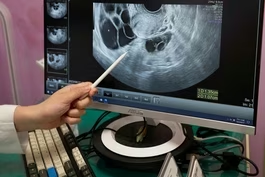
How new ovarian cancer findings may help reduce risk
Video has Closed Captions
How new findings on ovarian cancer origins may help reduce risk (6m 45s)
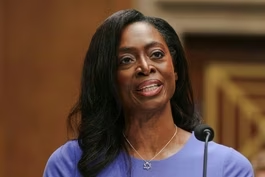
News Wrap: Senate confirms Erica Schwartz as CDC director
Video has Closed Captions
News Wrap: Senate confirms Dr. Erica Schwartz as CDC director (6m 5s)
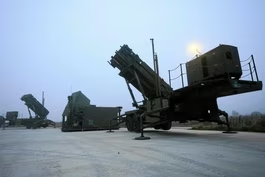
Retired Army colonel explains Patriot missile capabilities
Video has Closed Captions
Retired Army colonel explains why Patriot missiles are so valuable and in short supply (6m 25s)
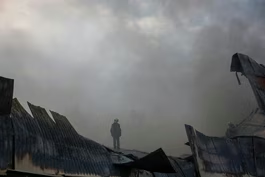
Russian attacks expose weakness in Ukraine's air defense
Video has Closed Captions
Russian missile attacks on Kyiv expose weakness in Ukraine's air defense (3m 33s)
Tennessee secretary of state on redistricting, low turnout
Video has Closed Captions
Tennessee secretary of state on redistricting, election security and low voter turnout (7m 14s)
What El-Sayed's primary win means for Democrats in November
Video has Closed Captions
What El-Sayed's primary win means for Democrats in November (6m 44s)

What scientists can learn from debris crashing into the moon
Video has Closed Captions
What scientists are learning after SpaceX debris crashed into the moon (5m 7s)
Why the Battle of the Little Bighorn still resonates today
Video has Closed Captions
How the Battle of the Little Bighorn reshaped U.S. policy toward Native Americans (10m 9s)
Providing Support for PBS.org
Learn Moreabout PBS online sponsorship New Episode
- News and Public Affairs

Today's top journalists discuss Washington's current political events and public affairs.

- News and Public Affairs

FRONTLINE is investigative journalism that questions, explains and changes our world.


 New Episode
 New Episode
 New Episode
 New Episode
 New Episode
 New Episode

 New Episode
Support for PBS provided by:
Major corporate funding for the PBS News Hour is provided by BDO, BNSF, Consumer Cellular, American Cruise Lines, and Raymond James. Funding for the PBS NewsHour Weekend is provided by...