
Climate: Climate Change and Greenhouse Gases
Special | 6m 5sVideo has Closed Captions
Meet a climate scientist and join her on a mission.
Greenhouse gases are a major reason for climate change. Meet Geoscientist Jen Pierce. She is on a mission to teach everyone about climate change.
Problems playing video? | Closed Captioning Feedback
Problems playing video? | Closed Captioning Feedback
Science Trek is a local public television program presented by IdahoPTV
Major Funding by the Laura Moore Cunningham Foundation and the Idaho National Laboratory. Additional Funding by The Friends of Idaho Public Television and the Corporation for Public Broadcasting.
Climate: Climate Change and Greenhouse Gases
Special | 6m 5sVideo has Closed Captions
Greenhouse gases are a major reason for climate change. Meet Geoscientist Jen Pierce. She is on a mission to teach everyone about climate change.
Problems playing video? | Closed Captioning Feedback
Where to Watch Science Trek
Science Trek is available to stream on pbs.org and the PBS app.
Science Trek
Science Trek is a place where parents, kids, and educators can watch short, educational videos on a variety of science topics. Every Monday Science Trek releases a new video that introduces children to math, science, technology, engineering, and math (STEM) career potentials in a fun, informative way.Part of These Collections
Earth Science
Earth Science is the study of the earth. Learn about the place we call home.
View Collection
Careers in Science
Interested in a career in science? See what some scientists do when they go to work.
View CollectionProviding Support for PBS.org
Learn Moreabout PBS online sponsorshipJOAN CARTAN-HANSEN, HOST: Every day, we have changes in the weather.
But a climate is the average amount of precipitation, like rain and snow, and the average temperatures over a long period of time.
And when the Earth's climate gets hotter or colder, that's what geoscientists call climate change.
Meet a climate change scientist and learn more.
[MUSIC] Okay, before I introduce you to our climate scientist, you first have to know about carbon dioxide and methane.
They are two parts, of what we call, greenhouse gases.
Carbon dioxide comes from lots of different places.
When we burn things like oil, coal or gas, things we call fossil fuels, we release carbon dioxide.
Methane also comes from the production and burning of fossil fuels.
And it comes from some agricultural operations [FARTING] and from decaying matter.
Geoscientist Jen Pierce has studied the Earth's climate and greenhouse gases for many years.
She knows greenhouse gases are a big reason for climates change.
She and some friends met in a park to give us a visual demonstration of what greenhouse gases do in the Earth's atmosphere.
Jen Pierce, Geoscientist: Light from the sun comes into the Earth, and that is transformed into heat.
When that heat tries to escape, some of that heat is trapped by greenhouse gases.
And this happens naturally; the Earth has a greenhouse effect.
If we didn't have any greenhouse gases, it would be about 50 degrees Fahrenheit cooler on Earth.
However, what's happened in the last century or more is that people have increased the amount of carbon dioxide and methane in the atmosphere through things like burning fossil fuels.
So, as we add more greenhouse gases to the atmosphere, those more greenhouse gases trap more heat and our planet is getting hotter.
CARTAN-HANSEN: The Earth has warmed by two degrees Fahrenheit since 1880.
While that doesn't sound like much, it has devastating consequences for the planet.
PIERCE: Those cold-dependent species like polar bears are losing their ice habitat that they need to survive.
In other areas like here in the Western United States, we're seeing increased size and severity of wildfires.
These fires impact our forests, impact our range lands and impact our people that live in those ecosystems.
In the Eastern United States, those communities are experiencing increased size and severity of hurricanes.
CARTAN-HANSEN: The Earth has gone through hotter and colder cycles over vast amounts of time.
As a geoscientist and associate professor at Boise State University, Pierce has studied the impact of changing climate on soils and forests.
She and almost every other climate scientist say the current warming of our planet is unlike anything we've ever seen in the past.
PIERCE: This climate change is different because the vast majority of the change we're experiencing is caused by people.
So, people are adding fossil carbon through burning fossil fuels to the Earth's atmosphere.
When we add that extra carbon that had been stored underground and put that carbon into the air, we increase greenhouse gases and increase warming.
CARTAN-HANSEN: Pierce directs the Earth, Wind, and Fire Laboratory at Boise State University.
There she studies wildfires and erosion, carbon storage in soils and the forces that shape the Earth.
But that's not all she does.
PIERCE: When I came to Boise State, was that there weren't classes taught on climate, basic climate change.
So, I started teaching climate change classes about 15 years ago.
I think we have an obligation to all of our citizens to teach them about the causes, consequences and solutions to climate change.
Our kids need to know why climate change is happening, what it's affecting, and most importantly, what they can do about it.
CARTAN-HANSEN: And what can be done to reduce the amount of greenhouse gases in the atmosphere and slow climate change?
PIERCE: Essentially, anything that results in less carbon in the atmosphere is a win.
We can do that by not using as much fossil fuel energy in the first place.
We can do that by using alternative energy that does not produce greenhouse gases.
We can do that by storing more of our carbon in our trees and in our soils.
We can do that by changing and improving our agricultural practices.
There are so many things we can do to address climate change.
We need engineers to make better, more effective solar panels.
We need biologists to understand interactions between microbes and methane production.
We need geoscientists to understand long-term trends in climate.
We need artists to document how climate change is affecting our landscapes.
We need good writers.
We need good filmmakers.
All of us have a role in addressing climate change.
And the good news is, is that the next generation and these kids come up with the most amazing solutions.
So, we need to empower them with the tools and technology to make those changes in our world.
CARTAN-HANSEN: If you want to learn more, check out the Science Trek website.
You'll find it at science trek dot org.
[MUSIC] ANNOUNCER: Presentation of Science Trek on Idaho Public Television is made possible through the generous support of the Laura Moore Cunningham Foundation, committed to fulfilling the Moore and Bettis family legacy of building the great state of Idaho.
By the Idaho National Laboratory, mentoring talent and finding solutions for energy and security challenges, by the Friends of Idaho Public Television and the Corporation for Public Broadcasting.
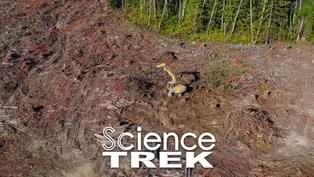
Climate: A Few Causes of Climate Change
Video has Closed Captions
Clip: Special | 1m 4s | What are some of the causes of climate change? (1m 4s)
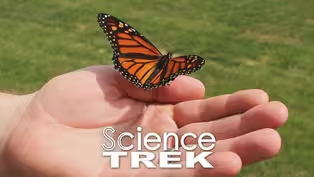
Video has Closed Captions
Clip: Special | 1m 4s | About a million animals are at risk of extinction because of global warming. (1m 4s)
Providing Support for PBS.org
Learn Moreabout PBS online sponsorship New Episode
- Science and Nature

Explore scientific discoveries on television's most acclaimed science documentary series.




 New Season


 New Season


Support for PBS provided by:
Science Trek is a local public television program presented by IdahoPTV
Major Funding by the Laura Moore Cunningham Foundation and the Idaho National Laboratory. Additional Funding by The Friends of Idaho Public Television and the Corporation for Public Broadcasting.