
Climate: What's a Climate?
Special | 6m 34sVideo has Closed Captions
Learn more about the different climates found on Earth.
The Earth has a number of different types of climates and they impact the people, animals and plants in their zones. What’s the difference between them. What’s the difference between climates and the weather? What does climate change mean? Find out more.
Problems playing video? | Closed Captioning Feedback
Problems playing video? | Closed Captioning Feedback
Science Trek is a local public television program presented by IdahoPTV
Major Funding by the Laura Moore Cunningham Foundation and the Idaho National Laboratory. Additional Funding by The Friends of Idaho Public Television and the Corporation for Public Broadcasting.
Climate: What's a Climate?
Special | 6m 34sVideo has Closed Captions
The Earth has a number of different types of climates and they impact the people, animals and plants in their zones. What’s the difference between them. What’s the difference between climates and the weather? What does climate change mean? Find out more.
Problems playing video? | Closed Captioning Feedback
Where to Watch Science Trek
Science Trek is available to stream on pbs.org and the PBS app.
Science Trek
Science Trek is a place where parents, kids, and educators can watch short, educational videos on a variety of science topics. Every Monday Science Trek releases a new video that introduces children to math, science, technology, engineering, and math (STEM) career potentials in a fun, informative way.Part of These Collections
Earth Science
Earth Science is the study of the earth. Learn about the place we call home.
View Collection
Providing Support for PBS.org
Learn Moreabout PBS online sponsorshipJOAN CARTAN-HANSEN, HOST: Weather and climate are not the same things, but they are related.
Come find out what weather, climate and climate change all mean.
[MUSIC] Weather is what you experience on a day-to-day basis.
Sometimes it rains, or snows, it's cloudy or sunny.
And weather is always changing over the course of the year.
But if you keep track of the weather in an area over years, you can see a pattern.
Like how hot it is in the summer or how cold in the winter and how daily temperatures change over weeks and years.
And also, things like how much moisture does an area get.Lots of rain or snow or very little.
Weather patterns describe a climate.
And climates generally have the same weather patterns year-in and year-out.
Maya: Man, it is cold.
Paris: It's hot.
Pablo: It's a little chilly.
Miss Astle: It's not bad.
Rylan: It's humid.
CARTAN-HANSEN: The Earth is divided into five basic types of climates.
And those can be broken down into sub-categories.
Maya: Polar climates are cold and dry with long winters and short summers.
The Artic region is a polar climate.
Paris: Dry climates have hot days and little rainfall.
Arid climates are found in the southwest United States, North Africa and much of Australia.
Semi-arid climates are found in central Asia and the Great Basin states in America, including southern Idaho.
Pablo: Temperate or moderate climates have warm summers and mild winters.
Like along the Eastern United States and the Pacific Northwest.
Miss Astle: Continental climates have cold, snowy winters and cool summers.
You'll find this climate in much of Europe and the northern United States, including North Idaho.
Rylan: Tropical climates are found near the equator in parts of South America, India, Africa and Indonesia.
This climate is hot, humid with lots of rain and warm temperatures year-round.
CARTAN-HANSEN: So why does the Earth have so many different types of climates?
Well, it's because of the different ways the sun's energy moves in and out of the atmosphere and how that energy moves around the planet.
And lots of things can influence the sun's energy as it spreads around the world.
One is latitude.
The Earth has an imaginary line going around its center called the equator.
And there are other parallel lines dividing up the planet north and south.
Latitude marks where you are between the equator and one of the poles.
And how much sunlight an area gets helps determine that latitude's climate.
Because the equator gets the most direct sunlight, temperatures there are warmer.
But as the sun's energy angles over the curvature of the earth, it doesn't hit as directly so areas receiving less sunlight have lower temperatures.
And, because the earth tilts on its axis, either the north or the south pole is pointed away from the sun, depending upon where the earth is in its yearly orbit.
When a pole is tilted away from the sun, it gets less sun light so it has colder temperatures.
Other things can affect an area's climate.
Altitude is one way we measure the distance from where you are to sea-level.
When you go up into the mountains, or up in altitude, the air is less or thinner.
That's because gravity pulls air closer to the earth's surface.
Thinner air is less able to absorb and store heat from the sun, so the higher the altitude the cooler the temperatures.
Having a large body of water nearby can also influence what kind of climate an area has.
Water absorbs and stores heat, so if you live near the ocean, your climate tends to be milder, wetter and have less variation.
Live far away from the ocean or a very large lake and your high and low temperatures tend to be more extreme.
So, the regional climate in your area depends upon where you are on earth, what your elevation is, and what geological features, like lakes and mountains, are nearby.
But there is also a global climate.
The global climate describes the condition of the planet as a whole.
It has a lot to do with how much energy the earth receives from the sun and the amount of energy trapped inside the atmosphere.
Earth's climate has changed many times over the eons.
Usually it takes thousands of years for a global climate to change.
But scientists report that the earth is now warming faster than it ever has in the past.
And research shows it's mostly because of human activities.
When we burn fossil fuels like oil, coal and gas, carbon dioxide is released.
The buildup of carbon dioxide and other gases in the atmosphere traps heat inside the planet, Like the glass panes keep the warmth of the sun inside a greenhouse.
Carbon dioxide, methane, nitrous oxide and water vapor are all called greenhouse gases.
At normal levels, greenhouse gases are good.
They keep the planet's temperature warm enough for us to live.
But too much greenhouse gases in the atmosphere means the Earth's temperature keeps going up.
And as temperatures increase, we get melting glaciers, Rising sea levels, and more extreme weather.
It means more plants and animals will go extinct because their habitats and food supplies disappear.
Global warming and the resulting climate change impacts everything on earth, including us.
So, what can we do?
Maya: Reduce your carbon footprint.walk more, drive less.
Paris: Save electricity.
Use energy efficient light bulbs and turn off lights, computers, and appliances when not in use.
Pablo: Plant trees.
Trees remove carbon from the atmosphere.
Miss Astle: Find ways to conserve water and use refillable water bottles.
Rylan: And reduce your amount of trash, and reuse as much as you can and recycle as much as you can.
CARTAN-HANSEN: If you want to learn more check out the Science Trek website.
You'll find it at science trek dot org.
[MUSIC] Announcer: Presentation of Science Trek on Idaho Public Television is made possible through the generous support of the Laura Moore Cunningham Foundation, committed to fulfilling the Moore and Bettis family legacy of building the great state of Idaho.
By the Idaho National Laboratory, mentoring talent and finding solutions for energy and security challenges, by the Friends of Idaho Public Television and the Corporation for Public Broadcasting.
Video has Closed Captions
Clip: Special | 1m 4s | What is a gigaton and why are the ocean levels rising? (1m 4s)
Video has Closed Captions
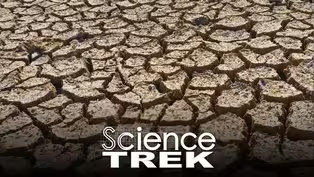
Clip: Special | 1m 4s | How has the Earth’s climates changed over time? (1m 4s)
Providing Support for PBS.org
Learn Moreabout PBS online sponsorship New Episode
- Science and Nature

Explore scientific discoveries on television's most acclaimed science documentary series.





 New Season

 New Season


Support for PBS provided by:
Science Trek is a local public television program presented by IdahoPTV
Major Funding by the Laura Moore Cunningham Foundation and the Idaho National Laboratory. Additional Funding by The Friends of Idaho Public Television and the Corporation for Public Broadcasting.