
February 26, 2026 - PBS News Hour full episode
2/26/2026 | 57m 46sVideo has Closed Captions
February 26, 2026 - PBS News Hour full episode
February 26, 2026 - PBS News Hour full episode
Problems playing video? | Closed Captioning Feedback
Problems playing video? | Closed Captioning Feedback
Major corporate funding for the PBS News Hour is provided by BDO, BNSF, Consumer Cellular, American Cruise Lines, and Raymond James. Funding for the PBS NewsHour Weekend is provided by...
Support provided by:

February 26, 2026 - PBS News Hour full episode
2/26/2026 | 57m 46sVideo has Closed Captions
February 26, 2026 - PBS News Hour full episode
Problems playing video? | Closed Captioning Feedback
How to Watch PBS News Hour
PBS News Hour is available to stream on pbs.org and the free PBS App, available on iPhone, Apple TV, Android TV, Android smartphones, Amazon Fire TV, Amazon Fire Tablet, Roku, Samsung Smart TV, and Vizio.
Providing Support for PBS.org
Learn Moreabout PBS online sponsorshipGEOFF BENNETT: Good evening.
I'm Geoff Bennett.
AMNA NAWAZ: And I'm Amna Nawaz.
On the "News Hour" tonight: Hillary Clinton# testifies to.. the Epstein files, while the# Justice Department looks into## whether documents mentioning President# Trump were withheld from the public.
GEOFF BENNETT: The Trump administration halts## Medicaid funding to Minnesota# over allegations of fraud.
AMNA NAWAZ: And a whistle-blower warns that# ICE recruits are not receiving proper training.
RYAN SCHWANK, Former ICE Academy Instructor:# It is a recipe for someone else to die,## potentially for multiple people to# die.
And it's going to be done by## officers who deserved better from this government.
(BREAK) GEOFF BENNETT:## Welcome to the ".. Members of the Republican-led House Oversight# Committee ques.. than six hours today as part of its investigation# into the late sex offender Jeffrey Epstein.
The## former secretary of state told lawmakers she had# no information on Epstein's criminal activities.
AMNA NAWAZ: During a closed-door session,# Clinton said she also did not recall ever## meeting Mr.
Epstein and never flew on his# plane or visited his island, homes or offices.
Today's meeting was the first of two days# of closed-door depositions for the House## Oversight Committee of both Clinton and# her husband, former President Bill Clinton.
REP.
JAMES COMER (R-KY): There were a# lot of questions that we asked that we## weren't satisfied with the answers that we# got, but we will continue to move forward.
AMNA NAWAZ: Democrats on the committee argued## their Republican colleagues did# not take the deposition seriously.
REP.
YASSAMIN ANSARI (D-AZ): Today, we are sitting## through an incredibly unserious clown# show of a deposition where members .. Congress in the Republican Party are more# concerned about getting their photo-up of## Secretary Clinton than actually getting to# the truth and holding anyone accountable.
AMNA NAWAZ: Neither Bill nor Hillary# Clinton have been accused of wrongdoing## in connection with Epstein's crimes, but# Bill Clinton has said he previously had## a professional relationship with# the convicted sexual offender.
For more on today's testimony, I'm joined# now by justice correspondent Ali Rogin.
So, Ali, today's session was behind closed# doors between Clinton and members of the## committee.
What did we learn today about any# ties between Secretary Clinton and Epstein?
ALI ROGIN: Well, Amna, Hillary Clinton# just came to the microphones and spoke## to the media following today's proceedings.
She# said she answered questions as best she could.## She called the day long and repetitive,# maintained that she has never met Jeffrey## Epstein and that she had no knowledge# of his or Ghislaine Maxwell's crimes.
She also said that, towards the# end of the questioning today,## it took an unusual turn and she spoke# about -- she was asked about things## like UFOs and Pizzagate, that scandal# from the first Trump campaign season.
We want to play for you a# piece of what she said today.
HILLARY RODHAM CLINTON, Former U.S.
Secretary of# State: I answered every one of their questions as## fully as I could based on what I knew.
And what I# knew is what I said in my statement this morning.
I never met Jeffrey Epstein, never had# any connection or communication with him.
ALI ROGIN: Amna, committee members also# said that Hillary Clinton today gave them## suggestions for other people to try to depose.# And Committee Chairman James Comer said that## repeatedly she answered questions by saying:# "I don't know.
You'll have to ask my husband."
AMNA NAWAZ: Well, we've heard the Clintons and the# representatives argue House Republicans here are## operating in what they call partisan political# theater.
At one point today, there was some## back-and-forth between them, the Clintons and the# Republicans on the committee.
Tell us about that.
ALI ROGIN: That's right.
During -- right before the meetin.. snapped a picture of Clinton, apparently# sent it to MAGA influencer Benny Johnson,## who posted it on X. Oversight Committee# Ranking Member Robert Garcia said,## everyone in the room was taken aback by# this clear breach of committee rules.
So proceedings did temporarily pause,# and then they did get back on track.
AMNA NAWAZ: So, this testimony,# this session comes after months of## negotiations with the Clintons.
Just# remind us how we got to this moment.
ALI ROGIN: This hearing took a# long time to schedule.
Initially,## the Clintons sought to argue that this# subpoena was invalid and could not be enforced.
Then the committee moved towards a full House of# Representatives vote on contempt of Congress.
Then## the Clintons said they would testify, but only# in public.
Oversight Committee Chairman James## Comer said that he would interview them the same# way everyone else has been interviewed on that## committee, which is closed-door, videotape, with# the video and transcript released subsequently.
Clearly, they arrived at a resolution, Amna,## because these members made their way to# Chappaqua, New York, for today and tomorrow.
AMNA NAWAZ: So they heard from# Secretary Clinton today.
Tomorrow,## they hear from former President# Bill Clinton.
Is that right?
ALI ROGIN: That's correct.
And, though, of course, be.. Bill Clinton indisputably had a closer# relationship with both Jeffrey Epstein## and Ghislaine Maxwell than did Hillary.
Epstein# visited the White House while Clinton served in## office.
Clinton traveled and socialized with# the two of them, as is evidenced from many of## the photos that have been released over the# months from the Epstein files, as a Clinton## spokesperson has maintained that Bill Clinton# knew nothing of either individuals' crimes.
As for the rest of the witness schedule,# this committee is also going to hear from## Epstein's accountant and his lawyer.
We also# learned today that Chairman Comer is open## to requesting that Commerce Secretary Howard# Lutnick testify.
Lutnick has had to revise his## statement several times about the nature of his# relationship with the White House with Epstein.
So it makes sense that the committee# would want to hear from him.
AMNA NAWAZ: While we have you, another piece# of related news I want to ask you about.
We## have seen reporting from multiple outlets this# week that the Justice Department withheld and## removed some of the Epstein files related to# President Trump.
What do we know about that?
ALI ROGIN: Yes, this is related to# notes from four interviews that the## FBI conducted with one woman in# 2019 after Epstein was arrested.
The DOJ did release notes# from one of those interviews,## in which the woman accuses Epstein of# sexually assaulting her when she was## as young as 13 years old.
But several media# outlets noted that the notes from the three## other interviews were missing and that, based# on other documents that they could triangulate,## there was information implicating potentially# President Trump in those missing documents.
In response to this, the DOJ has said# that it is reviewing those files and## that -- quote -- "Should any document be found to# have been improperly tagged in the review process,## the department will, of course, publish# it, consistent with the law," Amna.
AMNA NAWAZ: That's our justice correspondent# Ali Rogin beginning our coverage tonight.
Ali, thank you.
ALI ROGIN: You bet.
AMNA NAWAZ: We start the# day's other headlines in Cuba.
A U.S.
official tells the "News Hour" that at# least two individuals involved in yesterday's## speedboat shooting were U.S.
citizens and# that the owner of the vessel claims it had## been stolen by an employee.
Four people were# killed, including one of the U.S.
citizens.
The incident took place in the waters# off the island's north coast.
Cuba's## government said earlier the 10 people# aboard the Florida registered boat were## Cuban nationals who aimed to# carry out a terrorist attack.
On social media, Cuban President Miguel Diaz-Canel# vowed -- quote -- "Cuba will defend itself against## any terrorist or mercenary aggression that# seeks to undermine its sovereignty," while,## on the streets of Havana today, locals expressed# their support for yesterday's shooting.
ROBERTO HENRY FIGUEREDO, Havana Resident# (through translator): What they're doing## is testing our strength to see.. But the fire we gave them was good.# If they come, we will shoot at them.## If they shoot at us, we will eat bullets.# We will open fire if there are problems.
AMNA NAWAZ: From the U.S.
side, Secretary of# State Marco Rubio said last night the U.S.## government was in no way involved and# that it is investigating the incident.
In New York City, a Columbia University# student was detained by ICE agents in## her campus apartment today, then released# hours later.
Ellie Aghayeva is a senior from## Azerbaijan and a self-described# content creator.
This morning,## she wrote on Instagram -- quote -- "DHS# illegally arrested me.
Please help."
PROTESTER: Immigrants are welcome here~!
PROTESTERS: Immigrants are welcome here!
AMNA NAWAZ: Within hours, dozens had gathered at# the campus gates in protest.
Federal officials## described Aghayeva as an illegal alien# whose student visa was terminated in 2016.
Her release came after New York City# Mayor Zohran Mamdani said he discussed## the arrest with President Trump during# an unrelated meeting at the White House.
Police in Buffalo, New York, are investigating the# death of a nearly blind refugee from Myanmar days## after Border Patrol agents dropped him off# alone at a coffee shop miles from his home;## 56-year-old Nurul Amin Shah# Alam, who spoke little English,## had been jailed for a year on charges later# resolved with a misdemeanor plea deal.
Last week, he was released to Border Patrol# agents, who found he was -- quote -- "not amenable## to removal."
According to us Customs and Border# Protection -- quote -- "Agents offered him a## courtesy ride" and -- quote -- "He showed no signs# of distress, mobility issues, or disabilities."
A medical examiner ruled out exposure and# homicide, saying his death was health-related.## But Buffalo's Mayor Sean Ryan said the decision# to leave him was unprofessional and inhumane.
In Geneva today, Ukrainian and U.S.# officials gathered for talks aimed at## ending Russia's war in Ukraine now in# its fifth year.
Just hours earlier... (SIRENS BLARING) AMNA NAWAZ: ... Ukraine's President Volodymyr# Zelenskyy says Russia launched a barrage of## more than 400 drones and dozens of missiles# across several regions.
Officials say the## bombardment targeted critical infrastructure and# injured dozens of people, including children.
In the southeast city of Zaporizhzhia,# an elderly couple say their apartment was## destroyed when their building was hit.
They say# there's little hope that the war will end soon.
TROSHKO MYKOLA, Zaporizhzhia, Ukraine, Resident# (through translator): We don't believe it.## It won't end and Ukraine will be blown to# pi.. but they don't.
And now we don't know where# to go or what to do.
Everything is destroyed.
AMNA NAWAZ: President Volodymyr Zelenskyy# said today the next round of trilateral## talks involving Ukraine, Russia and the U.S.
will# likely take place in Abu Dhabi in early March.
In Afghanistan, the sound of explosions rang# out tonight in the capital city of Kabul,## though there's been no word yet on casualties.
It## comes just hours after Afghanistan# launched an attack on Pakistan,## which it claims was retaliation for Pakistani# airstrikes on border areas earlier this week.
Afghanistan claims to have seized more# than a dozen Pakistani army posts in## the latest escalation between the two# neighbors.
Pakistan called Afghanistan's## attack unprovoked and dismissed claims# that any army posts had been captured.
The FBI has reportedly fired more agents who# worked on President Trump's classified documents## case.
The Associated Press and others report that# at least 10 employees were terminated for helping## investigate Trump's hoarding of documents at his# Mar-a-Lago home after he left office in 2021.
It's just the latest purge under FBI Director# Kash Patel, who's fired dozens of employees## for working on Trump-related cases or# for being seen as disloyal.
The FBI## Agents Association condemned the firings,# saying they -- quote -- "weaken the bureau## by stripping away critical expertise# and destabilizing the work force."
Warner Bros.
Discovery said today that# paramount's revised bid for the company## is superior to its existing deal with# Netflix.
Paramount raised its price for## Warner Bros.
to $31 a share this week# as a best and final offer.
In response,## Netflix said it would not raise its offer for# Warner Bros., saying the deal is -- quote -- "no## longer financially attractive."
Ahead of that# news, shares of Warner Bros.
ended slightly lower.
Elsewhere on Wall Street, stocks struggled# after a blockbuster earnings report from## A.I.
giant Nvidia failed to win over investors.## The Dow Jones industrial average managed to# end a few points higher, but mostly flat.## The Nasdaq lost nearly 275 points on the day.# The S&P 500 also closed in negative territory.
Still to come on the "News Hour":## negotiations take place between the U.S.
and# Iran in an attempt to avoid an all-out war.
;## actor Rose Byrne discusses her Oscar-nominated# performance in "If I Had Legs I'd Kick You";## and our "Settle In" podcast challenges# us to rethink the idea of Black history.
GEOFF BENNETT: Vice President J.D.
Vance announced# yesterday that the federal government would hold## back $259 million in Medicaid funding for# Minnesota over fraud concerns.
The state and## its welfare fraud scandals have become# a target for the Trump administration,## which deployed thousands of immigration# agents to the Twin Cities in recent months.
The vice president spoke in# neighboring Wisconsin today.
J.D.
VANCE, Vice President of the United# States: The job of your government is not## to open your borders and allow fraudsters# to come in and take advantage of you.
The## job of your government is to shut# the border and shut off the fraud,## and that's exactly what we're# doing in the Trump administration.
(APPLAUSE) GEOFF BENNETT: Democrats, including# Mi.. says the defunding was politically motivated.
GOV.
TIM WALZ (D-MN): The sense of retribution,## no state has experienced this before.
How# does taking and puni.. have anything to do with fighting fraud, when# that's not where this issue was taking place?
GEOFF BENNETT: To break this all# down, we're joined now by Matt Sepic,## reporter from Minnesota Public Radio.
Matt, thanks for being with us.
And for folks who might be# confused by some of this,## first, we should explain, where exactly# do these fraud allegations stem from?
MATT SEPIC, Minnesota Public Radio:# Well, they go back several years.
And they really began with a scandal known here# as the Feeding Our Future fraud.
In that case,## dozens of people, 79 at last count, have# been charged.
Most of them have already## been convicted -- and this began -- it# became public in 2022 -- of stealing around## $300 million from taxpayer-funded# child nutrition programs.
That investigation has since morphed into# Medicaid fraud.
And that brings us to today.## A former assistant U.S.
attorney who investigated# this case estimated back in December that as much## as $9 billion may have been stolen from# Minnesota's Medicaid program since 2018.
GEOFF BENNETT: So there is something to this.
This $259 million figure, though, put# that in the context of how much money,## Medicaid money, the state gets# from the federal government.
MATT SEPIC: Well, Minnesota gets# about $21 billion in Medicaid funds## every year.
That's according to the latest# figure that we have, which is from 2024.
So this is a not-insignificant chunk of money.# And there remains some confusion over how this## is all going to play out.
Minnesota Medicaid# Director John Connolly said today that the## way this is structured means that the state will# actually owe the federal government $260 million## for the final three months of 2025 and will not# see a future installment for the current quarter,## the first three months of this year,# until this halt on spending is lifted.
GEOFF BENNETT: So who's# affected by these cuts, Matt?
MATT SEPIC: Primarily people who rely on 14# programs that had been flagged previously as## being susceptible to fraud.
These# include autism services for children,## a housing stabilization program that# Governor Walz in fact shut down last## year because there was so much fraud, as well as# things like nonemergency medical transportation,## so reimbursements for someone# driving you to the doctor.
What it doesn't appear to affect at# this point are what we normally think of## as core Medicaid services, such as physician's# visits, checkups, and that sort of thing.
GEOFF BENNETT: So when President Trump, as# he did at the State of the Union address## earlier this week, said that members# of the state's Somali community have## quote -- this is -- these are his words# -- pillaged an estimated $19 billion from## the American taxpayer, what do we know# about the accuracy of a claim like that?
MATT SEPIC: That number is wildly inflated.
The 14 programs that I mentioned# that have been susceptible to fraud,## according to Medicaid officials in the# federal government, the state has spent,## or the federal government has spent about $18# billion on those in total since 2018.
About half## of that -- and this is an estimate -- and it's# important to note that this is only an estimate.
This has not been proven yet, but a top federal# fraud prosecutor who used to work at the Minnesota## U.S.
attorney's office, Joe Thompson, estimated# back in December that about half of that could## be fraudulent.
And that's based on the exponential# growth in taxpayer outlays for those 14 programs.
GEOFF BENNETT: Has the state# done anything to address this## so it can't happen again, this level of fraud?
MATT SEPIC: Well, it's a hot topic at# the legislative session over in St.## Paul that just got under# way.
Lawmakers, Democrats,## and Republicans are considering a# number of proposals to combat fraud.
One of those is setting up a new inspector# general's office on the state level.
They're## also talking about more site visits to ensure# that Medicaid providers are providing what they## say they are.
State Attorney General Keith# Ellison, a Democrat, is also asking state## lawmakers to pay for fraud prosecutors in his# office specifically to go after Medicaid fraud.
GEOFF BENNETT: Matt Sepic of Minnesota Public# Radio, thanks again for joining us this evening.
MATT SEPIC: You're welcome.
AMNA NAWAZ:## In Geneva today, the U.S.
and# Iran concluded a third round## of indirect and at times direct# negotiations.
Iranian officials## announced that technical talks will begin# on Monday with the U.N.
nuclear watchdog.
That suggests some possible# progress, as the United States## deploys the largest military presence to# the Middle East in more than 20 years.
Stephanie Sy begins our coverage.
STEPHANIE SY: In Geneva today, U.S.# envoy Steve Witkoff and President## Trump's son-in-law Jared Kushner# held crucial negotiations with Iran,## at first indirect through Oman's# foreign minister and then direct.
Iran's Foreign Minister Abbas# Araghchi signaled positive momentum.
ABBAS ARAGHCHI, Iranian Foreign# Minister: We made a very good## progress.
We were able to define the# main ele.. and we discussed about those elements.
Of# course, there are still differences, but in## most of the cases we have at least a general# understanding how to resolve those questions.
STEPHANIE SY: That despite an official# brief on the talks telling "PBS News## Hour" that the U.S.
demanded Iran destroy# its three main nuclear enrichment sites,## Fordow, Isfahan and Natanz, the same sites# struck by American bombers last summer.
And the officials said the U.S.
team demanded# Iran get rid of its highly enriched uranium,## which Iran says was buried during the# strike on the Fordow enrichment plant.## Iran announced that technical talks would# start on Monday in Vienna and a fourth## round of political negotiations# would be scheduled in a week.
DONALD TRUMP, President of the United# States: They want to start all over## again and at this moment again# pursuing their sinister ambiti.. STEPHANIE SY: This week, in# his State of the Union address,## President Trump vowed that he would not# allow Iran to obtain a nuclear weapon.
DONALD TRUMP: My preference is to solve# this problem through diplomacy.
But one## thing is certain.
I will never allow the# world's number one sponsor of terror,## which they are by far, to have a# nuclear weapon.
Can't let that happen.
STEPHANIE SY: And President Trump# went further than public intelligence## estimates and accused Iran of pursuing# intercontinental ballistic missiles.
DONALD TRUMP: They have already developed missiles# that can threaten Europe and our bases overseas,## and they're working to build missiles that# will soon reach the United States of America.
STEPHANIE SY: Tehran has repeatedly# denied ever seeking nuclear weapons and## has long claimed its uranium enrichment# activities are for civilian purposes.
Just before the talks, Araghchi# reiterated that Iran's right to## nuclear enrichment is nonnegotiable and# vowed retaliation if the U.S.
attacks.
ABBAS ARAGHCHI: We are ready to remove# concerns, but we are not ready to give## up our rights for peaceful use of# nuclear technology.
If, God forbid,## the U.S.
decides to attack us, then their bases# in the region would be a legitimate target.
STEPHANIE SY: Wartime preparations are ramping# up.
Today, the largest U.S.
aircraft carrier,## the Gerald Ford, left the Greek island# of Crete in the Eastern Mediterranean,## adding to the Abraham Lincoln and its# accompanying ships already in the Arabian Sea.
Fighter jets and support aircraft, as well as# air defense, are deployed across the region.## And for the first time outside of a training# mission, the U.S.
has deployed F-22 fighter## jets to Israel.
Israel has made it clear# it would respond to any Iranian attack,## even if it follows a U.S.
strike# with a larger war than last summer.
BENJAMIN NETANYAHU, Israeli Prime Minister# (through translator): I passed on and## clarified to the regime of the ayatollahs that,# if.. history and attack the state of Israel, we will# respond with a force they cannot even imagine.
STEPHANIE SY: The ongoing talks could be a last# chance for diplomacy before a potential war,## a moment that could define the# future of peace in the Middle East.
For the "PBS News Hour," I'm Stephanie Sy.
AMNA NAWAZ: For perspective on today's talks## and President Trump's handling# of Iran, we get now two views.
Alan Eyre a four-decade career in U.S.
government,# including in the Foreign Service focusing on Iran.## He was part of the Obama administration's team# that negotiated the Joint Comprehensive Plan of## Action, or JCPOA, agreement with Iran.# He's now at the Middle East Institute.
And retired Colonel Joel Rayburn had# a 26-year career in the Army.
During## the first Trump administration, he was# on the National Security Council staff,## focusing on Iran in the Middle East.
He's# now a senior fellow at the Hudson Institute.
Welcome to you both, gentlemen.# Thanks for being here.
(CROSSTALK) COL.
JOEL RAYBURN (RET.
), Former Trump National# Securi.. AMNA NAWAZ: Alan.. Just give us your assessment of how th.. President Trump has been handling this approach# dealing with Iran, demanding it gives up a nuclear## program, assembling a massive military force,# and threatening strikes if there's no deal.
ALAN EYRE, Middle East Institute: I think# that, again, based on what we heard today,## there has been progress.
And I think if# there were enough time given to the problem,## to the process, there could, in fact, be a nuclear# agreement between Iran and the United States.
They made progress, but there's still key red# lines.
The problem is you have all that military## hardware in the Persian Gulf and nearby, and# you can't keep that there indefinitely.
So,## I mean, the most salient fact of# all of this is that the red lines## for either side have not really shifted,# not just since last year's 12-year war,## but since the beginning of the negotiations# between the Trump administration and the Iranians.
So we can reach an agreement, but# it depends on whether we're willing## to allow indigenous enrichment in Iran.
In# terms of how President Trump is handling it,## it's all a question of whether he# wants to give enough time to the## two sides to negotiate to reach# a deal.
And that's his decision.
AMNA NAWAZ: Colonel, how do you see it?
COL.
JOEL RAYBURN (RET.
), Former Trump# National.. think what's different this ti.. really.
If you listen to the president, if# you listen to Secretary Rubio in particular,## it's the other aspects of the Iranian regime's# destabilizing and aggressive behavior.
It's the ballistic missile and drone production# and proliferation, including, for example, into## the Ukraine war through the Russians.
It's the# support for the terrorist proxies like Hezbollah,## Hamas, and so on, and the Houthis, which# exploded on October 7 and October 8.
So I think what the administration is after# right now, it does seem the Iranian negotiators## will always try to sequester it down to the# narrow issue of nuclear enrichment, leaving## the rest of the aspects of the Iranian# regime's aggressive policies unaddressed.
And, frankly, that was one of the fatal# flaws of the 2015 JCPOA that the Obama## administration negotiated.
It became just# an agreement about the nuclear enrichment## file and left Qasem Soleimani# and Quds Force and Hezbollah's## behavior across the region unaddressed,# the missile and drone aspect unaddressed.
And that's what began to blow# up in 2017, 2018, and so on.
AMNA NAWAZ: Alan, to the point, this is what# we have heard from the Trump administration,## have they made a convincing case about# why there is an imminent threat from## Iran that would warrant a military# strike?
Have you heard that yet?
ALAN EYRE: I have not heard it.
I obviously# listened to the State of the Union speech.
Joel is right.
Iran is -- presents a# type of threat to the United States,## in that it is antagonistic to what# we're trying to do in the region,## to what we're trying to do in the world.# But in terms of it being an imminent threat,## other in the sense of its nuclear program,# its missile programs or its decimated,## if not destroyed networks of proxies,# no, no threat, no imminent threat.
And what's most interesting is that now Iran# has lost almost all of its deterrence that it## had before the October 7 attacks.
So, finding# an agreement with Iran on the nuclear issue## is theoretically possible.
If you put missiles# on the table, if you put proxies on the table,## the odds of reaching an agreement with Iran is# null, null set.
It's just not going to happen.
AMNA NAWAZ: So, Colonel, if the goal is a deal,## then why the military buildup?
Why the expedited# talks with the threat of a strike on the back end?
COL.
JOEL RAYBURN (RET.
): I think we're in a# different world in a post-October 7 and October 8.
Remember, October 7 was the Hamas attacking# against Israel.
October 8 was the Iranian## regime and Hezbollah decision to enter that# war, which they didn't have to do.
That## was a war of choice on the Iranian regime's# part, the supreme leader's decision-making.
So I think we're in a different world post-October# 7 and 8.
Their use of militant proxies,## the ballistic missiles and drones which they# provided that have done so much damage in Ukraine,## the Houthis shutting down the Red Sea,# for example, against commercial shipping,## that's not tolerated anymore.
That kind of hybrid# threat from the Iranians is not tolerated anymore.
AMNA NAWAZ: And many of those proxies# have been degraded now, right?
COL.
JOEL RAYBURN (RET.
): They have been degraded.# They have been degraded and the Iranian regime's## own capabilities have been degraded, but# the intention still seems to be there.
And I think what the president and the# administration are responding to is,## after the 12-day war last June, I think there# was an expectation that the supreme leader's## regime would abandon that aggressive policy,# they would they would abandon their ambitions## to get back to nuclear enrichment, to continue# to produce and proliferate drones and missiles,## and then they would they would be willing to# sever ties or wind down the militant proxies.
And that just hasn't happened.
The# evidence has been in the other -- in## the other direction.
I think that's# what's been compelling this action.
AMNA NAWAZ: Are you concerned this will# end with the U.S.
military strike?
And,## if so, what do you think that strike# looks like?
What form could it take?
ALAN EYRE: I'm not concerned it will# end with a U.S.
military strike.
I'm concerned it will start with the U.S.# military strike, in the sense that Iran has## made it known that, unlike previous# responses, were it to be attacked,## either what we would characterize as a limited# attack or decapitation, any type of attack,## Iran has said, largely because it feels its# deterrence has been eradicated and it needs## to restore it, that it will respond# aggressively and disproportionately.
So I'm concerned that despite the huge# imbalance in military power between the## U.S.
and Israel were to join and Iran, that Iran# will strike out and try to destabilize the region,## strike at our allies, strike# at our forces in the region,## strike at Israel.
And that would lead to# events in the region that can't be helpful.
AMNA NAWAZ: Colonel, 30 seconds left.# I will give you the last word here.
COL.
JOEL RAYBURN (RET.
): I just# think, in a military confrontation,## if it comes to that, between# the United States and Iran,## it's not really a fight.
It's not even just a# fair fight.
There really won't be a contest there.
The Iranian regime has adopted a security# doctrine in which they essentially don't have## conventional defenses.
They don't really# have an air force, a navy, an army.
They## barely have missile and air defense.
So this# would be a short contest.
It could be sharp,## I think, in the first couple of days, as it was in# their confrontation with the Israelis last year.
But the military disparity there is just# vast, I think more than people understand.
AMNA NAWAZ: We will see what happens.
We'd# love to have you back as things develop.
Colonel Joel Rayburn and Alan Eyre,# thank you so much for your time.
ALAN EYRE: Thank you, Amna.
GEOFF BENNETT: A former ICE lawyer and# training instructor who resigned this## month is warning that the agency# has scaled back training hours for## new recruits and is instructing# them to violate the Constitution.
Ryan Schwank told Democrats in Congress this past# week that the academy where he trained cadets## is -- quote -- "deficient, defective, and broken.
"# He says it's part of an effort to turn out new## officers and increase arrests as part of the# Trump administration's crackdown on immigration.
Ryan Schwank is here and joins us now# with his attorney, David Kligerman.
DAVID KLIGERMAN, Attorney for# Ryan Schwank: Pleasure to be here.
RYAN SCHWANK, Former ICE Academy# Instructor: Thank you for having us.
GEOFF BENNETT: Ryan, you have testified# that ICE dramatically shor.. training program for new recruits# from 72 days to 42 days.
Exactly how## much training was removed and what# type of classes were eliminated?
RYAN SCHWANK: So, out of a 584-hour# program, they cut about 240 hours.## And the classes they cut included# classes on the fundamentals of## the Constitution and the officers' duties# within the structure of our legal system.
They cut out classes on -- multiple classes# on use of force, multiple classes on how to## use their firearms safely.
They took# out testing requirements that were set## to allow us to measure whether or not# the cadets that were coming out of the## academy could actually exercise their# authority in a safe and lawful fashion.
They took out classes that tied# back to our understanding of## due process within the legal system really.
GEOFF BENNETT: DHS, in response to your testimony,## issued a statement that reads in part: "No# training hours have been cut.
Our officers## receive extensive firearm training, are# taught de-escalation tactics, and receive## Fourth and Fifth Amendment comprehensive# instruction," to which you would say what?
RYAN SCHWANK: Well, I would start by# breaking that into a couple pieces.
They said Fourth and Fifth Amendment# instruction.
And that's true,## there is some of that in the curriculum.
But# notice that they don't say anything about the## removal of the First Amendment protections.# They don't say anything about the due process,## right?
They won't deny that part# in the statement they issued.
And, frankly, in that statement, they said no# hours have been cut.
That's simply untrue.
You## can look at the curriculum, which, by the# testimony of Todd Lyons was 42 days out## of a 72-day program, 42 days in the public# statement they issued in January.
And now,## all of a sudden, in the same statement# you're citing to, they say it's 56 days.
They suddenly added two weeks of training# magically the day after I testified.
GEOFF BENNETT: How well prepared do you# believe new recruits are to distinguish## between lawful enforcement activity and# actions that could potentially violate## constitutional protections# like the Fourth Amendment?
RYAN SCHWANK: Well, I will tell you that the# cadets themselves brought their concerns with this## to me.
I had cadets who told me they were not sure# of what their role was or what their duties were.
And to answer your question, no one can tell# you right now that these cadets are fully## prepared to understand the difference between# a lawful and an unlawful order because no test,## no measurement exists for the new cadets# of how they would apply it in practice,## because they specifically removed all of# the testing that would have told us that.
GEOFF BENNETT: At what point did you believe# that it was necessary for you to speak out?
RYAN SCHWANK: I realized the day I arrived# at the academy and I was shown an unlawful## memo that authorized officers and told me# to teach officers to go into homes without## a judicial warrant to make arrests# that there was a serious problem.
And from that day, my goal was to make sure# that I could document and track and see what was## happening with that memo and then to see what was# happening with the academy itself, because it was## kind of like an avalanche.
It started with this# and then thing after step after step after step.
I just saw this massive degradation and# destruction of our training requirements## and the things that we owe to these cadets.
We --# there's a lot of conversation and immigration law## about the rights of the immigrant, and that's# a very important conversation.
But these law## enforcement officers themselves are being done# a terrible disservice, because we are sending## them out into the world without the training# they need to do the job they signed up to do.
GEOFF BENNETT: Generally speaking, who# are these new recruits?
And I asked the## question because one of the Democrats# during your testimony this past week## said that ICE and its recruitment# is appealing to white supremacists.
RYAN SCHWANK: When I was at the academy,# certainly, there were probably people at## the academy who would fit that description.
But# the vast majority of the cadets I worked with## were first- or second-generation immigrants.
They# were average people from across the United States.
I had many cadets for whom English isn't even# necessarily their first language.
In fact,## I remember one particular training scenario, I had# six cadets and not one of them had English as a## primary language.
And it's very hard to argue that# cadets coming into the academy who come from such## a diverse background set are white supremacists,# when most of them are in fact not white.
GEOFF BENNETT: David, what legal# protections does your client have## as a whistle-blower?
And are you# prepared for potential retaliation?
DAVID KLIGERMAN: Yes, unfortunately.
And we see this a lot at WhistleblowerAid.org.# .. environment, the game has changed.
It used to# be that you could come forward to an inspector## general or an Office of Special Counsel.# But those mechanisms have been swept away## by the Trump administration.
In fact, they have# been weaponized against our whistle-blowers.
So clients like Ryan ordinarily could just go# through the ordinary process.
They could remain## anonymous.
There'd be an independent person within# the system who was checking and balancing these.
With that gone, the only option is really to go# to Congress.
And that's suboptimal for a lot of## reasons.
First of all, it's a separate branch# of government, so it becomes adversarial.
And,## secondly, not all the information can be# revealed.
There are certain things that## ultimately clients have that may# be privileged or there are other## things that need to be protected.# So they're only getting a snapshot.
And Ryan's revealed a lot, but it would be# really ideal to go through the agency directly.
GEOFF BENNETT: Were you ever reprimanded,## pressured, or warned about speaking# up internally before you resigned?
RYAN SCHWANK: When I was shown the memo, it was# given to me by a supervisor who made it clear that## the consequence for disagreeing with it was going# to be the loss of my job, loss of my position.
And you could see it in the way the academy# operated.
There was a culture of fear with## all the officers I talked to.
I could have# conversations with officers about the program,## about our concerns, but we wouldn't do# it where other people could hear us.
You could literally see officers who wanted to# talk about the way they thought training was## going turn their heads, look over their shoulders,# and make sure there weren't other people around to## hear them.
And it would be -- literally, I would# have one officer do this, and then maybe the next## day I'm talking to the officer, another officer,# who was the officer he was worried about, right?
One looks over his shoulder# and sees the guy behind him,## and the next day I talk to the guy behind# him, and he's looking over his shoulder at## the guy I talked to the day before, right?# No one trusts anyone in that academy.
No one's willing to put faith in each other# to recognize the problems they have there,## because I think if they did, I think a lot of the# faculty would say, hey, maybe I don't know what## the legal department is doing or the firearms# department is doing, but I know in my unit,## in practical training, we're not measuring# things correctly.
Or I know in my unit,## where we teach the use of our computer# systems, we're rushing through it too fast.
And I think if they all sat down and# talked about it, they would recognize that,## step by step by step, the academy's graduate# and cadets who -- don't have the raw hours,## the raw practice they need# to do the job correctly.
GEOFF BENNETT: Do you see# a link between the training## quality and the fatal shootings# of Nicole Good and Alex Pretti?
RYAN SCHWANK: I do, but it's an indirect# link, and here's why I say that.
The officers involved in those shootings are not# recent graduates.
They're experienced officers.## The officer in the Renee Good# shooting is a member of the SRT team,## the -- essentially the special response team# that they have at ICE.
That's a difficult## position to get.
You have to have a# good deal of experience to get that.
The officers who are coming out of this academy# have half the training.
And yet they're being## sent to some of the most contentious# and difficult operations ICE has ever## undertaken.
Never in the history of the agency# have they done what they're doing in Minneapolis.
And when you put officers who don't know the# law and don't know use of force policies and## don't have all the training they need# on their firearms into that situation,## it is a recipe for someone else to die,# potentially for multiple people to die.## And it's going to be done by officers# who deserved better from this government.
GEOFF BENNETT: Ryan Schwank, David# Kligerman, thank you both for being here.
DAVID KLIGERMAN: Thank you for having us.
RYAN SCHWANK: Thank you.
I appreciate it.
AMNA NAWAZ:## Known for both comedic and dramatic roles, Rose# Byrne has already won a Golden Globe for best## actress this award season for the psychological# drama "If I Had Legs I'd Kick You."
She's## been acting professionally for more than 30# years, and now she's up for her first Oscar.
Senior arts correspondent Jeffrey Brown recently## joined her in New York for our# arts and culture series, Canvas.
JEFFREY BROWN: It's a portrait of a woman# coming undone, under so much pressure,## it's breaking her.
In the film "If I Had Legs I'd# Kick You," Rose Byrne plays Linda, with a severely## ill daughter hooked up to a feeding tube,# an often absent second-guessing husband.
Things are so bad, the roof of# her home literally collapses.## a therapist herself, she's in therapy.# Conan O'Brien, in a dramatic turn,## plays her unhelpful therapist.
And she's# begging someone, anyone, to tell her what to do.
ROSE BYRNE, Actress: But I'm asking# you a thing, an actual thing,## a problem to fix that I need help with# this.
Am I supposed to just sit around## and watch her fail and this is just# going to go on forever?
What do I do?
CONAN O'BRIEN, Actor: OK, that# means there's no drinking,## there's no drugs, there's no -- you have to... ROSE BYRNE: Are you listening# to me?
Can you hear me?
JEFFREY BROWN: What this# woman is going -- what your## character is going through can be hard to watch.
ROSE BYRNE: I know.
(LAUGHTER) JEFFREY BROWN: Y.. ROSE BYRNE: There's an element of# just -- like, of trying something,## being on a dangerous tightrope every day.
She's# unraveling.
But when -- how the unraveling looks## and at which parts, so she's trying to keep# it together and when she really falls apart,## so it was challenging, yes.# I didn't want to mess it up.
(LAUGHTER) JEFFREY BROWN: Now, 46, the Australian-born#.. including 2004's "Troy," horror# in the "Insidious" series,## and comedy foiled to Kristen Wiig# in the 2011 film "Bridesmaids"... ROSE BYRNE: Can you stop?
Stop.
JEFFREY BROWN: ... and to Seth Rogen on# the current Appl.. "Legs" is based in part on director Mary# Bronstein's real-life experience with## her daughter's illness.
Byrne says# she and Bronstein spent hours and## hours before production talking about the# character, trying to get a grasp on her.
You have said that you like to# know everything about a character,## who she was before the moment# we're seeing you on camera.
ROSE BYRNE: Yes.
I was just obsessed with who she was before# she was a parent, when she was a teenager,## like -- and everyone's going to respond# differently to a crisis.
And why is she## responding like that?
What is her# temperament?
What happened to her?## What's her story?
And that actor's homework# stuff that's so sort of boring, but that I... JEFFREY BROWN: Yes, but not# all actors like that.
I mean,## some actors just want to be dropped -- right?
ROSE BYRNE: Absolutely, absolutely.
Oh, I have worked with actors who don't want# .. and they don't want -- they want# to be completely authentic and in## the moment and spontaneous.
But I was# just -- I was less interested in, like,## relating it to myself than relating# it to this character of who she was.
ACTRESS: Mommy, Addie (ph) scares me.
She# only eat Nutella.
I need you, to be with you.
JEFFREY BROWN: One of the most# striking things about this film## is your face is on camera, but in real close-up.
ROSE BYRNE: I know.
(LAUGHTER) JEFFREY BROWN: We're sitting pret.. ROSE BYRNE: Yes, it was like a# few inches from my face, yes.
JEFFREY BROWN: The camera was right there?
ROSE BYRNE: I could hear it going# click, click, cl.. we were shooting on film, on 35.
JEFFREY BROWN: Yes.
Yes.
ROSE BYRNE: And so it's an ac.. And so I was contending with technically just# drowning out the noise and giving Mary what she## would need, but also trying to be also in the# moment, so not -- it's a balance, right, that## tightrope of, like, acting for the camera.
But# never have I had the camera that close to my face.
JEFFREY BROWN: But I'm curious# and I'm imagining.
Most people## don't know how this works for you as an# actress with -- vis-a-vis the camera.
ROSE BYRNE: Yes.
JEFFREY BROWN: You know it's.. ROSE BYRNE: Yes, that's a great question.
It was# like, I guess, I think every actor has a good,## decent power to disassociate, for better# or worse.
And in this case, I dove deep## into my ability to disassociate, because it's so# close, so everything is magnified 1000 percent.
It's like, OK, what don't you need?
Just# it's just going to be minimal when it's## that close.
And that was something I hadn't# really been required to do before on screen.
You keep telling us that it isn't our fault.
ACTRESS: Yes.
ROSE BYRNE: But it is.
JEFFREY BROWN: In other words, how much# to withhold as well as let loose,and how## much to use moments of dark comedy to# leaven the pain of a woman questioning## whether she should be a mother and whether# she's to blame for her child's problems.
ROSE BYRNE: She's failed and that I failed.
JEFFREY BROWN: Byrne, herself the mother of# two young boys with her longti.. fellow actor Bobby Cannavale, says the film taps# into larger cultural issues around motherhood.
ROSE BYRNE: It's such a varied# experience.
And that is what's## so wonderful about this script is that# it really showed a side that we don't## really see of a woman who's like I# don't think I should be doing this.
And I was so fascinated with that.
And who# was she?
Again, back to, like, I can relate,## of course, to the relentless nature of being a# parent, and she captures that raw kind of feeling## when you're really struggling.
But I have not had# a child with a serious illness, thank God, I mean,## knock on wood, like that.
And hopefully 99 percent# of parents won't go through what she went through.
We spoke to mothers who have# children with special needs,## and that was fascinating to see their# varied experiences and what that was like.
JEFFREY BROWN: You mean as# part of your preparation?
ROSE BYRNE: Yes, part of the pr.. to me from both -- from all different worlds# who've just said, I feel seen.
I feel seen.
JEFFREY BROWN: Also to that end, Byrne# co-founded Dollhouse Pictures with## Australian friends and colleagues to# prioritize female-driven storytelling.
ROSE BYRNE: A lot of it is really also, I think,## as an actor trying to find your own agency,# because often you don't have any and you're## sort of waiting for things to happen, and# things come your way and things don't.
So, I have been really inspired by other# actresses who've done that before me,## who just try to source material# and find stuff and develop it.
JEFFREY BROWN: But are you satisfied# with where you're at right now?
ROSE BYRNE: Oh, my gosh, I feel -- and# it's funny.
Yes, at a moment like this,## you sort of naturally take# stock a bit and reflect.
JEFFREY BROWN: Yes.
ROSE BYRNE: I think I'm just still# myself.
But I feel very, very gr.. JEFFREY BROWN: You're going home from this# interview, you said, to pick up the kids.
ROSE BYRNE: Exactly, going to pick up kids.
JEFFREY BROWN: Right.
ROSE BYRNE: But .. feel very honored.
And it's surreal.
And, again,## the film is -- it's a small movie and it's a# challenging film, so it feels extra magi.. JEFFREY BROWN: Rose Byrne goes# for her first Oscar on March 15.
For the "PBS News Hour," I'm# Jeffrey Brown in New York.
GEOFF BENNETT: This month marks 100 years since## Americans first celebrated what would# eventually become Black History Month.
On our video podcast, "Settle In," we# marked the centennial with award-winning## journalist and writer Michael Harriot.
We# talked about the ongoing fight over how## history is taught and his bestselling book# "Black AF History," which argues that Black## history isn't a counternarrative to the# American story, but the narrative itself.
Here's part of that conversation.
There's so much reverence around America's# founding story, and your take on Jamestown## stands out because it was so irreverent and# biting and you portray the English settlers## not as these heroic figures, but as these sort# of bumbling founders.
Tell me more about that.
MICHAEL HARRIOT, Author, "Black AF History: The# Un-Whitewashed Story of America": Yes, well, first## of all, like, of the 109 people who came here,# .. other.
They starved to death because they ate all# their provisions.
They didn't know how to plan.
They thought they could, like, climb in the# tree and see the Pacific Ocean.
Remember,## these were investors.
People came# here to make money.
They weren't## people who explored other nations.
And they# perished because of their incompetence.
And that reframing objectively, right, instead# of a mythology of these rugged individualists who## came here looking for freedom, we know that that's# not what they came here for.
And to tell that## truth, not just through the eyes of Black people,# but through an objective lens, is important.
GEOFF BENNETT: And then there's what transpired# in 1619, which gets a lot of attention now## because of the book.
But you look at this not# as a symbolic moment, but as a structural one,## the point at which the American colonies# became viable because of slave labor.
MICHAEL HARRIOT: And even the term# slave labor insinuates that it was## like the muscles and the brawn and the# hard work of those enslaved people.
But it is important to understand the# intellectual capacities of these people,## the intellectual know-how, the skills that# they brought to this country really kind## of made America a viable proposition# for the investors in Europe, right?
They didn't have an edible cash crop# until the enslaved people in South## Carolina started growing rice, and that# rice-growing culture, through language,## through the ability to eat and through the# average life expectancy that created this country,## and not this idea of like white people came here# and worked hard and made this country what it was.
GEOFF BENNETT: How do you respond to# people who might suggest that your take## on this is in some way controversial# or in some way revisionist history?
MICHAEL HARRIOT: Well, so, if I'm being honest,# I fortunately haven't kind of encountered that,## because no one has ever argued about the# contents of the actual history in this book.
The only argument against it is, well, why do# you have to bring up that version of history?## Don't you think that is divisive?
And I always# wonder, what part of the truth is divisive, right?## What part of recognizing everyone's humanity and# telling everyone's side of the story is divisive?
For most Black children in America, we have been# educated to revere men who are white supremacists.## We have been educated to respect men who saw us# as less than human.
And to tell those children,## to give those children a story about# their past that shows their humanity,## that shows that they are worthy of respect, that# shows that their parents and their grandparents## and their great-grandparents did great things and# contributed to this country is important to me.
And I don't think it's divisive.
And# I think that we can respect all of it,## right?
There's never been one side arguing that# we shouldn't revere Thomas Jefferson or think## that he is a founding father.
We are saying that# you should contextualize everything that he did.
And if you choose to respect the# documents and the stuff that he wrote,## rather than the stuff that he did, that is# perfectly fine.
But don't hide the stuff## that he did and say the stuff that# he wrote is all that we should know.
GEOFF BENNETT: If there's a chapter in# this book that you could lift out and have## included in every history book in this country# that schoolkids are given, what would it be?
MICHAEL HARRIOT: Oh, that's a great question.
I think the chapter on Reconstruction and the# idea that it was the Black American revolution,## right?
And what I did is kind of mirror the# ideas of the American Revolution and saying,## like, this was Black people's chance.# There were founding fathers.
There was## a Constitution with ideals.
I think that's one.
And then there's an excerpt on the Stono# Rebellion, which kind of is the genesis## of the treatment of Black people, formed# our slave laws, formed the slave codes,## it formed the Black Codes after 1865.
And# it reached into Reconstruction and until## the civil rights movement.
I think that's# one of the things that we should understand.
GEOFF BENNETT: You can watch# that full episode of "Settle## In" and others on our YouTube page# or wherever you get your podcasts.
Well, before we go tonight, we want# to bid farewell to our dear friend## and colleague Richard Coolidge.
Richard# is retiring after 11 years as a senior## producer here at the PBS "News Hour"# and 26 years at ABC News before that.
AMNA NAWAZ: Richard has guided us# through countless election nights,## political conventions, debates, and State of# the Union addresses.
Richard oversaw our "News## Hour" West bureau, traveled around the country# and overseas for stories in Uganda and Nepal.
He produced high-profile interviews and he's# overseen and enhanced our daily operations## to ensure we can bring you, our viewers, the# highest-quality broadcast every single night.
All of this comes after an award-winning career# at ABC, where he reported from some 50 countries,## including war zones, natural disasters, and some# of the biggest stories of the last few decades.
GEOFF BENNETT: But what we'll remember the most is# the steady voice in our ears during breaking news,## the steady hand in the control room when the# unexpected happened, the quiet behind-the-scenes## problem-solving that most never see, but# that makes everything you do see possible.
Richard, you have made us better journalists and# better colleagues, and you will be deeply missed.
AMNA NAWAZ: Richard is easily one of the# best in the business, someone we're all## lucky to have worked with and learned from,# but he's also just simply one of the best.
He will drive the team minivan in the field.
He# will keep us laughing during very long days and## very late nights.
And he will insist that we# make time to put our toes in the sand during## a nearby shoot.
Richard cares about the# stories and about getting it right, but## he also cares very deeply about this team, these# people, who will all miss him very, very much.
GEOFF BENNETT: The best of the best.
And that is the "News Hour"# for tonight.
I'm Geoff Bennett.
AMNA NAWAZ: And I'm Amna Nawaz.
On behalf of the entire "News Hour"# team, than..

Actor Rose Byrne on her Oscar-nominated performance
Video has Closed Captions
Rose Byrne on her Oscar-nominated performance as an unraveling mother (7m 9s)
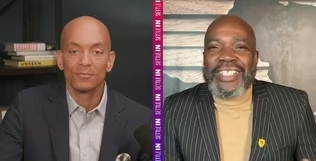
Michael Harriot joins Geoff Bennett on 'Settle In'
Video has Closed Captions
Michael Harriot and Geoff Bennett rethink Black history on 'Settle In' (5m 55s)

Mideast experts on U.S.-Iran talks and potential for war
Video has Closed Captions
Mideast experts on U.S.-Iran negotiations and potential for war (7m 31s)
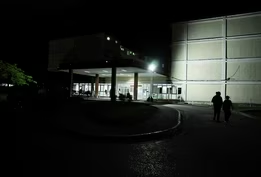
News Wrap: 2 U.S. citizens involved in Cuba boat shooting
Video has Closed Captions
News Wrap: 2 involved in Cuba speedboat shooting were U.S. citizens, official says (6m 12s)
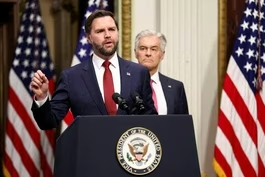
Trump halts Minnesota Medicaid funds over fraud allegations
Video has Closed Captions
Trump administration halts Minnesota Medicaid funds over fraud allegations (5m 35s)

U.S.-Iran talks end without deal, mediator reports progress
Video has Closed Captions
No deal reached as U.S.-Iran talks conclude, but mediator says progress made (4m 4s)
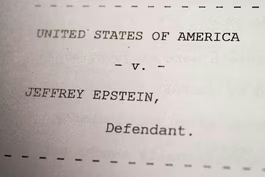
What happened during Hillary Clinton's deposition on Epstein
Video has Closed Captions
What happened during Hillary Clinton's closed-door deposition on Jeffrey Epstein (6m 24s)
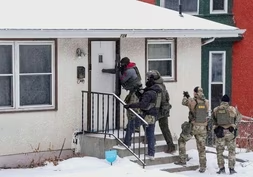
Whistleblower warns ICE has slashed training for recruits
Video has Closed Captions
Whistleblower warns ICE has slashed training for recruits (8m 24s)
Providing Support for PBS.org
Learn Moreabout PBS online sponsorship
- News and Public Affairs

FRONTLINE is investigative journalism that questions, explains and changes our world.

- News and Public Affairs

Amanpour and Company features conversations with leaders and decision makers.












Support for PBS provided by:
Major corporate funding for the PBS News Hour is provided by BDO, BNSF, Consumer Cellular, American Cruise Lines, and Raymond James. Funding for the PBS NewsHour Weekend is provided by...