
Here and Now
Here & Now for September 4, 2026
Season 2500 Episode 2510 | 26m 46sVideo has Closed Captions
Watch the entire episode of Here & Now for September 4.
Watch the entire episode of Here & Now for September 4.
Problems playing video? | Closed Captioning Feedback
Problems playing video? | Closed Captioning Feedback
Here and Now is a local public television program presented by PBS Wisconsin
Here and Now
Here & Now for September 4, 2026
Season 2500 Episode 2510 | 26m 46sVideo has Closed Captions
Watch the entire episode of Here & Now for September 4.
Problems playing video? | Closed Captioning Feedback
Where to Watch Here and Now
Here and Now is available to stream on pbs.org and the PBS app.
Providing Support for PBS.org
Learn Moreabout PBS online sponsorship>> The following program is a PBS Wisconsin original production.
>> With an eye toward the midterms.
President Trump is again setting his sights on how states run elections and a gas leak reopens.
Safety concerns for a controversial pipeline.
[MUSIC] I'm Frederica Freyberg.
Tonight on "Here& Now", with a hard push to oversee state elections, we ask an expert about renewed federal efforts to intervene.
The Wisconsin DNR secretary joins us for the latest on the Enbridge Line five gas spill.
The newest report on the state of working Wisconsin and the fight over farmland being used for wind and solar.
It's "Here& Now" for September 4th.
>> Funding for Here and Now is provided by the Focus Fund for Journalism and Friends of PBS Wisconsin.
>> On multiple fronts, the Trump administration is going hard against noncitizen voting ahead of the midterms.
There's the work with the U.S.
Postal Service to send out mail in ballots only to voters on state citizenship lists.
There's a purported U.S.
Census Bureau report claiming that 500 noncitizens voted in Wisconsin in the 2020 election, and a new Department of Homeland Security investigative surge in states including Wisconsin, to prosecute noncitizen voting.
And yet, Wisconsin election officials describe noncitizen voting as vanishingly rare because it's already illegal.
What's going on?
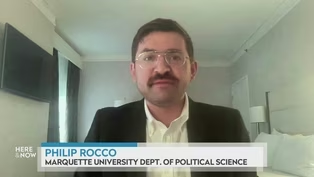
We turn to Marquette University professor of political Science Philip Rocco.
And thanks very much for being here.
>> Good to be with you.
>> So as to that question, what is going on?
>> Well, I think what we're seeing is a kind of multilayered effort by the Trump administration to kind of do January 6th every day to keep alive the myth that there's widespread noncitizen voting to kind of delegitimize elections.
And it's not just kind of one instrument or one tool that they're using to do this.
There's using information from the Census Bureau, using enforcement power from DHS, and using in a in a really irregular way.
The Postal Service, in an attempt to to gatekeep who votes.
And so I think what that tells us is that the administration is really hedging its bets, both on what strategies it thinks it's going to be successful with, but also what the outcome, in a way, of all of these strategies is going to be.
And they're kind of setting up, I think, some opportunities for themselves.
If one of the strategies doesn't work out, that they can sort of fall back on another.
>> Should ordinary voters be concerned about all of this?
>> Well, I think.
>> It's important to distinguish being concerned from being vigilant and aware of what the facts on the ground are, right?
State and local officials are the people who are responsible for administering elections in the United States.
The white House is explicitly not an entity that is allowed to do that.
The federal government is is allowed in in very limited instances, to play a role in election administration, but not the things that are happening now.
And so the information on on how elections are going to run, how they're going to work comes from state and local officials.
And in a way, that's the important.
Those are the important people to, to be listening to and to make a plan to vote is, is really important.
So I think to be aware, to be vigilant, but not to be sort of dismayed simply by looking at what's happening in Washington, but knowing that that that the authority at the state and local level.
>> So the Census Bureau report showed 24,000 noncitizens voted nationwide in 2020, and 500 in Wisconsin.
What was your reaction when you saw that Census Bureau report?
>> Well.
>> My reaction was that it didn't show that at all.
We, the Census Bureau's own research has time and time again done record matching studies of this kind and found false positives.
In other words, purported matches that weren't matches at all between two different lists of of individuals in excess of 6% of the sample.
And what we see here is a number of people who are alleged to be non-citizen voters.
That is far smaller than that.
And so really, you can't distinguish what the Census Bureau, if indeed the Census Bureau did this research, which is in doubt itself, found from no statistical evidence at all.
>> So there's also the process being developed by the Postal Service to send ballots and envelopes with barcodes showing recipients are on state citizenship lists.
I know Wisconsin officials say the new system is nowhere near ready, in ballots are already being sent out.
Will this disrupt the midterm elections?
Potentially including in Wisconsin?
>> Well, I think.
>> That if the courts are not successful in stopping this process from going forward, and I think we have some indications to think that it's going to be difficult for the Postal Service to to play this role, if not legally, then certainly operationally, it it is a really heavy operational lift that they are trying to pull off in a very short amount of time.
But I do worry about chaos and I worry about it not only because that that's what might play out, but also because how the the appearance or image of chaos can make it potentially easier for the Trump administration after the fact.
To say that this wasn't a legitimate election.
And it's very similar to somebody lighting a house on fire and then, you know, saying, oh, well, this is a this is a terrible situation when when they themselves have caused it.
>> There's the new investigation into states, including Wisconsin, on the part of the Department of Homeland Security, as we mentioned.
What do you know about that and what investigators will be looking at?
And what's your reaction to that?
>> Well, I think.
>> We don't know very much about that effort at this time.
It certainly seems to be an indication that the Trump administration, which has lost time and time again in federal court cases, trying to force states to produce information that is protected, information about individual voters, personal details, the Trump administration doesn't seem abandoning that effort, simply because courts have said that it's illegal.
They are now going to use seemingly every tool in their toolkit to try to intimidate state officials into giving them what they want.
It's kind of an extortionary activity, but we don't really know exactly what these officials are going to be looking for and what that looks like, but I think it's, you know, another part of this multi-layered strategy that we're seeing, which indicates to me that the administration doesn't seem interested in giving up.
>> All right.
We leave it there.
Philip Rocco thank you so much.
>> Thank you.
>> The Canadian oil and gas pipeline, the Enbridge Line five coursing through native lands in northern Wisconsin, has been shut down temporarily due to a leak discovered last week.
The very eventuality tribal nations have been sounding the alarm over in public and in court.
>> There is always just the environmental concern, the structural concern, you know, and and it's come to it's come to light now that they have made, you know, that they're susceptible to, you know, to really, really, really sloppy work.
And, and so our hope, my hope from, from our organization's standpoint is that they take time to refocus maybe so that there would be no, no more accidents like what we've, what we've experienced.
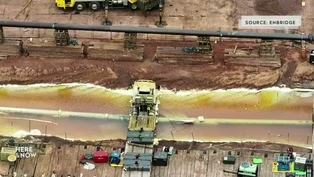
>> But tribal nations are not alone in their concerns over line five, with its reroute around Bad River lands, the Wisconsin Department of Natural Resources called to halt work on the project after a construction truck ruptured the line, causing more than a million gallons of propane and butane to release into the atmosphere.
For its part, Enbridge says there was a project wide safety stand down for construction workers, during which project leadership reinforced safety protocols.
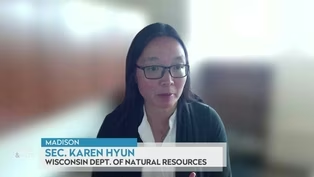
DNR Secretary Karen Hyun is here with latest details, and thanks very much for being here.
>> Thanks, Frederica.
It's nice to be with you.
>> So you called on Enbridge to halt work on the reroute construction.
And yet, according to the company, that work has already resumed.
What is your response to that?
>> Yeah, there are two separate issues here.
Just wanted to clarify.
One is that there is a an active incident happening around Saxon, Wisconsin.
We are still waiting to gain access to that site.
So that site and the safety of that site is controlled by Phmsa, which is the pipeline, and Hazardous Materials Safety Administration.
It's the lead agency at the site, and we haven't had been authorized to access that site, but we're continuing to monitor the situation as it develops, and we'll be ready to be on site as soon as we can to evaluate the impacts.
There is also the issue of the relocation that I think you mentioned earlier.
There have been several issues of noncompliance that have happened where there have been drilling fluid that's leaked in the process of their horizontal drilling under some of the waterways as they reroute the pipeline around the bad River reservation.
I heard the concerns from and other tribal nations, and we share those concerns over those recent incidents as well, which is why we asked for a stand down.
And we continue to have robust dialog with Enbridge about how they can increase their safety and environmental compliance and compliance with the permits that we've issued.
a letter to Enbridge saying that you are deeply concerned about the latest spill and immensely frustrated by other recent noncompliant events, and that you want the company to demonstrate that measures are in place to prevent future spills.
Has the company demonstrated that.
>> We continue to have ongoing discussions with senior leadership at Enbridge?
There were noncompliance events in the past few months, and there continue to be some noncompliance events, even after the safety stand down.
So we're continuing to discuss with them what they can do to increase their compliance with the permits and reduce these frack out events.
latest leak?
>> There have been barrels of liquefied natural gas that have evaporated into the atmosphere and volatilized into the atmosphere, which we have concerns about.
We.
So until we can get into the site, it's hard for us to assess what the damage is to the air and the land and the waters of the state.
>> What concerns do you have going forward?
>> Well, first and foremost, I want to make sure that our staff and other members that are entering into this site are safe, so we have to make sure that we're following Phmsa guidelines and authority in terms of accessing the site.
Once we're able to get in, we're going to look at impacts to the air, to the groundwater, to the surface water to the soil, to the sediments, and see how they might be impacted by liquefied natural gas.
Enbridge is the responsible party will be taking measurements, and we'll be able to analyze that data and see what kind of damages we might need to assess.
>> How do you feel about the DNR's role in granting permits for this project?
In light of your current deep concerns?
>> We have statutory authority to issue permits for things like stormwater, waterways, wetlands, and other and other things, but those are the main ones.
For this.
We issued those permits with a lot of collaboration and public input and tribal input.
Over time, we are going to hold Enbridge accountable to the noncompliance events, particularly the frack outs that have been happening.
And we want to see improvements as construction continues on the pipeline.
>> Meanwhile, Enbridge hopes to restore service to the pipeline that carries 23 million gallons of crude oil and natural gas by next week.
What is your comfort with that at this point?
>> Yeah, as I understand it, because of the actual spill in Saxon, which is different than the noncompliance events I was talking about earlier, they have stopped shipping product across through the pipeline that goes to different refineries and places across the Midwest.
I understand the importance of being able to provide that energy source to other places and other states, and even to Canada, but we need to make sure that in that process, accidents like this spill, which are really serious, are taken seriously and cleaned up to remediate the environment.
>> All right.
We leave it there.
Secretary Karen, thank you so much.
>> Thank you.
>> The monthly U.S.
jobs report out today shows encouraging news for the economy, adding 162,000 jobs, keeping the unemployment rate steady at 4.1%.
In Wisconsin, the state of working Wisconsin is mixed.
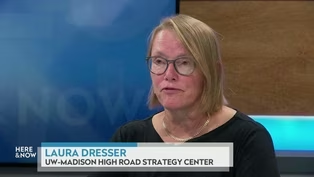
According to a report by the same name from the High Road Strategy Center at UW-Madison, Laura Dresser is an economist and associate director at the center.
And Laura, thanks a lot for being here.
>> I'm delighted to be here.
>> So how do our job numbers stack up and how have they trended since your last Labor Day report?
>> Yeah, it's been a really rocky time for the economy is a great report today from the national level.
But on net, the national labor market has barely grown since January of 2025.
And Wisconsin, as of the data that came out last month, Wisconsin's total job base had actually fallen and was slightly below where it had been in January of 2025.
>> So your report shows median wages have grown steadily.
So part of the mix that we're talking about now, sitting at just over $26 an hour.
But what stands out in that stat.
>> That stats interesting because the median it's great to see that going up because it's going up faster than inflation.
It's been steadily going up faster than inflation for most of the last ten years, except for 2022, when inflation was really high.
So that's a great stat on that sense.
But there's a lot of disparities hidden underneath the median.
And so we look in the report to see what's going on and some of the gaps between, for example, the lowest wage workers and the highest wage workers continue to shrink a little bit because of the tightness of this labor market and the way that lower wage workers have moved forward in wages faster than higher wage workers.
>> And there's also some kind of demographic gaps.
>> Yeah, for sure.
There's a big gender gap in wages.
People are familiar with that, though, over the last 40 years, which we document in this, men's wages have have only risen a little.
Women's wages have come quite substantially up.
So the gender gap is closed, has closed over the last 40 years.
And even over the last little bit.
But other gaps are large and have grown, especially racial gaps.
Black white disparity, Black, Hispanic white disparity has grown quite substantially.
people are hyper focused on, that being inflation.
You say there's concern that inflation could wipe out wage gains of 2026.
How so?
>> Yeah, that's even true in the the national report from today, inflation the rate of inflation is higher than the rate of wage growth.
This is what happened in 2022.
Wages workers wages went up in nominal terms.
But the cost of living just wiped that right out.
That looks like what we're heading into for 2026.
So while we got a high in 2025 and that's great news, 2026 looks much less likely that that will be a strong gain and possible that it will be a loss because of the high inflation.
>> As to affordability, you report that 1 in 3 households in Wisconsin cannot afford basic things.
You describe this as as nothing new, but is it about the cost of living per se, or is it about the wages?
>> Yeah, I think it's really important to see both of those things in balance.
I think when we are are focused on the cost of living, like we see the prices go up, especially recently of energy, gas, utilities.
That makes folks focus on the cost of living.
But in the background, the suppression of wages, the long term kind of under the rates of economic growth, wage stagnation that this nation has had, you know, even this last five years of growth have not gotten us back to to kind of moving ahead as the economy moves ahead.
And if it was the questions of the questions of affordability would be wiped out by having better job.
>> Laura Dresser we leave >> Thanks for having me.
>> As to the rising cost of energy, many people want to see an even bigger turn to renewable sources.
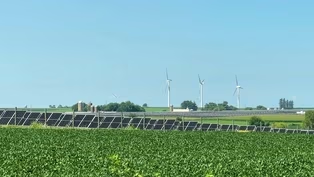
Solar panel fields and wind turbines have been cropping up next to and on top of Wisconsin farms for a couple of decades now.
But as reporter Steven Potter explains, not everyone is on board.
>> Chicken Tom >> Wilcox has farmed the same plots of land around his home in Clark County for more than 20 years.
>> Agriculture is good land use.
>> He's admittedly old fashioned with how he goes about it.
>> You got to understand, I farm like it's 1950.
>> He uses older equipment to harvest his hay and soybeans, and he mixes his own corn feed for beef, cattle, chickens and turkeys.
And he prefers it that way.
>> It's not that we're making a lot of money on these animals.
It's the lifestyle.
that he feels threatens the work of farmers across Wisconsin.
That's the increase of renewable energy projects such as wind and solar power.
He says that the acreage used for such projects is just too valuable.
>> At some point, we're going to have to decide, you know, do we want to use up all this tillable land?
And I personally, I don't.
We need to preserve.
>> Our our valuable farmland in the state of Wisconsin and really everywhere.
these developments.
Wilcox leads the volunteer group known as Farmland First.
They attend community meetings, fairs and parades, and reach out to public officials to stop developments that have been proposed.
He says most of his fellow rural Wisconsin residents don't want wind turbines and solar panel fields near them.
>> If you go anywhere around here to a public forum, you wind up being like a 90/10 split and the residents really don't want this.
And usually the people that are for it are going to get paid.
>> Farmland first is actively opposing two projects nearby.
>> It's basically a city of farms, and there's too many people here for this kind of project.
>> On the other side of this energy debate, several utility companies and clean energy organizations are pushing to have more solar and wind projects, saying we need them.
>> It can be controversial, for sure.
>> Alex Beld is with Renew Wisconsin.
They say renewable energy projects make economic sense.
>> The wind keeps blowing, the sun keeps shining.
Those energy sources aren't usually impacted by things like tariffs or, you know, global conflict.
>> Proponents also say the benefits go beyond just money.
>> Even if there wasn't, at this point, a great economic argument to be made for renewables, there's a huge environmental, health and to be made.
>> Beld says his group understands there's resistance.
>> There are people who don't want to see the landscape change or see farmland get used for something else.
>> But he says the needs outweigh the costs.
>> The goal is to, yeah, completely transform our our economy and our energy system so that it's all running on clean energy.
>> For the utility companies, renewable energy projects are big business.
>> The renewables are a great way for us to make big and positive impacts in our communities.
>> Ben Lipari is in charge of commercial operations for Alliant Energy, one of the biggest public utility companies in the state.
>> We have our wind portfolio that's growing.
We have our solar portfolio.
That's established and one of the largest operating solar portfolios in the Upper Midwest.
>> He says Alliant strives for a mixed menu of energy production.
natural gas and coal to support the around the clock energy needs.
And then, as we've been committed for a number of years now, we think that there's a critical role for renewables that don't have fuel costs and are able to complement some of those traditional energy sources.
>> Lipari also points to local funding generated by taxing power per megawatt.
That utility companies are required to pay.
>> Let me start with solar.
Over the last few years, we've brought 12 utility scale projects online throughout the state.
That's enough power to support over 350,000 residential homes and businesses in those communities.
That's providing critical shared revenues to support community projects over the life of those projects.
That's going to support communities upwards of $150 million.
are more than 20 large utility scale solar panel fields, and for wind power, there are more than a dozen projects generating electricity for utility use.
Steil Lipari acknowledges that not in my backyard.
Opposition.
>> You have certain folks in the community that would rather you cite the project somewhere else.
We spend a lot of time with those community members.
We want to hear their concerns.
>> Residents can make their voice heard about these projects.
>> Throughout the entire review process.
There are many opportunities for public participation.
>> Meghan Sovey-Lashua is with the Public Service Commission of Wisconsin.
The agency that regulates utilities in the state.
She says approving any new energy project is a very deliberate, drawn out process.
Over six months, the agency conducts reviews, holds public hearings.
>> And then there'll be an open meeting where the commission then deliberates.
After reviewing that very full record of evidence.
And then the commission makes its decision.
>> One major factor that the PSC considers with new power generation applications is the state's growing need for more energy.
In the SCS draft of their new strategic Energy assessment for 2026 to 2032.
The demand for power jumps more than 40%, and more than 70% of that increase is due to three active data center developments.
>> If there's a construction project that a utility needs to build to serve a data center, that would come before the commission.
But the commission has no authority over data centers.
>> The report also predicts a significant change in the types of energy production over the next six years.
In all, coal power will decline 28%.
Natural gas will increase 14%, wind will increase 6% and solar will increase 11%.
Such growth in wind and solar will require more landowners to share and least land.
>> Three, four, five, six seven eight.
>> That's a decision that Kathy Haas made more than 20 years ago.
>> I determined number two, and there is 41 in the project.
she has leased land for one wind turbine to the Cedar Ridge Wind Farm project in the town of Empire.
The least payments she and her neighbors receive has made a difference.
>> It's helped a lot of farmers, you know, some of the smaller ones, to be able to hang on to their farms.
needed is minimal.
>> The wind turbine project, it's able.
You can farm right up to it.
All you gave up was just this small piece of land to be able to develop this project and add electricity to the grid.
>> Haas says.
There was opposition to the project early on, but that's faded.
>> Once they realize that these were going to help keep our taxes down.
You know, then it was a little bit, you know, just so that everybody was going to benefit somehow.
Everybody's pretty much got used to them up there.
>> Still, for farmers like Tom Wilcox, his opposition is steadfast and represents what he sees is worth protecting.
>> You asked earlier if there's good places for this.
Yeah.
Places where crops don't grow and people don't grow.
>> Reporting from Clark County.
I'm Steven Potter for Here and Now.
>> For more on this and other issues facing Wisconsin.
Visit our website at PBS Wisconsin Education and then click on the news tab.
That's our program for tonight.
I'm Frederica Freyberg.
Have a good weekend.
>> Funding for "Here& Now" is provided by the Focus Fund for journalism and friends of PBS Wisconsin.
 New
NewHere & Now opening for September 4, 2026
Video has Closed Captions
Clip: S2500 Ep2510 | 1m 4s | The introduction to the September 4, 2026 episode of Here & Now. (1m 4s)
 New
NewHopes and Tensions over Renewable Energy in Rural Wisconsin
Video has Closed Captions
Clip: S2500 Ep2510 | 7m 59s | Supporters and opponents of wind and solar in rural communities wrangle over projects. (7m 59s)
 New
NewLaura Dresser on the State of Working in Wisconsin in 2026
Video has Closed Captions
Clip: S2500 Ep2510 | 4m 8s | Laura Dresser on the State of Working Wisconsin 2026 report on job trends and inflation. (4m 8s)
 New
NewOjibwe Tribal Group Condemns Line 5 Spill as 'Sloppy Work'
Video has Closed Captions
Clip: S2500 Ep2510 | 58s | The Great Lakes Indian Fish & Wildlife Commission denounced Enbridge over a Line 5 spill. (58s)
 New
NewPhilip Rocco on Noncitizen Voting Claims and Mail-In Ballots
Video has Closed Captions
Clip: S2500 Ep2510 | 6m 46s | Philip Rocco on moves to manage mailing ballots by alleging noncitizen voter fraud. (6m 46s)
 New
NewSec. Karen Hyun on a Natural Gas Leak in Line 5 in Wisconsin
Video has Closed Captions
Clip: S2500 Ep2510 | 5m 19s | Karen Hyun on Line 5 leaking natural gas in Iron County following a vehicle collision. (5m 19s)
Providing Support for PBS.org
Learn Moreabout PBS online sponsorship New Episode
- News and Public Affairs

Top journalists deliver compelling original analysis of the hour's headlines.
 New Episode
- News and Public Affairs

Today's top journalists discuss Washington's current political events and public affairs.

 New Episode
 New Episode
 New Episode
 New Episode


 New Episode
 New Episode
 New Episode
Support for PBS provided by:
Here and Now is a local public television program presented by PBS Wisconsin