
To The Point with Doni Miller
Mom’s Program: Maternal Opiate Medical Support
Special | 26m 46sVideo has Closed Captions
Mom’s Program – Maternal Opiate Medical Support joins Doni to discuss an important subject.
Behind the statistics are real women fighting addiction while trying to protect their pregnancies, care for their children, and rebuild their lives. MOMS, sponsored by the Zepf Center, provides crucial support, treatment, and hope when it's needed most. How do we help mothers overcome addiction and give their children a chance at a healthier future? Doni will discuss this with her guests.
Problems playing video? | Closed Captioning Feedback
Problems playing video? | Closed Captioning Feedback
To The Point with Doni Miller is a local public television program presented by WGTE
To The Point with Doni Miller
Mom’s Program: Maternal Opiate Medical Support
Special | 26m 46sVideo has Closed Captions
Behind the statistics are real women fighting addiction while trying to protect their pregnancies, care for their children, and rebuild their lives. MOMS, sponsored by the Zepf Center, provides crucial support, treatment, and hope when it's needed most. How do we help mothers overcome addiction and give their children a chance at a healthier future? Doni will discuss this with her guests.
Problems playing video? | Closed Captioning Feedback
Where to Watch To The Point with Doni Miller
To The Point with Doni Miller is available to stream on pbs.org and the PBS app.
The views and opinions expressed into the points are those of the host of the program and its guests.
They do not necessarily reflect the views or opinions of public media.
Welcome to the point I'm Doni Miller.
Every day, the opioid crisis affects mothers, babies and families in northwest Ohio.
Behind the statistics are real women fighting addiction while trying to protect their pregnancies, care for their children, and rebuild their lives.
Today, we'll be learning about the Moms program that's Maternal Opiate Medical Support Program, sponsored by the Zeff Center, which provides crucial support, treatment and hope when it's needed most.
How do we help mothers overcome addiction and give their children a chance at a healthier future?
We'll get straight to the point right now.
Connect with us on our social media pages.
And you know that you can email me, Doni underscore Miller at wgte.org.
And for this episode and any other that you'd like to see, please go to wgte.org/to the point.Welcome.
This morning, we have a fascinating program to tell you about today, and two experts right here in our town who are focused on the recovery of women, are joining us to talk about the Moms program.
I'd like to introduce you to Marissa Carson.
Say it for me, Marissa Castile's.
Castile's I practiced it, I promise you, I did.
Just let me see if I do better with Bobby.
Bobby.
Costantino.
Yeah.
Pretty good.
Oh, good for me.
Good for me.
Welcome.
So welcome.
Welcome today.
Why don't we give folks an overview of the Moms program?
That's what we're talking about today.
Absolutely.
You're the clinical manager there.
Like this?
Yes.
So the Moms program really helps women that are pregnant or have a child under the age of two who have an opiate use disorder or a stimulant use disorder, either current or have a history of use.
And our goal is really to do a wraparound to care with them.
So we provide them with case management peer support.
We have our health coordinator who kind of takes care of them and answers any questions that they have.
We do one on one with them.
We provide parenting classes for them.
And then we also have a group each week that they can kind of get information from peer to peer.
And so we're really helping them navigate resources in the community, helping them stay connected to their substance use treatment that they need, and just helping them kind of navigate what that looks like.
Bobby, you're the care navigation coordinator there.
Yes.
What are you finding to be the primary motivation for women to joining this program?
Definitely having a healthy pregnancy.
Should they join our program during pregnancy?
Being able to keep in actively parent their children, whether that be the child lives with them or lives with a relative, and.
Limiting those barriers that other programs.
In the past, we've had women that have said, I didn't go to treatment because I, you know, no one would take me when I was pregnant.
No one would put me on medication or keep me on my medication while I was pregnant, or just that fear in the stigma surrounding if I seek treatment while pregnant, I will have children services involvement.
I'll lose custody of my kids.
So definitely the pregnancy and being able to parent is a huge motivating factor.
That whole idea of stigma is huge and I want to get back to that in just a moment.
What would you all say to people who would say to you, why are we spending money on this?
This is a choice that folks have made.
These women have made.
They've decided to to use opiates and now we have to pay for their recovery.
What would you say?
I mean, I definitely think that each person is worth more than the worst thing they may have ever done, right?
And so I think each mother deserves a chance to be able to be a healthy parent.
We know in our community we are on, you know, second generation of an opioid epidemic.
So we are treating women now whose own parents were impacted by opiates or they were raised by grandparents.
So if we could kind of break some of that generational trauma that happens to families, everybody's worth having a healthy life.
These unborn kids or young kids are worth having healthy parents to parent them.
And really, if you like, invest in a family early.
It does save the community money.
When you think long term right, it saves.
Hopefully we get people in treatment while they're pregnant and that reduces some of the hospital stays.
That reduces trips to the E.R.
because they're engaged in prenatal care while they're in treatment with us.
So from a business standpoint or a cost effective standpoint, it totally makes sense.
But then also, just like people need help and we should help them.
Yeah.
And so many of these women want to parent, you know, when they start getting they're not sure.
They don't think they're worth it.
But as they're working with us and they start to see the hope that is there, they really want to be able to parent and they start to learn and like, really do what they can to get those skills.
They don't want to be the parents that sometimes they had.
And so we see so many times that they really, really want to be that parent.
And some of them don't always choose to be pregnant.
They come in to get recovery and find out their pregnant through intake or something like that.
And so that changes what they're going to do.
Do you find that women who are in your program are coming in with challenges to their self-esteem?
Absolutely.
Really?
Absolutely.
Yeah.
Where do you think that comes from?
Just the guilt and shame that comes with being an active addiction.
Active substance use, trauma.
Some women are just embarrassed that this is the situation.
They might be like, we our team knows that we usually meet people not a pleasant time in their life.
Sometimes we get people that are already established in their recovery and just happen to find out their pregnant while they're in treatment, but usually we're, you know, we're meeting people when they're not well.
So building a rapport and helping them feel empowered to, you know, trust the process is, you know, that that whole issue of empowerment is such an important issue, at least from the perspective of those of us looking in from the outside.
It's making women specifically understand their worth.
Understand that they have control over the things that impact their life.
Those are the things that must, you must find to be important pieces of conversation in support groups and in this whole recovery process.
Absolutely.
That's what's so great about the group that we have once a week, because we have some that are a little bit more established in their recovery or have that ability to they've been parenting a little bit longer.
And then we have some that are brand new to the program and they really help each other out.
So they talk a lot about like just trust the process.
Do what?
Maybe some are involved with children's services, some have some legal.
And so they're just letting them know you have to trust that.
And do you know those people are here to help you so that you can get to the place where you want to be because they're going to drop out of your life at some point.
That's right.
And then you'll be able to, you know, have more of that choice, more of that control over the things that you want.
And so the group's great because they just they can help each other.
And we're just sometimes there and we just like yeah that's right.
Just yeah.
That's awesome.
Yeah, yeah.
And we're able to just listen and guide the conversation.
But really it's the more established ones helping the newer ones.
Just trust the process.
So we're talking about the process.
We're talking about trusting the process.
What can people expect.
What can women expect when they enter the Moms program.
What happened?
So I have the first appointment with them and it's an intake.
I find out some of their health history, substance use history, what their case management needs or social determinants of health.
Like we kind of start linking them to services as quickly as we can, finding out about other children.
Maybe they have a history with CPS or a history of children being adopted or lost permanent custody.
I ask if they want to if they plan to parent actively place for adoption.
We support people through all forms of parenting and what that might look like.
We have resources for.
If you're not quite sure if you're ready to parent what that looks like moving forward, and then after that, they're linked with a case manager.
Marissa and I do have a couple of clients ourselves, but mostly they go with our case manager, Myra, and then they work with her individually.
We talked to about the program rules and expectations and attending the group so you can get the support offering parenting vocational services.
A big issue we have is a lack of stable housing.
So that's one of the things that we like to work on pretty soon after we get them.
If you're housing insecure or, you know, staying with friends or family, what that looks like moving forward, because that is a really lengthy process.
And then just being transparent with them.
Like we go over what we have to report to make sure that they are honest with us.
If they're on medication assisted treatment, we talk about what that looks like when you deliver your baby and what the hospital stay might look like for them, so that they have as much education and information as possible.
And then we do make like a treatment binder with them, provides a verification of treatment with whatever medications they're on, letters from their providers.
We give a certificate every time they attend our group, so then they can start building that to show.
Should CPS commitment?
Sure, absolutely.
And one of the great things, and especially in your role, is that they have the support of someone every step of the way.
So they're not managing this process by themselves?
No.
And we definitely we establish like, what is something that you feel comfortable like doing on your own?
What would you like me to show you how to do?
And then just be here to answer questions?
And then what would you like me to like?
Absolutely.
Come with you and do from start to finish.
And we call that like do for, do with and like cheer on.
And so that really kind of helps keep them motivated.
And then as they work with us, we're like, you know, like in the beginning you might not doing that, but now you can totally do that on your own.
I just met with someone last week and I was like, I'm pretty sure you you can handle that.
You know, like a year ago, maybe not, but now you are able to, like, go to that appointment on your own.
You can just call me later and tell me how it went.
Right?
But yeah, we provide transportation to appointments should they need it.
We meet them at appointments, we go to court with them, we go to children's services, appointments with them, visitation, whatever they might need us to do.
Yeah.
It sounds like there's no wrong time to do this.
Whenever you feel that you have the energy, or even if you don't feel like you have the energy, but you know you need to make the call, it sounds like it's okay to do that.
Yeah.
Any time.
Ideally, of course, you'd want to get someone when they were pregnant for to have a the healthiest birth outcome possible.
Sure.
But as a nurse, like typically these kiddos are pretty healthy as far as pregnancy is concerned.
So getting them when they're postpartum, we get a lot of referrals once someone has delivered their baby because like they're they're they're motivated to like want to parent or, you know, they've met their child and they're like, wow, I want to, you know, get over.
And I really want to do this.
So we get people all the time that have newborn babies.
Sometimes just looking at that baby will do it for it.
So we're going to go to a break.
But when we come back, I want to talk about that stigma because I think that is such a major barrier.
And it's something we need to talk about.
We need to talk about the damage that that can do.
Yeah.
Right.
Okay.
All right.
We will be right back.
Please stay with us.
To me, community means connecting to others.
I'm Doni Miller and welcome to the Point.
I love PBS kids.
We're a community committed to education.
Discover new ideas, dive into exciting subjects, and engage with the world around you.
I would send them personally a t shirt.
Crime doesn't pay in the old West End.
Pass it on.
That's how we cleaned up the neighborhood.
Vision loss for people is not the end.
It's the story.
It's the next chapter.
WGTE Public media invites you to get out and play day.
Monday through Friday.
It's the 419 powered by WGTE with Matt Killam, Gretchen DeBacker, I'm Kevin Mullen.
What can people expect on the show?
Give me an hour.
A reminder of why this is a great place to live, work and play.
Where you come to watch, listen and learn.
Connect with us on our social media pages.
But you know all about that.
You also know about emailing me at Doni Underscore Miller at wgte.org And for this episode, which is especially informative and any others that you would like to see.
Please don't hesitate to go to wgte.org/to the point.
We are joined today by Marissa Castellucci and Bobby Costantino got them both right that time and we are talking about this amazing program here in town sponsored by the Zeff Center.
It's called the Moms Program and it deals with pregnant women and newborn new moms who are suffering from opioid addiction.
We had a really informative, I think, first half of the show talking about, you know, join any time and through the course of the pregnancy or the the new mom phase of your life, if you think that you are ready for this, and even if you don't think you're ready to be a part of this program, step on in.
Because Bobby, your team holds hands and makes the next day possible and helps inspire that hope that people need to get through this.
But as the clinical manager, Marissa, it would seem to me that one of the biggest issues, this whole stigma, it's, you know, you're accustomed to to living life with a certain group of people and in a certain way and the acceptance in that group.
And then you want to step away from that, to do, to live your life differently.
But people make it really hard by hard for you to do that, by layering judgments on you.
Major issue, I would think so.
Absolutely.
Yeah.
What's the impact of that?
You know, it's really you know, people are afraid to get treatment sometimes.
And sometimes we see that because they're not sure how we're going to treat them because they've gone somewhere else and they've been treated a certain way.
Or maybe they've been told like, oh, no, you don't ask for help because they just want to get your children taken away from you.
And so really, our goal is to help educate.
We were at a community meeting.
There was a community event going on, and we were talking to one of the local people, and that's what they said.
They were like, oh, we don't refer to people to programs like that because we're afraid that, like, they're just going to get their children taken away.
So it comes with a lot of education.
We have to educate people about what our goals are, and our goals are to help keep families together, if that's what they choose, and really helping them understand that that is the importance of this program, and we're going to meet people where they're at and help them navigate their goals.
It's not what we want.
It's really what they want and helping them figure out what those alternatives are.
Some people, you know, they want a parent and others don't.
And so it's our goal is to help them navigate what that looks like.
And it's through tons of education, going to community events, going to meetings in the community and really helping people understand.
And Bobby has had to educate.
You know, she's taking people to an appointment before and seeing some of that stigma.
And she's, you know, very appropriately said, hey, can I pull you aside and just like, have a conversation.
And so sometimes it's sometimes that informal conversation that we have to have in helping people understand that not everyone's choice is to parent.
And that's okay.
It's absolutely okay.
Sometimes people don't know that they're being judgmental, I think.
So when you ask.
And I think that's a wonderful way to approach it.
When you ask if you could speak with them privately, what do they say when you talk to them about that?
I mean, sometimes it's usually with professionals and you're just you're doing your job and you're not thinking of like how your approach or like your nonverbal.
So you're running into these to this sort of stigma, most definitely professional.
And so I'm just kind of like this is the current situation with this particular client.
It's not an ideal situation, but they're just here for care, right?
I'm just like, if you could just go through the motions and like take the emotion out of it.
Because I think we assume that every pregnancy is a happy pregnancy, and that's not always the case.
And so just providing that education on there here to just get basic prenatal care, they may not be excited.
And here's the reasons why.
But we don't need to know someone's entire story to be able to just provide the care.
And then I think in order to help reduce the stigma for our women, it's like helping them practice radical self-acceptance that let's talk about that a little more.
I love that and just that the trauma of it all, like the trauma of being an active addiction, the trauma of having previous history with agencies, the trauma of maybe losing custody of other kids.
We kind of need to put all of that on the table in order for you to continue to want to accept help currently.
Right.
And just like you can't go back and undo things, but like, you can still move forward in the future and what that might look like for that person.
And I try to individualize it as much as possible.
But I think in the group to like, it's similar to like why sober support meetings in AA and Na works so great.
It's like the universal experience of like, I'm not the only person that has experienced this.
And so they get to come to group and they see other women and we have women with all different circumstances.
You might have someone whose children are currently in foster care, and they're working a case plan, and they have limited access to their kids.
You have someone who they only see their children at moms group because we become approved supervisors for them.
You have other people who just reunified with older children.
And so seeing that like what is possible, should I continue down this path has been really helpful for some of our women.
And you know what?
You know what else to Marissa?
I was I was thinking as you were talking, Bobby, that this might be an opportunity to break what could have been a cycle of addiction.
Absolutely, definitely.
And changed the lives of kids and kids after that.
Yes.
And that's really the goal of a lot of the moms.
Like they want to be their best person so that they can raise children, that they can break that cycle because, you know, some of them have had parents that are were in addiction themselves and they they don't want to be that parent.
And so we do a lot to help them understand, you know, what that consistently can look like and like they can do it.
Sure.
And they have the ability to do it.
I do that and we talk a lot about mental health and keeping up taking care of yourself because so many, when they have their children, they they want to do everything for their children and they forget that they also have to take care of themselves.
Absolutely.
And so we talk a lot about mental health and taking care of those primary care appointments and making sure they're going to those things so that they can continue to take care of themselves.
Because if they're their best person, they're going to be the best parent.
It doesn't, you know, they don't have to do all the things and buy all the materials for their kids.
It's just if their cup is full, then they're going to really be able to take care of their children the best way.
Have you had the opportunity to see children in this process?
Absolutely as well.
Yeah.
What's the impact that you see on the kids?
So with our moms group, they're allowed to bring their kid to group.
And so it's not just them and they have to like find daycare or something, but they are allowed to bring their children there.
And so we really seen a lot of our kids, they thrive.
And we have a partnership with Early Intervention.
And they come once a month to group.
And she kind of comes around Teresa and gets to teach the mom different things.
Or if the moms are noticing something or they're nervous about a kid maybe not hitting their developmental needs, they she kind of talks with them and helps them see, like, oh no, they're fine.
Like everything's great because so many of our moms, you know, they they see social media and they're like, oh, this kid's crawling or walking or talking, and my kid's not yet.
And she's like, they're fine.
They're doing this thing.
And, you know, they're they're doing the motions to get there.
So they're going to be fine.
Or if she does notice something, it's a really easy connect to get them set up with Early Intervention right away.
And then they already kind of are familiar with who they might be meeting with.
So it's a great partnership to have.
And we've really seen, you know, a lot of the kids really just I mean, they're just they're just kids.
They're just awesome and really being able to get along with each other.
And, you know, they make their own little friends.
They're all like two years old.
So they do, you know, infant or toddler things.
And sometimes we have to teach them moms like, that's normal.
It's okay.
Like they're not mean.
They're not bad.
They're not.
You know, there's nothing like, you know, wrong with them because so many moms feel like.
Because they were.
Yeah.
Because they were using during the pregnancy or something that like, something might be wrong.
And it's like, you know, Bobby's like, no, it's fine, that's normal.
That's normal toddler things.
That's totally fine.
Yeah, yeah.
So what if what are the opportunities for people who come and aren't quite ready?
So they they relapse or they struggle staying clean.
Do you.
Is your place a place of many chances?
Absolutely.
Absolutely.
Yeah.
We work with everyone.
Harm reduction, active use, abstinence.
We really meet people where they're at.
So someone could be actively using and they could still work with us, they could still work with us.
And we'll just kind of plant the seeds.
And I'll start a conversation about, you know, what is sobriety look like to you?
Do you even want to stop using?
And then if I've had sometimes answers flat out no.
Right.
And then I'm like, okay, so how can we just have a healthy baby, right?
Like, what does that look like?
Could we reduce our use?
Could we maybe like get on medication assisted treatment?
What are you seeing the most?
I don't mean to interrupt you.
What do you see?
The most popular opioid being these days?
I mean, right now is just fentanyl.
You know, occasionally you might get some something else, but that's very rarely these days.
Yeah.
And so you say to them, even, how do we have a healthy baby and they help you design.
And then I talk to them about like what continued use looks like when you deliver your baby, how that use impacts your pregnancy and not from like you're harming your baby.
But just like physically, this is what it's like for your child.
They experience the same symptoms that you do sometimes, and then what the hospital state will look like and what neonatal opiate would draw some dumb looks like.
And so that kind of shifts the conversation.
Like, obviously you care about your baby enough that you're having a conversation with me, right?
So I'll take that with it.
That's a that's a gift.
And then sometimes it's just harm reduction.
It's like, okay, so could we maybe like not use needles or like let's have fentanyl test strips or like do you have Narcan?
I mean, I've had a million conversations about you're still actively using, but do you have Narcan.
Are you using alone.
You know, what does that look like up until like, oh, you want to go to detox or withdrawal management?
Like, let me help you do that.
You're pregnant.
Let's go to the hospital first.
Make sure everything's okay with your pregnancy.
Let's get you in a bed somewhere.
Whether it be a deaf or another agency.
Whoever has been taking all the way through, like.
Okay, so you've already stopped when we met prior to meeting.
What does that look like?
Let's be able to continue abstaining from substances.
So in the last 30s.
And that's about all we have left.
What would you like to leave people with about the importance of this program?
Alyssa.
Yeah, yeah.
I mean, it's really, you know, we're going to meet you where you're at.
We're going to be able to help you and you're going to guide it.
Right?
You're the you're the or the person in this that's really going to tell us what you need and how we can kind of help.
You have the healthiest pregnancy, right.
That you and your family are worth all of the good things.
There you go.
Yeah, absolutely.
And don't be afraid.
Absolutely.
Don't be afraid.
These folks are going to hold your hand.
You will be so happy at the end of this process that you engaged these two wonderful women who are just here to help.
Thank you so much for joining us today.
I appreciate your time.
Have a wonderful, wonderful day and I'll see you next time.
On to the point.
The views and opinions expressed into the points are those of the host of the program and its guests.
They do not necessarily reflect the views or opinions of public media.
To the point is supported in part by viewers like you.
Thank you.
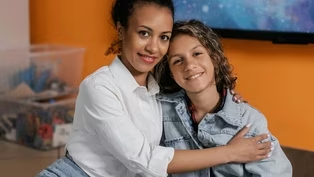
Mom’s Program: Maternal Opiate Medical Support promo
Airs Friday, July 24th at 8:30 p.m. and repeats Sunday, July 26th at 11:00 a.m. (30s)
Providing Support for PBS.org
Learn Moreabout PBS online sponsorship New Episode
- News and Public Affairs

Top journalists deliver compelling original analysis of the hour's headlines.
 New Episode
- News and Public Affairs

FRONTLINE is investigative journalism that questions, explains and changes our world.
 New Episode
 New Episode
 New Episode
 New Episode
 New Episode
 New Episode
 New Episode
 New Episode
Support for PBS provided by:
To The Point with Doni Miller is a local public television program presented by WGTE