
Snakes: Discover Snakes
Special | 3m 39sVideo has Closed Captions
Why do snakes always look like they are staring?
Snakes have long, scaly bodies with no arms or legs. They live almost everywhere on Earth and play a vital role in the ecosystem. So, why are we so afraid of these creatures? Find out why you should value the snake in your backyard.
Problems playing video? | Closed Captioning Feedback
Problems playing video? | Closed Captioning Feedback
Science Trek is a local public television program presented by IdahoPTV
Major Funding by the Laura Moore Cunningham Foundation and Idaho National Laboratory. Additional Funding by the Friends of Idaho Public Television and the Corporation for Public Broadcasting.
Snakes: Discover Snakes
Special | 3m 39sVideo has Closed Captions
Snakes have long, scaly bodies with no arms or legs. They live almost everywhere on Earth and play a vital role in the ecosystem. So, why are we so afraid of these creatures? Find out why you should value the snake in your backyard.
Problems playing video? | Closed Captioning Feedback
Where to Watch Science Trek
Science Trek is available to stream on pbs.org and the PBS app.
Science Trek
Science Trek is a place where parents, kids, and educators can watch short, educational videos on a variety of science topics. Every Monday Science Trek releases a new video that introduces children to math, science, technology, engineering, and math (STEM) career potentials in a fun, informative way.More from This Collection
Every animal in an ecosystem plays an important role in the well-being of our planet. Some are predators. Some are prey. Some pollinate plants or spread seeds. Each contributes to its part of the community and land around it. Take time to learn more about the lives of animals.
Yellowstone: A Most Unusual Neighborhood
Video has Closed Captions
Yellowstone National Park is unlike anywhere else on Earth. (8m 14s)
Video has Closed Captions
What special skills do birds of prey have that make them such good hunters? (6m 52s)
Birds of Prey: World Center for Birds of Prey
Video has Closed Captions
Visit the World Center for Birds of Prey. (6m 8s)
Video has Closed Captions
Learn what bears like to eat and why you should avoid them. (6m 49s)
Bears: Grizzly, the Bear in a Coat
Video has Closed Captions
How are grizzly bears different from other bears? (5m 33s)

Video has Closed Captions
Architects borrow from nature all the time. Find out how. (6m 26s)
Rabbits: Are You Rabbit Ready?
Video has Closed Captions
What do you need to know before getting a rabbit for a pet. (5m 57s)
Video has Closed Captions
Showing rabbits at your local fair opens the door to science. (6m 30s)
Video has Closed Captions
What is White Nose Syndrome and why is it so deadly? (5m 15s)
Video has Closed Captions
How do bats find their food at night? (4m 17s)
Providing Support for PBS.org
Learn Moreabout PBS online sponsorshipJOAN CARTAN-HANSEN, HOST: Snakes have long scaly bodies with no arms and legs, and they live almost everywhere on Earth.
Snakes play an important role in our ecosystem.
So let's find out more about these amazing reptiles.
[MUSIC] There are over 2,500 different types of snakes in the world.
Snakes are reptiles.
They're cold blooded.
That means a snakes body temperature depends upon the temperature of where it lives.
So, snakes like to keep warm by absorbing heat from sun-soaked rocks or from the ground, or they hide under rock piles or low-lying plants to stay cool.
GRIFFIN MCMAHON, SNAKE OWNER: Snakes haves scales covering their skin.
The scales protect their bodies like armor.
The scales also help keep moisture inside their bodies so they don't dry out in the sun.
CARTAN-HANSEN: Snakes travel in different ways.
Most commonly, a snake moves by pushing one side of its body and then the other against rocks or bumps on the ground.
It can also use its scales to help get some traction.
Snakes don't have eyelids.
Instead, snakes have a clear scale protecting their eyes.
That's why they always look like they're staring.
Snakes don't have ears like we do, but are very good at detecting vibrations.
And snakes have special smell detectors in their mouth and can pick up the scents in the air with their forked tongue.
MCMAHON: Snakes are predators.
They eat their food whole.
They have special jaws that allow them to open their mouths really wide.
CARTAN-HANSEN: Snakes usually lie in wait and then quickly strike and grab their prey.
Some snakes, like boas, squeeze their prey to death.
And some snakes inject venom to kill their prey.
Rattlesnakes are the best known of the venomous snakes here in the Americas.
When a rattlesnake senses danger, they make a loud noise with the rattles at the end of their tails.
It's a warning to stay away.
Though most snakes are harmless.
You never know.
So, don't bother snakes in the wild.
MCMAHON: But snakes you buy at the pet store can make good pets.
CARTAN-HANSEN: Yeah.
Just be sure you know how to care for them properly and that you want to do it for a long time because some snakes can live as long as 20 years.
Many people are afraid of snakes.
Don't be.
Snakes play an important role in nature.
They eat a lot of things we think of as pests.
So, without them, we'd be in trouble.
Snakes live in almost every part of the world.
A few types of snakes are endangered because we're destroying their habitat or killing them off.
So, respect snakes.
Don't bother them in the wild and appreciate their role in the balance of nature.
If you want to learn more about snakes, check out the Science Trek website, you'll find it at ScienceTrek.org.
[MUSIC] ANNOUNCER: Major Funding for Science Trek is made possible by the Laura Moore Cunningham Foundation, helping Idahoans reach new heights for generations.
Additional funding provided by the Idaho National Laboratory, mentoring talent and finding solutions for energy and security challenges; and by contributions to The Friends of Idaho Public Television, from viewers like you, thank you.
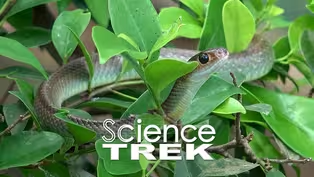
Video has Closed Captions
Clip: Special | 1m 4s | Don’t like snakes? Here is where you can live to avoid them. (1m 4s)
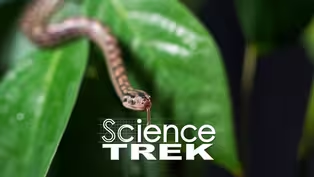
Video has Closed Captions
Clip: Special | 1m 4s | Snakes can open their mouths very wide. Why? (1m 4s)
Providing Support for PBS.org
Learn Moreabout PBS online sponsorship New Episode
- Science and Nature

Explore scientific discoveries on television's most acclaimed science documentary series.






 New Season


 New Season


Support for PBS provided by:
Science Trek is a local public television program presented by IdahoPTV
Major Funding by the Laura Moore Cunningham Foundation and Idaho National Laboratory. Additional Funding by the Friends of Idaho Public Television and the Corporation for Public Broadcasting.