
Europe's view of U.S. amid Iran war, Trump's NATO threats
Clip: 4/10/2026 | 8m 41sVideo has Closed Captions
Europe's view of the U.S. amid Iran war and Trump's new threats toward NATO
Donald Trump’s war in Iran is putting economic pressure on much of Europe. The president has also suggested he will “punish” NATO allies that did not help the U.S. in Iran. The panel discusses the lasting effects of the conflict on the U.S. and its traditional allies.
Problems playing video? | Closed Captioning Feedback
Problems playing video? | Closed Captioning Feedback
Major funding for “Washington Week with The Atlantic” is provided by Consumer Cellular, Otsuka, Kaiser Permanente, the Yuen Foundation, and the Corporation for Public Broadcasting.
Europe's view of U.S. amid Iran war, Trump's NATO threats
Clip: 4/10/2026 | 8m 41sVideo has Closed Captions
Donald Trump’s war in Iran is putting economic pressure on much of Europe. The president has also suggested he will “punish” NATO allies that did not help the U.S. in Iran. The panel discusses the lasting effects of the conflict on the U.S. and its traditional allies.
Problems playing video? | Closed Captioning Feedback
How to Watch Washington Week with The Atlantic
Washington Week with The Atlantic is available to stream on pbs.org and the free PBS App, available on iPhone, Apple TV, Android TV, Android smartphones, Amazon Fire TV, Amazon Fire Tablet, Roku, Samsung Smart TV, and Vizio.
Buy Now

10 big stories Washington Week covered
Washington Week came on the air February 23, 1967. In the 50 years that followed, we covered a lot of history-making events. Read up on 10 of the biggest stories Washington Week covered in its first 50 years.Providing Support for PBS.org
Learn Moreabout PBS online sponsorshipJeffrey Goldberg: Gillian, give us the view from London.
The normally very careful prime minister has expressed to high degree of frustration based on its economic pressure that this is causing frustration about the president.
Give us the view of Trump at the moment inside not only the pulse of power in London, but on the continent.
Gillian Tett: Well, I think extreme frustration would be the best way of explaining it, because there's a recognition, as one senior British official said the other day, that the Iranians understand the Americans much better than the Americans understand the Iranians.
And that's an imbalance, which is critical right now.
President Trump cannot understand how a nation cannot fight just for money, that is well beyond money, that's a key point.
And that's one of the biggest problems.
But there's also a sense that in Europe as a whole, they're going through the five stages of grief about the rupturing of the transatlantic alliance.
I think they've gone beyond the shock and denial and that even the bargaining into some inching towards some kind of exceptions about how they remake NATO.
And in the U.K., they're trying to work out, you know what all this means.
Are they going to get closer to the European Union, which is certainly what Keir Starmer has indicated, or will they try and maintain some form of bridge with Trump or not?
One of the very interesting things that's got almost no attention to-date is that, behind the scenes, the British have been playing quite an interesting role, not just in Ukraine, but also in the region, Strait of Hormuz.
Because of British had been so involved in Ukraine in the drone side, they have been the ones linking up a lot of the Ukrainian drone experts with the Gulf leaders who actually want some support on that.
And that's really a very significant way they've been helping behind the scenes.
But without the Americans, by the way, another area is the British have very strong capabilities in minesweeping that arguably they're some of the best in the world, if not better than America.
Because guess what?
Britain's an island.
We care about this.
I'm both American and British.
So, again, they are trying to create this coalition of the willing right now that will go ahead and help to try and break the deadlock in Hormuz, even if NATO doesn't move.
But it's a very difficult juggling act and the signs are that Prime Minister Starmer is facing a lot of criticism at home around this.
Jeffrey Goldberg: Right.
And President Trump has suggested he will punish NATO members who haven't helped in the Gulf against Iran.
Give us the sense of the health of the relationship between the U.S.
and its various NATO partners.
Anne Applebaum: It's a very strange moment, because, on the one hand, actually U.S and NATO allies are cooperating an enormous amount.
A lot of those strikes and the flights that are going into the Middle East are coming from European bases.
Actually, the plane that crashed -- the American plane that crashed in Iran took off from a British base.
The intelligence logistics, everything is being done with the cooperation of Europe.
And nobody's crowing about it or shouting about it, but that's true.
And so on the level of logistics and those kinds of contacts, everything is pretty unchanged.
But Trump has, in his frustration at being unable to be the winner as he likes to be and being reluctant to blame himself or his decision, or the Russians who are helping the Iranians.
He's looking for scapegoats.
And he's landed on Europeans.
And, you know, for Europeans, you know, no insult is for free.
I mean, they've been insulted, they've been tariffed, they've been attacked.
And there does come a moment when people do start to say, you know, what are we getting out of this relationship?
Jeffrey Goldberg: Right.
Anne Applebaum: You know, we're still cooperating, we're doing we're doing quite a lot.
And with the exception of one or two countries that have a -- Spain, for example, has blocked flights into the Middle East.
Jeffrey Goldberg: And they might very well lose some American bases because of that.
Anne Applebaum: And it might make the Spanish prime minister a lot more popular than he was.
I mean, so another thing that's happened is, you know, these are democracies and they have public opinion and people don't like Trump and they don't like the war.
And you're beginning to see political leaders saying, right, I can do well out of attacking the war and out of attacking the American president.
Jeffrey Goldberg: Let's -- I want to get to Hungary before we finish, but, Kareem, one question about -- I guess it's a psychology question, as which we're in a period where nothing seems surprising anymore and yet Trump's threat to annihilate Iranian civilization was quite shocking over the past weekend.
How was it interpreted in Iran?
Did they understand it as a bluff or did they take it - - they didn't obviously take it very seriously because they didn't seem very scared by it.
Karim Sadjapour: That was a huge gift to the Iranian regime.
Because if you remember what got Trump into this conflict was when Iran was massacring its people last January.
Trump promised on nine occasions that help was on the way.
And a lot of Iranians wanted to -- wanted him to make good on that promise.
And to go from help is on the way to we're going to destroy Iranian civilization in three months was just a propaganda gift to the regime, which has been saying all along, this is not a war against Islamic Republic, it's a war against Iran.
Jeffrey Goldberg: Nancy, in the Pentagon, quickly, did -- was there a reaction to that level of bellicosity?
Nancy Youssef: Yes.
I mean, that -- when it came out, there was almost a rumor starting, like what is he talking about?
What would Caine, the chairman, do if he was asked to use nuclear weapons?
Like just led to a spiraling of scenarios of possibilities because that's not the kind of rhetoric that you hear from the American president.
They're used to hearing that from adversaries, like ISIS, not from the American leadership.
Jeffrey Goldberg: Right.
Just listen to me -- listen with me for one minute to Vice President Vance talking about -- talking in Hungary about the upcoming election there.
J.D.
Vance, U.S.
Vice President: You should never have a foreign head of government or a foreign head of state threatening the foreign -- threatening the head of government of an allied nation.
It's preposterous.
I've also been told that the vice president of the United States coming and saying that Viktor Orban is doing a good job and as a helpful statesman to the cause of peace, that's foreign influence.
But what's not foreign influence is when the European Union threatens billions of dollars withheld from Hungary because you guys protect your borders.
That's apparently not foreign influence.
Jeffrey Goldberg: Gillian, what do you make of that?
Gillian Tett: Well, it's certainly a statement that's caused a lot of consternation across the European Union and the U.K., because there is a sense that America's increasingly interfering with elections.
And, frankly, it's a pretty shocking statement because that is not what the European Union was doing.
It was linked to the corruption issues.
I mean, the Financial Times did a big investigation into that.
And that's why funding was potentially being withheld.
It was around corruption.
And the interference or attempted interference in the election in Hungary has been so blatant that I suspect perversely it may have the opposite reaction.
And as we just heard from Anne, European politicians are learning that it actually pays to be standing up to President Trump and that makes them more, not less popular.
Jeffrey Goldberg: Right.
And you're an expert on, among other things, Hungarian politics, someone has to do it.
I'll give you the last word on this.
That statement, it was fairly remarkable in many respects, including the idea that the vice president is in Hungary nearly campaigning with Viktor Orban.
Anne Applebaum: Well, he went to a campaign rally.
Jeffrey Goldberg: He was literally almost standing there.
And then he's talking about the absurdity of foreign interference, how bad a foreign interference is.
What did you make of that and how is that going to affect the upcoming election?
Anne Applebaum: It was stunning hypocrisy, actually stunning, you know, that he would start talking about the E.U.
interfering, which is baseless and untrue, even while he's interfering.
And it's all in the cause of the leader in Europe, who is the most pro-Russian, who has worked - - who has also worked closely with China, who was helping out Iran, in fact, at an earlier stage.
You know, this is a country that has worked against U.S.
security interests, against European security interests for, you know, years and years now.
It's a leader who has occupied, you know, the - - taken over the state in an illiberal way.
You know, why is United States supporting Hungary?
Jeffrey Goldberg: Right.
Well, we'll be talking about this next week, I think.
But we are going to have to leave it there for now.
 New
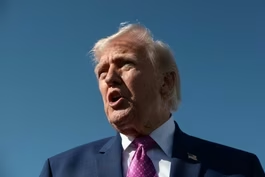
NewTrump’s ever-shifting Iran views
Video has Closed Captions
Trump’s ever-shifting Iran views (14m 19s)
Providing Support for PBS.org
Learn Moreabout PBS online sponsorship
- News and Public Affairs

Top journalists deliver compelling original analysis of the hour's headlines.

- News and Public Affairs

FRONTLINE is investigative journalism that questions, explains and changes our world.












Support for PBS provided by:
Major funding for “Washington Week with The Atlantic” is provided by Consumer Cellular, Otsuka, Kaiser Permanente, the Yuen Foundation, and the Corporation for Public Broadcasting.