
Warner Bros. sale prompts concerns among creative community
Clip: 12/22/2025 | 7m 44sVideo has Closed Captions
Proposed Warner Bros. sale prompts concerns among Hollywood's creative community
Paramount is engaged in a battle to buy Warner Bros., but Netflix's proposed $83 billion offer is still considered the favorite, for now. Talk of this deal has triggered widespread fears in Hollywood about what this could mean for the creative industry. Jeffrey Brown has perspective from one of the leading unions for our arts and culture series, CANVAS.
Problems playing video? | Closed Captioning Feedback
Problems playing video? | Closed Captioning Feedback
Major corporate funding for the PBS News Hour is provided by BDO, BNSF, Consumer Cellular, American Cruise Lines, and Raymond James. Funding for the PBS NewsHour Weekend is provided by...
Warner Bros. sale prompts concerns among creative community
Clip: 12/22/2025 | 7m 44sVideo has Closed Captions
Paramount is engaged in a battle to buy Warner Bros., but Netflix's proposed $83 billion offer is still considered the favorite, for now. Talk of this deal has triggered widespread fears in Hollywood about what this could mean for the creative industry. Jeffrey Brown has perspective from one of the leading unions for our arts and culture series, CANVAS.
Problems playing video? | Closed Captioning Feedback
How to Watch PBS News Hour
PBS News Hour is available to stream on pbs.org and the free PBS App, available on iPhone, Apple TV, Android TV, Android smartphones, Amazon Fire TV, Amazon Fire Tablet, Roku, Samsung Smart TV, and Vizio.
Providing Support for PBS.org
Learn Moreabout PBS online sponsorshipWILLIAM BRANGHAM: As we just heard, Paramount's recent merger with Skydance is fueling major concerns about editorial control at CBS.
At the same time, Paramount is engaged in a battle with Netflix to buy Warner Bros.
Discovery.
Paramount's most recent bid was rejected in part over financing.
But, today, Larry Ellison, the father of Paramount CEO David Ellison, personally guaranteed $40 billion as part of an effort to revive that bid.
But Netflix's proposed $83 billion offer is still considered the favorite for now.
Talk of this deal has triggered widespread fears in Hollywood about what this could mean for the creative industry.
Our senior arts correspondent, Jeffrey Brown, gets some perspective from one of the leading unions.
It's part of our arts and culture series, Canvas.
JEFFREY BROWN: One key opponent to the deal is the Writers Guild of America, whose members have a lot at stake.
Joining me now is president of the WGA West, Michele Mulroney.
And thanks so much for joining us.
Now, you have come out strongly opposed to this deal.
What's your chief concern?
MICHELE MULRONEY, President, Writers Guild of America West: Our members are very concerned about this merger because we have seen in the past that mergers always promise benefits, but they inevitably lead to fewer jobs for industry workers, mass layoffs and diminished competition in the marketplace.
JEFFREY BROWN: What have you seen in the past that causes that?
MICHELE MULRONEY: We only have to look a few years back to the Disney and FOX merger, where there were a lot of promises that this merger would mean more production, more programming.
But, in fact, the opposite has happened.
In 2016, pre-merger, these two entities were putting out about 25 movies a year.
And last year, they only put out 14.
So that's just an example of the way that unfortunately these mergers and acquisitions often cause contraction in the marketplace.
JEFFREY BROWN: So how would that play out, do you think, or how do you fear it might play out in this specific case?
Would HBO go away?
Would there be fewer theatrical releases?
What's the worst fear here?
MICHELE MULRONEY: Yes, there are several fears.
Obviously, Netflix is in a pole position here, it seems, for this potential merger.
And they're the biggest streamer out there with 300 million subscribers.
And for them to absorb HBO Max and HBO, we just don't know if the HBO that we have all come to know and love would survive a merger like this.
Any time there's an increasingly small number of creative gatekeepers getting to decide which projects our writers write, which stories get told and what consumers get to watch on TV, streaming or in theaters, that's of concern.
We anticipate potentially less variety.
And, certainly, we're concerned about the theatrical exhibition business, which has been, as you know, struggling since the pandemic to find its footing again and what this acquisition might mean for them.
JEFFREY BROWN: Could it not be argued that Netflix, of course, has a lot of money, that it certainly has created all kinds of programming?
Could there not be more opportunities, not less, with its resources?
MICHELE MULRONEY: It's hard to say, but, again, based on mergers we have seen before, that's rarely the case.
There's often a lot of talk of one plus one equals three, but, in our experience, it's more like one plus one equals 1.5.
Yes, they have a lot of resources, and now potentially getting into the theatrical business.
We have to see how that plays out.
We know that their core business, which has been very successful, of course, has relied on all of us staying at home on our couches watching the scripted programming.
Are they suddenly going to want us all out in movie theaters?
How are they going to handle theatrical windows, that time frame between when a movie is in a theater and when it appears on a streaming platform?
If those windows are short, as they have been for Netflix, around 17 days, that doesn't give a movie a chance to perform and find an audience.
So we're very concerned about the long-term effect on theatrical exhibition of this potential merger.
JEFFREY BROWN: But those long-term economics of the industry that you're talking about, those have been happening and those continue either way, don't they, the shorter theatrical releases, the move more towards streaming?
MICHELE MULRONEY: They don't necessarily have to.
I mean, there was a time when the movie business, the theatrical business was doing better because we had more robust theatrical windows of 45 days, 90 days.
This trend doesn't have to continue this way.
I mean, we don't even think that it's inevitable that Warner Bros.
has to be sold.
I mean, this is a situation where Wall Street prefers that companies give their money to shareholders, rather than investing back in their businesses and trying to compete.
We don't believe that mergers are the only way forward.
We don't necessarily believe that Warner needs to be swallowed by another major competitor, who would then control an alarming amount of market share.
JEFFREY BROWN: You know, just for larger context, I mean, the last time the world was focused on your members, it was a couple of years ago during the strike.
What's been the aftermath of that for your members?
Of course, there was the pandemic as well.
Where do things stand right now?
MICHELE MULRONEY: It's been a very complicated time for our industry.
Of course, we made really, really important gains and wins in that five-month strike.
But since the strike, not because of the strike, but since the strike, we have seen a real pullback in spending in this industry, where less is being produced.
We have seen almost a 40 percent decline in jobs in episodic television, for example.
And so it's been a very challenging time for our members.
So, at a time when there's already more - - this contraction in our business, I think we can ill afford the risks of a merger and what might come from that.
JEFFREY BROWN: Paramount may still come back with a new hostile takeover attempt.
Do you have the same concerns over that potential deal?
MICHELE MULRONEY: Yes, our concerns aren't buyer-specific.
Our feeling is that, whoever wins here, writers stand to lose.
So each merger brings its own concerns, but, overall, just an anticompetitive environment, an anticompetitive creative marketplace is something that should be of great concern.
And, of course, we hope that there will be a robust regulatory process looking at this.
JEFFREY BROWN: So how does this end?
Warner does want a deal to go through.
You want regulators to block it altogether?
MICHELE MULRONEY: In an ideal world, that's what we're pushing for.
We're meeting with congressional committees and attorneys general to really ask them to do what they're supposed to do, ask the hard questions, go through the antitrust process, and look at the downsides of, as I said, any single entity controlling this much market share.
I mean, the Kroger's merger in the supermarket world was blocked, and the -- in the publishing world, the Penguin merger was blocked as well.
So it's kind of -- it's not like they can't do this.
They have done this in the past.
And so we're very concerned that the proper attention needs to be paid on the regulatory level for this.
JEFFREY BROWN: Michele Mulroney of the Writers Guild of America West, thank you very much.
MICHELE MULRONEY: Thank you so much for your time.
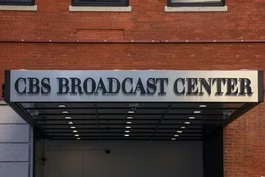
CBS News chief draws backlash by pulling '60 Minutes' story
Video has Closed Captions
Clip: 12/22/2025 | 7m 5s | New CBS News chief draws backlash by pulling '60 Minutes' story on El Salvador prison (7m 5s)
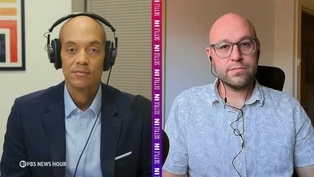
Gideon Meyerowitz-Katz joins Geoff Bennett on ‘Settle In’
Video has Closed Captions
Clip: 12/22/2025 | 4m 39s | Gideon Meyerowitz-Katz joins Geoff Bennett for our ‘Settle In’ podcast (4m 39s)
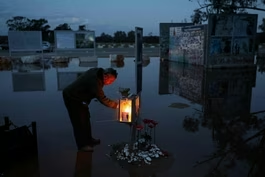
How communities scarred by Oct. 7 celebrated Hanukkah
Video has Closed Captions
Clip: 12/22/2025 | 6m 30s | How Israeli communities scarred by Oct. 7 celebrated Hanukkah (6m 30s)

News Wrap: Trump names special envoy to Greenland
Video has Closed Captions
Clip: 12/22/2025 | 5m 26s | News Wrap: Trump names Louisiana governor as his special envoy to Greenland (5m 26s)
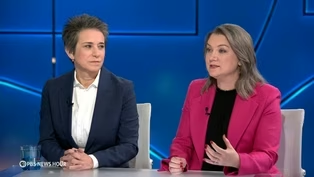
Tamara Keith and Amy Walter on a fractured Republican Party
Video has Closed Captions
Clip: 12/22/2025 | 8m 27s | Tamara Keith and Amy Walter on a fractured Republican Party (8m 27s)

Trump halts East Coast projects in latest blow to wind power
Video has Closed Captions
Clip: 12/22/2025 | 6m 6s | Trump halts East Coast projects in latest blow against wind power (6m 6s)
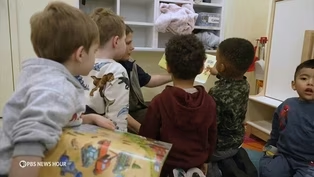
Why finding childcare for kids with disabilities is so hard
Video has Closed Captions
Clip: 12/22/2025 | 6m 54s | Why finding childcare for kids with disabilities is so difficult in the U.S. (6m 54s)
Providing Support for PBS.org
Learn Moreabout PBS online sponsorship
- News and Public Affairs

FRONTLINE is investigative journalism that questions, explains and changes our world.

- News and Public Affairs

Amanpour and Company features conversations with leaders and decision makers.











Support for PBS provided by:
Major corporate funding for the PBS News Hour is provided by BDO, BNSF, Consumer Cellular, American Cruise Lines, and Raymond James. Funding for the PBS NewsHour Weekend is provided by...