
July 30, 2026 - PBS News Hour full episode
7/30/2026 | 57m 46sVideo has Closed Captions
July 30, 2026 - PBS News Hour full episode
July 30, 2026 - PBS News Hour full episode
Problems playing video? | Closed Captioning Feedback
Problems playing video? | Closed Captioning Feedback
Major corporate funding for the PBS News Hour is provided by BDO, BNSF, Consumer Cellular, American Cruise Lines, and Raymond James. Funding for the PBS NewsHour Weekend is provided by...
July 30, 2026 - PBS News Hour full episode
7/30/2026 | 57m 46sVideo has Closed Captions
July 30, 2026 - PBS News Hour full episode
Problems playing video? | Closed Captioning Feedback
Where to Watch PBS News Hour
PBS News Hour is available to stream on pbs.org and the PBS app.
Providing Support for PBS.org
Learn Moreabout PBS online sponsorshipGEOFF BENNETT: Good evening.
I'm Geoff Bennett.
AMNA NAWAZ: And I'm Amna Nawaz.
On the "NewsHour" tonight: U.S.
attacks on Iran ramp up as the war expands across the region.
GEOFF BENNETT: The U.S.
economy slows, and the Federal Reserve's new leadership is likely to respond to economic pressures on multiple fronts.
AMNA NAWAZ: And Israeli settlers escalate attacks on Palestinians in the West Bank.
MOHAMMED BANI ODEH, West Bank Resident (through translator): All of the West Bank is surrounded, whether cities, villages, or towns.
There isn't a place without settlers surrounding us everywhere.
(BREAK) AMNA NAWAZ: Welcome to the "News Hour."
Strikes and counterstrikes between the U.S.
and Iran intensified today, fueling fears the conflict could spread across the entire region.
GEOFF BENNETT: For the first time in five months, suspected military action expanded to Egypt with a drone strike that now marks a new front in the war.
William Brangham starts our coverage.
WILLIAM BRANGHAM: Today, a declaration that the war has now spread to the Mediterranean, Egypt confirming that a drone caused yesterday's massive fire that engulfed two natural gas vessels.
It struck Damietta Port on Egypt's northern coast, about 30 miles from where the Suez Canal meets the Mediterranean Sea.
One of those ships was American-owned.
Egyptian officials said no party claimed responsibility for the attack, but, tonight, Iran's foreign minister blamed the attack on -- quote -- "Israeli plots."
It comes as the U.S.
and Iran exchanged barrages overnight, a brief pause in fighting up in flames and a pattern of back-and-forth strikes reignited.
The Iranian military said it destroyed three American F-35s at an air base in Jordan, though the U.S.
military denied that.
Jordan said it intercepted at least five Iranian missiles.
That all came after what U.S.
Central Command called a heavy wave of U.S.
airstrikes targeting Iran's military command centers, weapons facilities, and coastal surveillance sites.
Iranian state media said at least three people were killed in an explosion on Qeshm Island off Iran's Gulf Coast.
Some residents in Tehran called on their government to respond with even more force.
AMIR, Tehran, Iran, Resident (through translator): Iran should take the initiative.
We're always waiting for them to attack first and then for us to attack.
MILAD KESHAVARZ, Tehran, Iran, Resident (through translator): In my opinion, America's aim is to weaken the Islamic Republic system and break the Axis of resistance in the region.
WILLIAM BRANGHAM: Hopes for a quick end to the war, now past the five-month mark, are increasingly dim.
And diplomats, including key mediators from Pakistan, fear it could escalate even further.
TAHIR ANDRABI, Spokesperson, Pakistani Ministry of Foreign Affairs: We note with concern the security situation -- that the security situation remains precarious, despite the relative calm of last few days.
The negotiations between the parties are ongoing to normalize the situation, particularly the situation in the Strait of Hormuz.
WILLIAM BRANGHAM: The embattled Strait of Hormuz is now one of three major shipping choke points threatened by this conflict.
This week, Houthi rebels attacked ships in the Bab al-Mandab, the gateway to the Red Sea, and the drone strike in Egypt puts the Suez Canal at similar risk, all while the conflict continues to wreak havoc on the global economy.
For the "PBS News Hour," I'm William Brangham.
GEOFF BENNETT: The blockade of the strait through which nearly all Middle Eastern oil flows has prompted Saudi Arabia to call for a maritime defense coalition to protect Red Sea shipping.
Today, representatives from 43 countries met to take up that proposal.
For perspective, we turn now to Ian Ralby.
He's a global maritime security expert, president of Auxilium Worldwide, and a senior fellow at the Center for Maritime Strategy.
It's good to speak with you.
So, how does this drone strike near the entrance of the Suez Canal further complicate the situation in the Middle East?
IAN RALBY, President, Auxilium Worldwide: Well, it shows that it's expanding.
We now have not just a one or two choke point crisis, but a three choke point crisis involving the Middle East situation that's actually starting to meet in the middle with the crisis emanating from the Black Sea.
And so it's an expansion of not only one, but two major conflicts that seem to be starting to take away a lot of the maritime transit routes on which we are all reliant for global trade.
GEOFF BENNETT: Say more about that, the degree to which the Middle East conflict and the Russia-Ukraine war are bleeding into one another.
Walk us through that.
IAN RALBY: Yes.
So, five days ago, on the 25th, we saw Ukrainian strikes against an Iranian vessel carrying weapons to the Russians in the Caspian Sea, north of Iran.
And we often forget that the Iranians have two coastlines.
They have the one that we have been all focused on around the Strait of Hormuz and the Arabian Sea, but they also have the Caspian Sea to the north that has been an amazing weapon route for Shahed drones and other armaments to go from Iran to Russia to fight the Ukrainians.
And that has now been attacked.
And at the same time, we have seen the Ukrainians attacking extensively different infrastructure, including the Caspian pipeline that ends up in the Black Sea port of Novorossiysk in Russia.
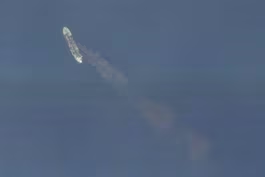
And so this is an expansion of two conflicts starting to meet there, and at the same time in the Mediterranean, where we have seen Ukrainian strikes against Russian and other shadow fleet vessels, including the Arctic Metagaz, which has been floating as a concern for quite a while now.
So these two conflicts are starting to merge as they continue to expand.
GEOFF BENNETT: And if you look at all of the choke points, the Strait of Hormuz, you have got the Bab al-Mandab, now potentially the Suez, plus the Black Sea, if you're a tanker leaving the Persian Gulf today, what are your options?
IAN RALBY: They're very limited, and you're running a huge risk.
What we're seeing, though, is that there's a choice.
Run that risk without any kind of visibility or tracking and try to get either U.S.
protection or some other protection, or take the risk of getting sanctioned and go through the Iranian route through the Persian Gulf Strait Authority.
Or, if you're China, negotiate separately, because it seems the one exception to all of this is the movement of Chinese vessels, which seem not to be applied in the same way for the Houthi blockade.
So it is a very bizarre mix of physical global trade and geopolitics and security, and that is becoming an increasingly complex picture that is hard to make sense of, but definitely seems to favor the BRICS countries, the ones that are focused on development from the Chinas, the Russias, the Irans, the Indians, and others who have been pulling a sort of a split in the global economy, and now seem to be emerging as a bloc able to push back against the West.
GEOFF BENNETT: Meantime, you have got Saudi Arabia.
They're now calling for a maritime defense coalition to protect Red Sea shipping.
How big a deal is this, and what could such a coalition actually do?
IAN RALBY: You know, it's very interesting, because the Saudis have been calling for something of this sort for a while.
They were - - 10 years ago were trying to initiate a Red Sea coalition, but were very hostile to the notion of non-littoral states, so not any of the states that weren't immediately adjacent to the Red Sea being involved.
Now what they're calling for sounds a lot like the combined maritime force that the U.S.
used to headquarter in Bahrain involving 35 to 45 states at any given time, with liaison officers and assets to provide that sort of regional security picture.
And so it remains to be seen what their focus and how their approach is going to be.
But there are a lot of complications, especially because the Saudis now are potentially putting themselves in direct odds with the Houthis, which are obviously aligned with Iran.
And, at the same time, there's friction with Israel.
And so the whole situation increases in its complexity by the day and involves a greater number of states, which makes it harder to see a path towards resolution, given the differing dynamics between a lot of those states bilaterally.
So it's a great initiative.
It would sound great on paper and it would be great in another time, but this might be a very difficult one to pull off in any reasonable degree of success.
GEOFF BENNETT: And strategic reserves can only cover so much for so long.
If these routes of these exits stay blocked, what's the plan B?
Is there a plan B?
IAN RALBY: I'm not privy to one, but it doesn't sound like plan B's have been in high number lately.
We have seen a huge number of different factors depreciate the overall concern.
In other words, we could have seen oil spike to $150, $200 a barrel over the last five months, but they haven't.
And there are a lot of reasons for that.
One is that China has decreased its demand for oil enormously, and they were one of the biggest demand signals prior to this conflict.
So they have actually helped that situation a lot.
But at the same time, the U.S.
has increased pumping.
It's also increased its tapping into those Strategic Reserves, and the president has done an amazing job of timing messages in order to manipulate markets towards a calmer, more stable position.
At the same time, we have given sanctions relief to Russia and Iran at different times to allow for critical elements of the energy sector to keep costs, for example, of bunker fuel, the shipping fuel, to be lower.
But we're running out of numbers of options for how to proceed.
And it may be that, if all of that oil ends up physically trapped, there is just no option but to actually confront that cataclysmic economic situation and take new approaches towards diplomatically resolving the situation, because, militarily, more military action is likely to create more military action, rather than a de-escalation in the overall situation.
GEOFF BENNETT: Ian Ralby, thanks, as always, for your insights.
We appreciate it.
IAN RALBY: Pleasure.
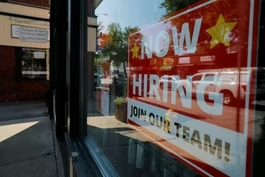
AMNA NAWAZ: Meanwhile, here at home, in a sign that the war may be weighing on economic growth, the U.S.
economy saw a slowdown in the second quarter, expanding at a lower-than-expected rate of 1.5 percent.
That's according to a new report today from the Commerce Department.
It all comes after the Federal Reserve voted yesterday to keep interest rates unchanged, despite three dissents, all arguing in favor of a rate increase.
To help make sense of it all, we're joined now by Greg Ip.
He is chief economics commentator at The Wall Street Journal.
So, Greg, I'm going to ask you to just pick up on what we heard from Ian Ralby there when it comes to the impact of the war in Iran on the U.S.
economy.
If we're moving from a two-choke point crisis to a three-choke point crisis, more disruptions to oil supplies and global trade, broadly speaking, what's ahead for the U.S.
economy?
GREG IP, The Wall Street Journal: Well, what is surprising is that, despite all the turmoil that the war has created for the U.S.
and global economy, including very high gasoline prices and interest rates, is that the American consumer seems to be shrugging it off.
Now, we did hear that growth in the second quarter came in low at 1.5 percent.
But that actually -- if you look under the hood, things were a lot stronger, very, very strong growth in consumer spending, especially on durable goods.
The reason growth came in low was that a lot of that spending was on imports and/or came out of inventories.
So it didn't lead to higher domestic production.
So that tells us, at least thus far, the impact of higher energy prices has been pretty mild for the consumer.
Now, that might be for a couple of reasons.
One is that there were a lot of tax refunds in the second quarter.
That probably helped.
The other is that we have this A.I.
boom that's still going on, and that has lifted the stock market.
So people who are wealthy and have a lot of stock market wealth are still spending a lot.
Looking ahead, I do think that the pressure of those higher interest rates, the end of tax refunds, and possibly some flattening of the stock market means that the consumer could struggle a bit more.
AMNA NAWAZ: In terms of how people can look at this, because there is some confusion, let's just revisit some of those highlights from the GDP report today.
We did say there that the U.S.
GDP grew at 1.5 annually in the second quarter, lower than expected, down from 2.1 percent annual growth in the first quarter.
At the same time, consumer spending, as you mentioned, ticked up.
That's now 3.2 percent annually.
That's up from just 0.5 percent in the first quarter.
There seem to be a lot of mixed signals here.
So what do you take away from all of that?
GREG IP: So these numbers can be very confusing, partly because of the fact that, in any given quarter, you can have people spending money, and they might be spending it on stuff that we make here at home, or they may be spending it on stuff that we import or stuff that was already in inventory.
And it looks like, in the second quarter, a lot of that spending was on stuff that we imported or was already in inventory.
That's why the GDP number seemed low.
The production number seemed low, but spending was very strong.
I would expect that some of that spending would start to flow through to domestic production in coming months.
So the underlying picture here is still of a resilient economy and a pretty healthy consumer.
But, again, we have to look at the fact that going forward with energy prices and interest rates still pretty high, that may not last.
AMNA NAWAZ: Well, tell me more about that, because when every time we talk about resilience, we hear from folks who say everyday Americans are experiencing this economy in a different way.
You look at some of the big picture numbers here, and 30-year mortgages have climbed back up to their highest rate in a year.
Gas is now above $4 a gallon at the national average again.
Grocery costs are up 33 percent since 2019.
What does all that mean for the average American and how they're experiencing this economy?
GREG IP: Well, the average American is certainly still not able to get over the fact that prices, as we're saying, are up 25 to 30 percent from four or five years ago.
They keep hoping that prices will go down.
It doesn't happen because typically prices don't go down.
That's called deflation.
It's very rare.
So you have that sort of like level of unhappiness with the inflation that's been there honestly for quite a few years now, perhaps disappointment that President Trump, who campaigned on a promise to bring prices down, has not succeeded and has in fact presided over a big increase in some key prices, such as for beef and gasoline, some of it his doing, some of it not his doing.
And then there's the fact that you the averages conceal what's going on beneath the surface.
As I was saying, the fact that the stock market has done so well means that people who are very affluent have been able to spend a lot, even though overall incomes aren't growing up a lot.
But that's not true of most of the typical family who doesn't have that biggest stock portfolio.
So those healthy averages are hiding what I think are probably significant disparities between people at the top and people at the bottom.
And the message we're hearing is that the median consumer is not doing nearly as well as some of those average figures, which are being basically buoyed by stock market wealth, are telling us.
AMNA NAWAZ: You mentioned inflation.
That brings me to the Federal Reserve and, as we reported earlier, the decision to hold rates steady that was announced yesterday under their new chair, Kevin Warsh, who also we should remind folks came into this role promising a new regime at the Fed, a new way of communicating as well.
Here's part of what he had to say yesterday.
Take a listen.
KEVIN WARSH, Federal Reserve Chairman: Market participants are learning to play the ball, not the referee.
And market prices will continue to respond in the direction and magnitude they see fit.
This is, in my view, a change for the better.
I understand the desire for rolling forecasts and commentary from this committee.
But, for our part, we need to observe market reaction to developments, direct and unfiltered.
AMNA NAWAZ: Greg, help us understand what Warsh is saying here and what all this might mean for the next Fed meeting and their decision ahead.
GREG IP: What Warsh is basically saying is that he believes that, in the past, Fed officials have commented too much on the data and what it might mean for the change in interest rates in coming months.
He believes that interferes with getting a pure, unfiltered view of what the markets think about the data.
So when he says play the ball, not the referee, he's saying have the markets respond just to the data, not try and predict what he, the Fed chairman, is going to do.
But there's a problem with that analogy, which is that he may think that the Fed is a neutral umpire here, but it's not.
It's a player in the game.
It's the most important player.
The Fed sets the short-term interest rate.
That is an absolutely central factor in market pricing and in the economy.
Bond investors are always trying to figure out not just what the data means, but what does it mean for what the Fed is going to do to short-term interest rates?
That's why they hope and expect the Fed will give them its own view on what some of this data means.
If Warsh is going to stay out of that business and never explain to the market what any of this data means, it's going to be confusing.
So, for example, this week, he said once again, the Fed is absolutely dedicated to getting inflation down, which is right now too high.
But he didn't raise interest rates.
And so the markets and investors and the public want to know, well, why?
If you're serious about that, why didn't you raise interest rates?
And he didn't answer that question.
And so they're jumping to conclusions.
They're saying he talks a big talk, but he's really not that serious about that.
And you can see in the markets questions beginning to arise about the credibility of this Fed chair to really get inflation down.
AMNA NAWAZ: Greg Ip of The Wall Street Journal, great to speak with you, as always.
Thank you.
GREG IP: Thanks for having me.
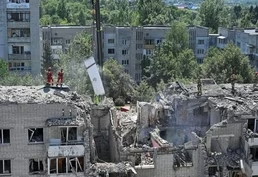
AMNA NAWAZ: We start the day's other headlines in Ukraine, where an overnight barrage of Russian drones and missiles killed at least 10 people, including children.
Fire and smoke rose over the capital over city of Kyiv.
Ukrainian officials said more than 300 ballistic missiles and attack drones struck targets as far west as the city of Lviv.
Rescuers there were seen pulling children from the rubble of an apartment complex.
Russia says Ukraine responded by striking a pair of retail warehouses inside its borders.
Ukraine has accused that retailer of supplying the Russian military.
In the meantime, in Poland... (SIRENS BLARING) AMNA NAWAZ: ... air raid sirens sounded after a Russian missile strayed from Ukraine and entered Polish airspace.
A giant crater was left in its countryside.
NATO scrambled fighter jets and later called it - - quote -- another reckless act by Russia."
In France, over 80,000 evacuees were allowed to return home today as firefighters made progress against a massive blaze that's burned an area four times the size of Paris.
But other parts of Europe are still struggling.
In Greece, at least three firefighters have died battling wildfires there.
Gale-force winds have fanned the flames and made containment difficult.
Further west, in Spain, firefighters fought new blazes in several provinces, even as they made progress against infernos near Madrid.
Many Europeans have expressed fear about how close the fires have come.
MARIA CONDE, Zamora, Spain Resident (through translator): We're scared for the restaurant, for the village, the campsite, scared for everything here and all the people who have had to be evacuated from the villages.
It's just a feeling of helplessness.
AMNA NAWAZ: In the meantime, a fast-moving fire in Southern England has prompted dozens of evacuations.
Drought and heat have created tinder-dry conditions across Europe, the world's fastest-warming continent.
The death toll in Japan has climbed to at least 25 from this week's powerful earthquake, and hope is waning that rescuers might find survivors.
Part of that concern stems from a grueling summer heat.
Many homes were still without running water or electricity in and around the hard-hit area of Kumamoto.
Officials there warn it could take days, if not months, to repair badly damaged pipes and other infrastructure.
The Japanese military helped deliver drinkable water and food aid to displaced residents.
The Georgia father whose teenage son killed four people in a 2024 school shooting was sentenced to 15 years in prison.
Colin Gray gave his son the gun used in the shooting at Apalachee High School.
Colin Gray was convicted in March of both second-degree murder and involuntary manslaughter.
His son was sentenced two days ago to life in prison without the possibility of parole.
After today's sentencing, the county district attorney said he hopes parents will remember their responsibility not to ignore mental health risks with their children.
BRAD SMITH, Barrow County, Georgia, District Attorney: These kids are not in the position where they are able to make rational decisions when it comes to things like firearms.
And we need the society step up and realize who should and who should not have access to them.
AMNA NAWAZ: Colin Gray joins a growing number of parents who've been prosecuted for the actions of their children.
Two of soccer's regional governing bodies for both Europe and North America say they reject a FIFA proposal to sell stakes to private investors.
UEFA of Europe goes further, saying it will boycott FIFA competitions, including the World Cup, if the plan goes ahead.
In a statement, UEFA wrote -- quote -- "The World Cup cannot be treated as an investment product.
No part of it should ever be surrendered to private investors.
The World Cup is not for sale."
It marks a growing repudiation of FIFA's plan revealed earlier this week to spin off commercial operations to investors, including the family of Trump's son-in-law Jared Kushner, among others.
The State Department says it takes full responsibility for hastily altering and then presenting a map of Africa at a global AIDS conference that mislabeled every single country it highlighted.
Attendees shared photos of the incorrect map online.
Coastal countries like Nigeria, Mozambique, and Cote d'Ivoire were all landlocked and in the wrong locations.
Other countries' borders were misrepresented.
An analysis by Reuters found a watermark in the map image that suggests it was made with OpenAI.
And worries about U.S.
GDP and inflation did not translate on Wall Street today.
The Dow Jones industrial average surged more than 600 points, or 1.2 percent.
The Nasdaq jumped nearly 3 percent, snapping a six-day losing streak.
The S&P 500 more than recovered from yesterday's sell-off.
Still to come on the "News Hour": the vote on Todd Blanche's nomination to be attorney general is postponed; a Missouri couple is murdered in Guatemala after the husband was deported; and a leading democracy scholar proposes a new plan to end gerrymandering.
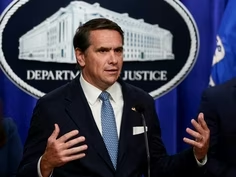
GEOFF BENNETT: Acting Attorney General Todd Blanche's nomination to lead the Justice Department full-time is in limbo after a handful of Republican senators have blocked it from moving forward.
Two Republican senators, John Cornyn of Texas and Thom Tillis of North Carolina, say they will oppose Blanche's nomination unless the DOJ kills a $1.8 billion fund to provide payments to Trump allies who believe they have been wrongfully prosecuted.
The president said in a social media post that he would keep Todd Blanche as acting attorney general, saying -- quote -- "I have no objection to temporarily withdrawing Todd's name if they do not do the right thing, and putting him back after Cornyn and Tillis are out of office.
But Senator Tillis pushed back against the president's plan.
SEN.
THOM TILLIS (R-NC): His statement lends credence to what the Democrats are saying about him resurrecting this thing at the appropriate time.
And so either people are lying to me, saying that this was moot and that we could move on, or the president's getting bad advice from somebody, saying, no, you don't want to do this, boss.
GEOFF BENNETT: New reporting from The New York Times shows that, even though the fund is on hold, the DOJ is still issuing similar settlements.
For more, we're joined now by Devlin Barrett, who covers the Justice Department for "The Times."
It's good to see you.
DEVLIN BARRETT, The New York Times: Good to see you, Geoff.
GEOFF BENNETT: So based on your reporting, why is pulling the Blanche nomination more acceptable to President Trump than making concessions on this fund?
DEVLIN BARRETT: Well, for one thing, it even if you pull the Blanche nomination now, Trump doesn't really lose much control of the Justice Department, because Blanche is already the acting attorney general and can keep him there for quite a long time if he wants to.
So you're not actually losing him being in charge of the department.
That would continue.
And what Trump seems unwilling to let go of is the possibility of reviving the weaponization fund, as he calls it, and also this condition that sort of gets not just him, but his relatives, his companies, and a very undefined group of people called affiliates off the hook for any audits from by the IRS.
GEOFF BENNETT: And you have reported that even if the administration kills this fund, the DOJ can apparently keep making these payouts one settlement at a time through the ordinary claims process.
Is that right?
DEVLIN BARRETT: Right.
The Justice Department has always had this authority and they continue to use it.
We saw an announcement just Tuesday of a more than a million dollar payout to someone that they -- that the administration claims is a victim of the Biden administration era weaponization.
So they're still paying out money, even as all this fight is going on.
GEOFF BENNETT: So is the argument from Tillis and Cornyn, is it symbolic?
DEVLIN BARRETT: I don't think it's symbolic at all.
I think in fact they have gotten a lot of lip service from the administration, and they're asking that lip service be translated on to paper.
And what's so fascinating to me about this standoff is it seems the White House is very, very reluctant to actually put it in writing.
GEOFF BENNETT: And so when Todd Blanche says he promised the senators that this fund won't return, but he also said that the reasons for creating it, this is his words he used, remain as important as they were before, how should that be received?
Is this a signal that the fund could come back if he's confirmed?
DEVLIN BARRETT: I mean, one of the ways in which I think the administration is not endearing itself or generating much credibility is for exactly statements like that.
They keep talking as if they are almost hint-hint, wink-winking that they are in fact going to try to bring this back at some point, or are going to just find another way to skin the cat.
And that is what frustrates the senators.
That is what I think undermines the administration's credibility in these negotiations where they just -- where the senators are clearly determined to get something in writing.
GEOFF BENNETT: There's another dimension here I want to ask you about, because your reporting cites four different federal judges in Florida and Virginia and Tennessee and Minnesota.
They all criticize Blanche by name in written opinions across completely unrelated cases.
In your long experience covering the DOJ, how rare is that?
DEVLIN BARRETT: It's incredibly rare, for two reasons.
One, historically speaking, the number two official of the Justice Department does not aggressively insert themselves into specific cases.
They are key decision-makers, but they often try to stay out of the legal fray.
Blanche is the exact opposite.
Blanche injects himself into very controversial cases and injects his name and his own actions and credibility into those cases, often with bad effect, because you see these judges saying that they distrust the deputy attorney general.
That has been a feature of the entire time he's been running the Justice Department.
GEOFF BENNETT: About this fund, is there any mechanism, whether it's congressional appropriations power, judicial review, the DOJ's own internal rules, that could actually stop taxpayer-funded payouts to people the president believes were somehow wrong?
DEVLIN BARRETT: Absolutely.
Congress could certainly do -- Congress could certainly pass legislation that would limit this.
And judges could certainly try to impose their own limits on it.
I think what's striking about the senators wanting something in writing is that, even if Todd Blanche were to put this in writing, even if the White House were to sign off on putting something in writing, it's just an administration document.
They could issue another written version later.
Even the settlement that created the fund, they have added new documents after the fact.
So even putting it in writing, which is what the senators are asking for, doesn't guarantee that they won't change -- that the administration won't just change the rules again.
Congress passing a law would be different.
Congress passing a law would have more teeth.
GEOFF BENNETT: All right, Devlin Barrett, always good to speak with you.
DEVLIN BARRETT: Great to see you.
AMNA NAWAZ: The violent deaths of a Missouri couple who had illegally immigrated to the United States are shining another spotlight on the Trump administration's deportation policy.
They were killed after the husband was deported and the wife self-deported back to Guatemala.
Lisa Desjardins is here now to tell us more -- Lisa.
LISA DESJARDINS: Nixon Giovanni, Perez Paz, and Glendy Marisol Gonzalez de la Cruz were found bound, gagged, and shot in a sugarcane field in Guatemala.
Their 14-month-old daughter was alive and crying next to her mother's body.
The couple, whose funeral was last week, leaves behind two other young daughters as well.
Gonzalez de la Cruz left the United States with her daughters just weeks ago, self-deporting after her husband was detained by ICE and deported last year following a traffic stop.
Now two communities in two countries are reeling and searching for answers.
For more, I'm joined by Brian Munoz.
He is with St.
Louis Public Radio, and he broke the story.
Brian, first of all, help us understand what we know about the murders of this couple and in particular the status of their children.
BRIAN MUNOZ, St.
Louis Public Radio: Absolutely.
So this is just the latest harrowing story out of Missouri about people perishing after interactions with U.S.
Immigration and Customs Enforcement.
In this specific case, Glendy and Nixon had came to the St.
Louis area and were separated after Nixon and his brother Rolando were stopped by ICE officials on the way to work one day last April.
They say that -- the brother tells me, that is, that they were on the way to their roofing jobs when an unmarked vehicle started chasing them down and pulled them over.
After they stopped, agents swarmed the vehicle and they were taking in and subsequently deported.
LISA DESJARDINS: And that happened last year, right?
BRIAN MUNOZ: Yes.
That happened last April, according to an ICE spokesperson.
And so Glendy decided, hey, I'm going to stick it out.
She stayed and decided to work two jobs, trying to put food on the table, but the rising cost and the fear of being detained and separated from her children made her do the unthinkable and decide, hey, I'm going to go back.
She had an act of asylum claim here, according to federal records, and her friends tell me that, like I mentioned, she was afraid.
She was afraid for her safety and for the safety of her children.
So, after having said, hey, this is too much, she decided to go, and she took her three kids with her.
And not even a month later, I think a week or two, she was found shot and killed.
So her three daughters, young, in grade school, the youngest is only 14 months old or so, are now in the custody of their aunt and uncle, Nixon's brother.
LISA DESJARDINS: Do we know anything about the motive here?
BRIAN MUNOZ: That's an excellent question.
And there's so many things that are unknown.
From what I have gotten from family and friends this week is, the motives are known.
Really, these folks were on their way to register a motorcycle that Nixon had with their youngest daughter when they were ambushed by assailants.
They don't know who, they don't know the motives, but their families and friends have been left grieving.
LISA DESJARDINS: Now, ICE sent you a statement reading in part: "ICE remains committed to removing criminal aliens from our community by enforcing immigration laws and maintaining the integrity of our borders."
Did either of these two have a criminal record?
BRIAN MUNOZ: Yes, so, Nixon, the only thing I could find, and as it was also pointed out in the ICE statement, was, he was cited and charged with driving without a license in 2024 in suburban St.
Louis.
There was about a $200 fine that was paid.
And ICE said that there were two drunk driving charges in Overland, Missouri.
I scoured the court system that's publicly facing that would have those records in it, and I wasn't able to find them.
They also pointed to a 2010 citation in Palm Beach, Florida, where Nixon was charged with an ordinance violation for having an open container, but it appears the prosecutors ended up not pursuing that case.
LISA DESJARDINS: And we know that traffic stop you mentioned, the fine, that is usually a misdemeanor.
Glendy, I want to talk about her as well.
She had filed for asylum, as you said.
She was awaiting a hearing next year, when she self-deported.
What does this case and her fate tell you about the system overall?
BRIAN MUNOZ: Yes.
I think this case is indicative of a system that advocates say is broken.
So, right now, right before this interview, I looked at the track -- online immigration case tracker, and it says that there are roughly 45,000 to 50,000 backlogged cases in the Kansas City Immigration Court, which oversees the entire state of Missouri and Kansas.
Of those, about 11,500 or so are backlogs in asylum cases.
So attorneys for immigrants across the state are telling me, we're waiting years and years and years to be able to even get a hearing.
And right now, the rules are changing so much that it's difficult to best serve our clients and to give them a fair shake, because we don't know what's going to happen from one day to the next.
LISA DESJARDINS: You mentioned new rules.
There is a new rule on asylum from the Trump administration this week, which means that essentially most applying for asylum will go straight to an immigration judge and won't get an interview.
What do you think that means for the system?
BRIAN MUNOZ: Absolutely.
So it is a challenge for folks that are trying to represent these immigrants in immigration court.
On one hand, of course, the backlog is most likely going to be reduced, but advocates and attorneys tell me that it's going to be incredibly challenging to make a case to these judges that are only taking a minute or two to go through them because there's so many on the backlog.
So, yes, this thing is going to move a little more expeditiously, but advocates and attorneys warn that they feel like they may be a little hamstrung on best representing their clients.
LISA DESJARDINS: Brian Munoz, thank you for your reporting, and we will keep following what you're saying.
BRIAN MUNOZ: Thank you for having me.
GEOFF BENNETT: Violence surged in the West Bank this past weekend when Palestinians say Israeli settlers burned two mosques following deadly clashes between Israeli soldiers and Palestinians.
This week, a group of former Israeli military commanders accused Israeli settlers of increasing their attacks and footprint in the West Bank on land that Palestinians hope will be their future state.
Israel says it's Palestinians who are committing the violence.
The "PBS News Hour" recently visited multiple West Bank villages, where producer Karl Bostic and Nick Schifrin report on the increasing violence and threats.
NICK SCHIFRIN: In the West Bank, a place of prayer now desecrated, its holy words reduced to rubble.
On the burnt facade, a menacing message: "The land of Israel is redeemed with blood, revenge."
On Sunday, Israeli settlers stormed the Palestinian villages of Qusra and Kour, setting the local mosques ablaze, the latest in an escalating series of violent, often deadly attacks.
Last Friday, Israeli settlers entered the nearby village of Tell, confronted by Palestinian residents.
The clash became fatal.
Israel says a local Palestinian took the gun of an Israeli security guard and shot and killed him and an Israeli soldier.
Palestinians say Israeli soldiers then opened fire, killing four, the ensuing grief echoed by an entire community in the West Bank, and, in Israel, a military funeral.
Israeli Prime Minister Benjamin Netanyahu vowed a crackdown.
And since Friday, Israeli forces have raided at least 20 Palestinian towns and villages, demolished at least three homes that they called illegally built and arrested over 130 Palestinians in what it called extensive counterterrorism operations.
Palestinians say the threat comes from the military and settlers simultaneously.
Last weekend, settlers set fire to Palestinian villages, residents rushing in fear from their flaming homes.
Settler attacks are increasingly common in the West Bank.
The U.N.
says, so far this year, settlers have launched at least 580 attacks.
They are often hostile to locals and journalists.
Our team recently visited the village of Ainub (ph), where Palestinians had been forcibly displaced.
On the day we visited, Palestinians brought the body of 69-year-old Bahia Al-Tabal (ph) for burial.
But the settlers wouldn't open the gate.
So they carried her body underneath, humiliation even in death.
MAN: Why are you here?
NICK SCHIFRIN: And they might be wearing uniforms, but they're not soldiers.
Settlers with army rifles tell another journalist they're not welcome.
MAN: Everyone with the camera, tell them to come here right now.
NICK SCHIFRIN: And in the village of Al Hadidiyah, they loom just a few hundred feet away as we conduct an interview.
Mohammed Bani Odeh family has lived here for decades.
Settlers forced his neighbors to flee.
They're one of the few families that stayed.
MOHAMMED BANI ODEH, West Bank Resident (through translator): They came and attacked them with guns and bullets, more than 20 settlers.
They attacked their homes.
They remained in fear and were forced to leave this area.
NICK SCHIFRIN: While we spoke, settlers drove by.
It was a kind of show of force to make sure they knew they too had cameras.
Odeh says those same settlers who live in the illegal outpost in the background assaulted his family.
MOHAMMED BANI ODEH (through translator): They attacked using firearms.
They pointed their weapons towards us and opened fire.
But God saved us, thankfully.
They didn't just want to terrorize us, but to kill too.
NICK SCHIFRIN: Right-wing members of Israel's government vow to expand the settlements.
BEZALEL SMOTRICH, Israeli Finance Minister (through translator): We are making sure that the decisions we have made regarding the establishment of the new settlements will not remain on paper, but will become reality on the ground.
NICK SCHIFRIN: That means there's nowhere for Odeh to go.
MOHAMMED BANI ODEH (through translator): Here is my home, my life, my sheep.
I can't leave it and go somewhere else.
Where would I go?
All of the West Bank is surrounded, whether cities, villages, or towns.
There isn't a place without settlers surrounding us everywhere.
BENJAMIN NETANYAHU, Israeli Prime Minister: It's actually 150 or so what you would call juvenile delinquents.
NICK SCHIFRIN: On CNN earlier this month, Israeli Prime Minister Benjamin Netanyahu said it was Palestinians attacking Israelis in the occupied West Bank, but he also vowed to reduce settlers' crime.
BENJAMIN NETANYAHU: I think it's wrong on its own account.
I don't want and don't accept vigilantism, and I don't care if it comes from Arabs or Jews.
Our citizens cannot practice violence against anyone.
NICK SCHIFRIN: But even the youngest of Palestinians are not spared from that violence.
Palestinian schoolchildren in the village of Umm Al Khair walk what was once their path to school.
But it's now blocked by barbed wire marked with Israeli flags.
Palestinians say this video shows settlers in army uniforms firing a tear gas canister to stop villagers from reaching the school.
And so before the school term ended, the hill became their classroom for an English lesson.
STUDENT: I have been there for a week.
NICK SCHIFRIN: Their audience, settlers with military rifles.
The children demand, open the road.
They demand a better future.
Masa Al-Hathaleen Is six.
MASA AL-HATHALEEN, Umm Al Khair, West Bank, Resident (through translator): They want to take our land in all Palestine to prevent us from going to kindergarten or school, so our teacher won't say that we are brilliant.
NICK SCHIFRIN: Asked what she thinks of the settlers, she tells us she'd rather not say, for fear of getting shot.
She dreams of helping others.
MASA AL-HATHALEEN (through translator): I want to be a doctor to treat people, so if anyone gets injured, I will treat them.
NICK SCHIFRIN: But hers is a dream deferred and a path that is blocked.
With Karl Bostic in Umm Al Khair, for the "PBS News Hour," I'm Nick Schifrin.
AMNA NAWAZ: We turn now to our series "On Democracy," where we hear a range of perspectives on how government should function, what's led to this moment in American history, and where the country goes next.
With fewer than 100 days to go until the midterm elections, high-profile battles over redistricting have become a fixture in political headlines.
A number of Republican-led states under pressure from President Trump have redrawn their congressional maps to gain an election edge.
Some Democratic-led states have followed suit.
Those battles have already this year led to the elimination of majority-Black districts in Louisiana, Alabama, and Tennessee.
One group of scholars is sounding the alarm on the consequences of gerrymandering; 500 of the nation's top democracy, voting rights, and legal experts have signed an open letter to Congress urging lawmakers to consider one solution, proportional representation.
These scholars argue that single-member districts are -- quote -- "failing to deliver fair and representative outcomes" and are the result of outdated electoral rules that worsen gerrymandering.
A proportional system, they say, is a practical remedy.
Here with us to unpack this is one of the signatories.
That's Pamela Karlan, a law professor from Stanford University.
Pam, welcome to the show.
Thanks for joining us.
PAMELA KARLAN, Stanford University: Thanks for having me.
AMNA NAWAZ: So let's just start with why you decided to sign on to this letter and why now.
PAMELA KARLAN: Well, our system of electing people to Congress is broken.
Over the last several years, what we have seen is the Supreme Court has given a total green light to gerrymandering, partisan gerrymandering, and it's gutted the Voting Rights Act.
And the upshot of this is that instead of voters being able to elect the candidates of their choice, politicians are picking the voters of their choice.
And that's not healthy for a democracy.
AMNA NAWAZ: There was a similar letter that went out four years ago that had some 200 backers for it.
The fact that you're now up to 500 people arguing for this system, does that tell us something about consensus around this or this particular moment?
PAMELA KARLAN: Well, I think it does.
I mean, one of the things that we have seen over the last year-and-a-half is that states used to just redraw their congressional districts after the census came out, and now they're redrawing them again and again in an effort to squeeze out the last bit of partisan advantage.
And, as I said, nobody can look at that and think that that's a good system.
AMNA NAWAZ: So you argue in the letter that gerrymandering's gone too far, and that, in your words, the way to end redistricting wars is to make redistricting matter far less.
So just explain for us how proportional representation would do that.
PAMELA KARLAN: Well, instead of electing members of Congress from single-member districts, so we have 435 districts now, instead, what states that elect multiple members would do is, they would create districts that elect more than one member, and in which who gets elected depends on the proportion of votes that each party gets.
So, for example, in a state like Louisiana, which has six congressional seats, you might have two districts, each of which elect three people.
And what that would do is, it would enable numerical minorities to elect some candidates of their choice.
So it wouldn't be as winner-take-all as the system now is.
AMNA NAWAZ: Pam, even as the system could seek to solve one problem, could it create new ones?
I mean, one of the chief frustrations we hear from voters is gridlock within the systems.
Could a proportional system mean more parties or third independent parties are now empowered, they have to work towards coalitions?
Does it potentially create more gridlock?
PAMELA KARLAN: I don't think it's likely in the American system, because we're not a parliamentary system.
We are a presidential system.
And even if we were electing people from multiple districts, most of those districts would have three or four representatives, and that would mean that people would still have an incentive to vote for one of the major parties, as long as they're actually satisfied with what the major parties are doing.
AMNA NAWAZ: Just for some context here, we know the U.S.
is somewhat unique, in that the majority of nations around the world that have elected representation use proportional representation or mixed systems in some way to elect their legislators, or a little over 60 percent of those countries.
Why hasn't proportional representation been seriously considered in the U.S.
before?
PAMELA KARLAN: Well, one thing is that our system for electing members of Congress has been fixed since 1842.
And there's actually a really interesting speech that one of the senators gave in 1867, and he said, if we had known about proportional representation at the time, we might have gone for proportional representation, rather than districting.
Once you have a system in place, especially in a country like the United States, it's very sticky, because the members of Congress, they know they can get elected from single-member districts, and they don't know necessarily what would happen if we had a proportional system.
And so it's hard unless there actually turns out to be a political movement behind it to change the way elections are conducted.
AMNA NAWAZ: Well, that leads to my next question, which -- how realistic is it to implement this kind of system right now, especially given that the people who are navigating the system and benefiting from it would be loath to try to change that system at the same time?
How do you see that?
PAMELA KARLAN: In the short run, it's not going to change.
I mean, you really have to build a political movement behind this.
And part of what I hope we're going to start doing is having a real discussion about why our current system of electing members of Congress just doesn't work anymore.
And it's creating a system in which, although Congress is divided between the Democratic and Republican Parties, individual states don't have representation that's fair to people on both sides of the aisle in those states.
AMNA NAWAZ: If the system doesn't change, if there's no serious election reform, what do you see happening in the years ahead?
PAMELA KARLAN: Well, what I see happening is people becoming increasingly disillusioned with the system, people believing less and less that our democracy works, and that's not a healthy world in which to live.
AMNA NAWAZ: Pamela Karlan, law professor from Stanford University, thank you so much for your time.
Really appreciate it.
PAMELA KARLAN: Thanks for having me.
GEOFF BENNETT: Music has helped tell America's story from the very beginning, reflecting the nation's triumphs, its struggles, and the many cultures and traditions that have shaped it.
AMNA NAWAZ: On Judy Woodruff's latest "In Pursuit of Happiness" podcast, she sits down with music historian and author Ted Gioia and music journalist Sidney Madden to explore how American music became a powerful expression of who we are and why its diversity may be one of its greatest strengths.
JUDY WOODRUFF: Sidney, why do you think the Black experience has been such a powerful force throughout our music?
SIDNEY MADDEN, Music Journalist; I think it has a lot to do with the building blocks of America, which is collision, contradiction, and low-key violence.
Black people were not coming here from their own volition traditionally.
The American slave trade is a violent past that some people still try to deny happened.
But through that, and through that survival and resilience, there has been just this influx and overindexing of storytelling.
JUDY WOODRUFF: And listening to that, Ted, so much of that does come from these hard, hard circumstances.
And yet over time there's been a lot of celebratory music created, Elvis Presley, Frank Sinatra.
I mean, you go down the list of American artists and different so many different genres of American -- types of American music.
Is there is there one thread that runs through American music, or are there so many threads that it's just impossible to narrow it, Ted?
TED GIOIA, Music Historian: Well, as you know, I have a music newsletter called "The Honest Broker," and I have a large number of subscribers.
Many of them are professional musicians themselves or other music critics, so it's a very knowledgeable audience of music lovers.
So I asked them last week, I asked them to tell me what was the quintessential American song or songs.
So I wanted to tap into their wisdom.
And I got back hundreds of responses immediately, I mean, just the overwhelming number of people commenting on this.
So the first thing I realized is that people feel strongly about this.
When you ask them what is an American song, everybody has an opinion.
And the sheer diversity of answers was amazing.
The most popular response was "The Star-Spangled Banner" as played by Jimi Hendrix.
SIDNEY MADDEN: That's a good one.
TED GIOIA: Number two was "American Tune" by Paul Simon.
And the third most popular response is "The Revolution Will Not Be Televised" by Gil Scott-Heron.
That shows you the diversity, I mean, that we're covering a lot of -- a wide range already.
And people went on and they had all sorts of examples from every genre.
There were people that told me, well, you got to have country music because this -- it's about our country.
So you want American songs, it's got to be country.
Or people will say hip-hop is the most real and rootsiest music of them all.
Others think that these rock stadium anthems are just the thing to celebrate their Fourth of July barbecue.
Some people wanted intensely patriotic songs and John Philip Sousa marches and "Yankee Doodle."
Other people wanted protest songs.
I mean, the sheer diversity of that was overwhelming.
So the only thing I can say is, when you ask people about American music, it's a free country, and everyone has got their opinion and they're very outspoken about it.
And that might be our strength when you get down to it, is that we have so many voices and so many passionate views.
And people really, really care about music in this country.
And that's a that's a nice thing.
GEOFF BENNETT: You can watch all episodes of "In Pursuit of Happiness" on our YouTube channel or wherever you get your podcasts.
AMNA NAWAZ: And, remember, there's always a lot more online, including a look at TSA Gold+.
That's the Trump administration's new effort to privatize airport security.
That is at PBS.org/NewsHour.
GEOFF BENNETT: And that is the "News Hour" for tonight.
I'm Geoff Bennett.
AMNA NAWAZ: And I'm Amna Nawaz.
On behalf of the entire "News Hour" team, thank you for joining us.
 New
NewBlanche vote on hold over anti-weaponization fund opposition
Video has Closed Captions
Blanche's AG nomination on hold over opposition to DOJ's 'anti-weaponization fund' (5m 55s)
 New
NewBreaking down the GDP report as U.S. economy slows
Video has Closed Captions
Breaking down the GDP report as U.S. economy slows in 2nd quarter (7m 32s)
 New
NewHow music has helped tell America's story
Video has Closed Captions
How music has helped tell America's story from the very beginning (4m 48s)
 New
NewHow shipping risks from Ukraine and Iran wars are converging
Video has Closed Captions
How shipping risks from Ukraine and Iran wars are converging (6m 26s)
 New
NewMissouri couple murdered in Guatemala after deportation
Video has Closed Captions
Missouri couple murdered in Guatemala after husband was deported (6m 22s)
 New
NewNews Wrap: Russian drone, missile attack kills 10 in Ukraine
Video has Closed Captions
News Wrap: Russian drone and missile attack kills 10 in Ukraine (5m 25s)
 New
NewScholars urge Congress to adopt proportional representation
Video has Closed Captions
Group urges Congress to adopt proportional representation to end redistricting battles (6m 21s)
 New
NewU.S. and Iran strikes intensify as war opens new fronts
Video has Closed Captions
U.S. and Iran strikes intensify as war opens new fronts (3m 3s)
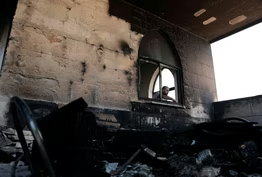 New
NewViolence surges in West Bank as settlers escalate attacks
Video has Closed Captions
Violence surges in West Bank as Israeli settlers escalate attacks on Palestinians (6m 43s)
Providing Support for PBS.org
Learn Moreabout PBS online sponsorship
- News and Public Affairs

Today's top journalists discuss Washington's current political events and public affairs.

- News and Public Affairs

FRONTLINE is investigative journalism that questions, explains and changes our world.



 New Episode


 New Episode
 New Episode
Support for PBS provided by:
Major corporate funding for the PBS News Hour is provided by BDO, BNSF, Consumer Cellular, American Cruise Lines, and Raymond James. Funding for the PBS NewsHour Weekend is provided by...