
June 15, 2026 - PBS News Hour full episode
6/15/2026 | 57m 46sVideo has Closed Captions
June 15, 2026 - PBS News Hour full episode
June 15, 2026 - PBS News Hour full episode
Problems playing video? | Closed Captioning Feedback
Problems playing video? | Closed Captioning Feedback
Major corporate funding for the PBS News Hour is provided by BDO, BNSF, Consumer Cellular, American Cruise Lines, and Raymond James. Funding for the PBS NewsHour Weekend is provided by...
June 15, 2026 - PBS News Hour full episode
6/15/2026 | 57m 46sVideo has Closed Captions
June 15, 2026 - PBS News Hour full episode
Problems playing video? | Closed Captioning Feedback
Where to Watch PBS News Hour
PBS News Hour is available to stream on pbs.org and the PBS app.
Providing Support for PBS.org
Learn Moreabout PBS online sponsorshipWILLIAM BRANGHAM: Good evening.
I'm William Brangham.
Amna Nawaz and Geoff Bennett are away.
On the "News Hour" tonight: President Trump arrives in Europe for the G7 summit after agreeing to an initial deal with Iran to extend the cease-fire and reopen the Strait of Hormuz.
As diplomatic efforts continue, we look at how Israelis view the latest deal and the road to curtailing the Iranian nuclear threat.
MAN: The whole thing was a betrayal for the Iranian people and Israeli people, because it's only American interests here.
WILLIAM BRANGHAM: Plus, summer is under way with record-breaking heat, but also a newly approved ingredient in sunscreen that people have been asking for, for years.
DR.
RACHEL NAZARIAN, Dermatologist: So, it's going to feel great on the skin.
It's less irritating, and it still does a fantastic job of preventing sun damage and skin cancers.
(BREAK) WILLIAM BRANGHAM: Welcome to the "News Hour."
The president and his top lieutenants spent today heralding an initial deal signed electronically to extend the cease-fire and reopen the Strait of Hormuz.
The war with Iran began with U.S.
and Israeli attacks nearly four months ago.
But details and key questions remain murky ahead of an official signing later this week.
The talk of a deal was center stage in France today, where President Trump joined other world leaders for the G7 summit.
White House correspondent Liz Landers begins our coverage.
LIZ LANDERS: Today, all eyes were on the quiet French alpine town of Evian for the annual G7 summit.
President Trump arrived to again herald the news of a weekend cease-fire deal, which he says will bring an end to the U.S.
war with Iran.
DONALD TRUMP, President of the United States: The deal's all signed, and the Strait is already partially open.
LIZ LANDERS: Alongside French President Emmanuel Macron today, Trump lauded it as a major step forward.
DONALD TRUMP: A lot of great things are going to happen in the Middle East right now, and, very importantly, the oil is plummeting down and the stock market is shooting up like a rocket.
And the main thing is that Iran will not have a nuclear weapon.
They fully agree to that with strong policing powers, and they won't have a nuclear weapon, which is what it was all about.
URSULA VON DER LEYEN, President, European Commission: Let me start also by welcoming the agreement reached between the United States and Iran.
LIZ LANDERS: World leaders attending the summit were cautiously optimistic about the agreement brokered by Pakistan and Qatar.
The text of the memorandum has not been released, though a senior U.S.
official said it would be within 24 to 48 hours.
Officials say it would bring shipping through the Strait of Hormuz back to pre-war levels, adding that the priority will be on heavy tankers with oil and gas.
Last night, President Trump proclaimed -- quote -- "Ships of the world, start your engines.
Let the oil flow."
But a U.S.
military advisory to merchant ships warned the blockade will remain in place -- quote -- "pending execution of the deal."
ESMAEIL BAGHAEI, Iranian Foreign Ministry Spokesman (through translator): Over the past 24 hours, we have witnessed major developments.
LIZ LANDERS: Today, a spokesperson for Iran's foreign ministry emphasized additional terms.
ESMAEIL BAGHAEI (through translator): The release of Iran's foreign or restricted assets alongside the issue of compensation for damages are two important economic matters.
The American side is committed to taking action in both cases.
LIZ LANDERS: Vice President J.D.
Vance reiterated ultimatum on CBS this morning.
Iran will only get their side of the deal, including a $300 billion reconstruction fund, if they cooperate.
J.D.
VANCE, Vice President of the United States: When people say that billions of dollars of assets will be released, that's not true.
What is true is that Iran will have a much better and much more prosperous future if they meet the obligations they make in this agreement.
We will of course, see.
That's one of the things we're going to work out in the technical talks that will follow the official signing on Friday.
LIZ LANDERS: A senior U.S.
official said that the amount of Iranian assets unfrozen by the United States or any other country remains at zero.
Another condition, peace in Lebanon.
Iran says the memorandum calls for -- quote -- "respect of Lebanon's sovereignty and territorial integrity."
But since the announcement, Israel launched another drone strike there, killing one person, and Israel's defense minister said the military will not withdraw from land already seized in Lebanon.
One senior U.S.
official says that the Israeli withdrawal from Lebanon is not a condition of the agreement between the U.S.
and Iran, adding that if Iran does not -- quote -- "control" the militant group Hezbollah and that group attacks Israel, they will -- quote -- "have the right to defend themselves and respond."
At a news conference this afternoon, Israel's Prime Minister Benjamin Netanyahu doubled down.
BENJAMIN NETANYAHU, Israeli Prime Minister (through translator): We will need to continue to be vigilant, to remain strong and determined, to defend ourselves as necessary.
This is true not only against Iran, but against Iran's terrorist arms, which we have struck in an unprecedented manner.
LIZ LANDERS: Still, news of the deal brought hope to more than the one million people in Southern Lebanon, whose lives have been uprooted by the fighting.
Today, for the first time in months, some families returned to where their homes once stood, devastated, but at the same time anxious to rebuild.
ALI HAYDAR, Nabatiyeh, Lebanon, Resident (through translator): This used to be our home, our childhood home, where we grew up, and now it's gone.
At the end of the day, this is our country, and we must return, even if it's destroyed.
We will return to rubble and sand.
It's better than being displaced.
LIZ LANDERS: As the terms of the formal deal are hammered out in weeks to come, the U.S.
military presence in the region will stay at current levels, according to one official, who says the administration hopes to draw those 50,000 military personnel down soon, but it's not happening yet.
The vice president, Jared Kushner, and Steve Witkoff are all expected at the signing ceremony on Wednesday on Friday, in addition to Iranian officials, according to a senior U.S.
official.
Just to underscore the uncertainty here with this memorandum of understanding, the president told reporters today in France that the text would be released by Friday, while senior U.S.
officials who briefed reporters earlier today told us it would be between 24 and 48 hours that we would see that.
WILLIAM BRANGHAM: Liz, as you mentioned, President Trump landed in France for the G7 summit, but not before last night he attended this unprecedented Ultimate Fighting Competition cage match.
WILLIAM BRANGHAM: You have done a lot of reporting on this.
Tell us about that.
LIZ LANDERS: It was a spectacle at the White House last night.
It marked President Trump's 80th birthday.
This is the second year in a row that he has had a big celebration.
Last year, it was that military parade near the White House.
And there were a number of notable attendees who were there last night, including David Ellison, the CEO of Paramount, who had the exclusive streaming rights to the fight last night, Mark Zuckerberg, the CEO of Meta, Pope Leo's brother.
I was asked by ambassadors in the last few weeks if I knew how to get tickets.
That's how hot this was to try to get there here in D.C.
There were also military personnel who were in attendance there last night.
And there were military assets, like the Blue Angel fighter jets that flew over the White House twice last night.
As someone who covers the White House, I was amazed to see how they staged some of these very formal rooms and the whole campus really into this UFC fight night.
The Diplomatic Room, where you usually see heads of state come and go, that was the staging area where fighters were waiting before they walked out onto the South Lawn.
The Eisenhower executive office building was a sort of warm-up area and locker room for some of these fighters as well.
And the fights themselves went into the wee hours of the night.
One of the fighters though, sort of drummed up controversy with some inappropriate and offensive comments about the former first lady Michelle Obama, saying that -- quote -- "She was a man."
He presented President Trump with a chain -- this was Josh Hokit -- and then said these comments shortly after.
Dana White, the head of UFC, was asked about this by "TIME" magazine.
And he said in a text message: "I understand that the Obamas are public figures, but I'm completely against saying nasty and false things about people's families.
Everyone knows my position on free speech, but I hate that kind of nonsense."
White also said that he is not expected to stage anything like this again at the White House because he can't afford to do it.
WILLIAM BRANGHAM: Incredible event last night.
I also want to ask you about this other controversy.
And that is the legal fight over the removal of President Trump's name from the Kennedy Center.
Tell us about that.
LIZ LANDERS: This has been a controversy since the Trump-appointed board added his name in December to the facade and to all the branding around the Kennedy Center.
There's been a legal fight that has been playing out since.
And a judge decided at the end of May that the board acted beyond their authority and said that they had to remove his name.
I got this memo a few days after that judge's decision.
And it came from the general counsel of the Kennedy Center.
And it was sent to all the staff there.
And it directed them to take the president's name off of all the signage there, off of their Web site.
And it said that everything, including the brochures and the signage in front, had to be removed by June 12.
That was on Friday.
The board of the Kennedy Center filed this late motion.
It was rejected by the judge.
So, Friday night, there was this spectacle around the Kennedy Center.
People were watching.
And there were tarps in scaffolding that went up.
And the president's name was removed from the Kennedy Center on the late hours of Friday into the early hours of Saturday there.
But it was not visible to the public when it came down.
So I asked the Kennedy Center about this tarp still being up there.
And the Kennedy Center spokesperson told me that the scaffolding and tarp will remain up as crews address maintenance needs of the marble and the soffit panel, William.
WILLIAM BRANGHAM: Liz Landers, thank you so much.
LIZ LANDERS: Of course.
WILLIAM BRANGHAM: The memorandum signed by the U.S.
and Iran has little to do with the third combatant in this war, Israel.
Top officials there expressed dismay and even derision for the deal and, as we reported, a key part of what is not in this initial agreement, the Israeli occupation of Southern Lebanon.
There, Israel continues to fight Hezbollah, the Iranian-backed militant group, despite a cease-fire that neither side is honoring.
Now Israelis say they are caught in the middle between a bad deal and constant fighting.
Here's Stephanie Sy.
STEPHANIE SY: The distant shrieks in the sky from incoming rockets, the air raid sirens, the trudge to below-ground shelters becoming almost mundane in Northern Israel.
Israel says nearly 30 of its soldiers and four civilians have died in fighting with Hezbollah.
Across the border in Lebanon, nearly 4,000 have been killed.
The cycle of violence has become all too familiar, and it's unclear whether the framework agreement for peace struck over the weekend between the U.S.
and Iran will end it.
YAEL ALON, Israeli Citizen: I'm not very happy about it.
I think it will last maybe two years until Trump is ending his term, and then we will go back to the same thing.
STEPHANIE SY: The exact terms of President Trump's deal weren't public before many Israelis had already formed their opinions.
The agreement doesn't resolve many Israeli concerns about Iran's nuclear and missile programs.
GUY BAR NATAN, Israeli Citizen: It's only American interests here, and it's in -- for the matter of national security of Israel, this is the worst, worst agreement that could ever be done.
CARMIEL FRUTKOFF, Jerusalem Resident: I don't think the agreement is a good agreement, and I think that trying to sign these kind of agreements with the bully of the neighborhood is not going to bring us long-lasting peace.
STEPHANIE SY: Top Israeli officials also made their opinions known.
BENJAMIN NETANYAHU, Israeli Prime Minister (through translator): Regarding Lebanon, we have created a buffer zone, and we will remain there as long as necessary.
Iran wanted us to withdraw from there, but that did not happen.
Do you know why it didn't happen?
Because I stood very, very firm.
STEPHANIE SY: Defense Minister Israel Katz posting on X: "We will have the ability to act independently to prevent Iran from acquiring nuclear weapons and will not withdraw from the security zones in Lebanon."
This month, Iran launched a barrage of missiles toward Israel after the IDF attacked the suburbs of Beirut and Iran's proxy Hezbollah.
The IDF has now made its deepest incursion into Lebanon in decades, destroying broad sections of the south and displacing more than a million people.
EYLON LEVY, Former Israeli Government Spokesman: There is still fighting with Hezbollah, still fighting with Iran.
Hamas still hasn't gone away.
STEPHANIE SY: Eylon Levy is a former spokesperson for Israeli Prime Minister Benjamin Netanyahu's government.
EYLON LEVY: The ballistic missile threat, the nuclear threat are a shadow of what they were in the past.
But it's like taking a round of antibiotics and finishing before the end.
The Iranian regime is still on its feet, nursing its wounds, vowing revenge, and remains dangerous.
STEPHANIE SY: He says Netanyahu is trying to salvage his legacy.
EYLON LEVY: The prime minister promised total victory, and we're nowhere near that at the moment.
STEPHANIE SY: As the military campaign drags on, Netanyahu's support has fallen.
AVIV TATARSKY, Jerusalem Resident: We have been living for years under threats caused by the belligerence of our government.
So I hope it is a lesson also for Israeli citizens that military force mainly creates problems.
STEPHANIE SY: In the seaside town of Nahariya, just six miles from the Lebanese border, tourism has taken a hit.
It's a quiet summer, but residents are vocal and divided on how much Trump is influencing Netanyahu.
YOSI MARKO, Nahariya, Israel, Resident (through translator): Trump can say whatever he wants, don't bomb here, bomb there.
If we need to carry out strikes, we will carry out strikes anywhere in the world.
YONATAN AZOULAY, Nahariya, Israel, Resident (through translator):I felt like it's the same game that's always being played.
They start, they continue, then they stop.
Daddy Trump says stop, so they stop.
Daddy Trump says continue, so they continue.
And we have a yes-man, Netanyahu, who does what he's told, and we are learning to live with that.
STEPHANIE SY: But many Israelis support military action against Hezbollah and Iran, even while questioning Netanyahu's ability to secure Israel.
In a poll earlier this month, 61 percent of Israelis said Netanyahu should not run in the next round of national elections slated for early fall.
But the prime minister announced today that he would.
While Netanyahu prepares for another election cycle, Israelis prepare for another cycle of insecurity that Eylon Levy says is unacceptable.
EYLON LEVY: That's why it is critical not to accept a new normal in which the Iranian regime thinks it can call the shots.
STEPHANIE SY: For the "PBS News Hour," I'm Stephanie Sy.
WILLIAM BRANGHAM: So where does all this leave U.S.-Israeli relations and the relationship between President Trump and Prime Minister Benjamin Netanyahu?
For that, we turn again to Aaron David Miller.
He's served in both Democratic and Republican administrations trying to negotiate peace in the Middle East.
He's now senior fellow at the Carnegie Endowment for International Peace.
Aaron, so good to have you back on the program.
You track Israeli public opinion and the opinion of its leaders.
Give us a sense of how they are seeing the announcement of this fledgling deal.
AARON DAVID MILLER, Carnegie Endowment for International Peace: I mean, I think there's grave concern, understandably, because on the issue of Iran's nuclear program, the U.S.
is Mars and the Israelis are Venus.
It does pose an existential threat.
And where you sit has a lot to do with where you stand.
So there's a lot of concern that this war of choice that the president launched, in conjunction with his Israeli partner -- and, I must say, you would have to go back to World War II to find the kind of seamless interaction of two militaries engaged in such an extraordinarily challenging and comprehensive military campaign.
So, on one level, you have this sort of seamless military integration and cooperation.
On the other, however, you have a growing rift, it seems to me.
If a U.S.
ally is defined as someone who has a high coincidence of interests, shared common values, and a strong base of domestic support, in all three of these foundations, there's more stress than at any time I have seen.
And you have a president, Donald Trump, who has said things about an Israeli prime minister and has allowed his private conversations, some profanity-laced, but in the main mocking the prime minister's judgment, basically to go public.
This is unprecedented.
So Trump has enormous leverage because of the elections.
Trump cannot elect Benjamin Netanyahu, but unless he campaigns actively for him, Netanyahu's vulnerabilities -- and there are some -- are going to expand exponentially.
And Lebanon may well be part of the -- it is part of the problem right now.
WILLIAM BRANGHAM: And from the Israeli perspective, the details that are trickling out about this deal feel like, what, a capitulation, giving away the farm too early?
AARON DAVID MILLER: It's not just from an Israeli point of view.
This was a war of choice.
And I worked and voted for Republicans and Democrats.
This is a war of choice in which the administration overestimated its own capacity and underestimated the capacity of its adversary.
And as a consequence, this war of choice is leading to what I would describe to you as a flawed -- I won't just -- I will say "peace" in quotes -- a flawed peace of necessity.
Iran is not going to sever its relations with its proxies.
There aren't going to be any restrictions on ballistic missiles.
The regime has not only survived.
It's weaponized geography, and it's demonstrated that it does not have to match the vaunted power, formidable power of the Israeli and American militaries.
It can expand horizontally.
And it's done that by attacking key Gulf states and again by demanding - - the straits will be open, no doubt.
But I suspect Iran wants some measure of control and sovereignty, whether it's tolls 60 days later or navigation fees.
They're not going to give this up.
So, on balance, a normal human would have to ask themselves a basic question.
Despite all the tactical military achievements, the degradation of ballistic missiles, drones, all of that, where is the strategic gain, not just for Israel?
Where is the strategic gain for the United States?
If the administration can produce, recapture diplomatically or diluting or exporting out of the country the 900 pounds of highly enriched uranium, it would be a big gain.
If they could get the Iranians to agree to a moratorium on enrichment for a long period of time, the Iranians say 20 -- Trump said 20 years.
Iranians, I think, say 10.
It'd be a notable achievement.
But the Iranians have negotiated for decades.
They play this game a lot better than we do.
So, on balance, I think it's not just a strategic defeat for Israel.
Frankly, I'm much more concerned that it's a strategic defeat for us.
WILLIAM BRANGHAM: Aaron David Miller of the Carnegie Endowment, always appreciate your insights.
Thank you.
AARON DAVID MILLER: Thanks so much for having me.
WILLIAM BRANGHAM: In the day's other headlines: California Governor Gavin Newsom says the Trump administration is using the Justice Department to investigate him and his wife, saying the move is politically motivated.
GOV.
GAVIN NEWSOM (D-CA): Donald Trump isn't just coming after me because of my mean tweets.
He's coming after me because I'm considering running for president, because he hates that I have consistently called him out over and over again for his lies and deceit.
WILLIAM BRANGHAM: Newsom says that, in recent days, federal agents have knocked on the doors of friends and former employees looking for records of an unspecified crime.
The Democrat also likened himself to former FBI Director James Comey and other Trump foes who have been targeted by the DOJ.
But a source tells the "News Hour" that there are at least two ongoing probes into those close to Newsom which originated with prosecutors in California, not in Washington, D.C.
The U.S.
military says a B-52 Stratofortress bomber crashed shortly after takeoff in California's Mojave Desert today.
Aerial footage from the scene shows smoking wreckage near Edwards Air Force Base, which is about 100 miles north of Los Angeles.
Officials at the base wrote on social media that -- quote -- "Emergency crews immediately responded to the scene and the situation is ongoing."
There was no immediate word on whether anyone was hurt.
The B-52 is typically crewed by five people and is a long-range bomber that first entered service in the 1950s.
In Missouri, federal investigators were on the scene today of a plane crash that killed 12 people, including the pilot.
Authorities say the plane was taking off for a skydiving trip yesterday when it went down soon after takeoff in Butler, Missouri, which is about 70 miles south of Kansas City.
A local official says the pilot may have been trying to reach a nearby road when the aircraft stalled and crashed.
The company that operates the plane says the local skydiving community is in shock.
As of this afternoon, authorities had not released the names of the victims.
In Ukraine, President Volodymyr Zelenskyy says at least 11 people were killed and more than 50 others injured by Russian attacks overnight.
In Kyiv, explosions could be heard as strikes hit a number of apartment buildings.
A cathedral in one of the city's most revered religious sites was also set ablaze.
It's part of an 11th century monastery complex, which is one of the most sacred landmarks in Eastern Orthodox Christianity.
The head of the complex called for those responsible to be -- quote -- "condemned forever."
MAKSYM OSTAPENKO, Director General, Kyiv Pechersk-Lavra Complex (through translator): This is one of the most renowned examples of Ukraine's cultural and historical heritage that Russia is targeting precisely to destroy it.
In doing so, it is not only destroying Ukrainian heritage, but also world heritage, posing a challenge to the entire world.
WILLIAM BRANGHAM: Also today, Ukraine formally opened the first phase of membership talks with the European Union.
Officials called it a Rubicon moment for Ukrainians, as that country's leadership tries to further tie its fate to the West.
Health officials working in the Democratic Republic of the Congo say the true scale of the Ebola outbreak is still unknown.
That assessment comes a day after authorities there said at least 181 people have now died, making this the third deadliest Ebola outbreak on record.
And the situation is growing even more tense.
Security forces fired warning shots and tear gas yesterday to scatter a crowd that was trying to take the body of a suspected victim.
Health workers say they face distrust from local communities as they try to contain this outbreak.
The British government announced a sweeping social media ban today for teenagers under 16 years old.
The plan would limit access to platforms like TikTok, Instagram and YouTube and is expected to take effect next year.
The U.K.
joins a growing list of countries implementing such bans, including Australia, Brazil and Canada.
Prime Minister Keir Starmer says the measure is aimed at protecting young people from harmful content and will improve the quality of life for kids.
KEIR STARMER, British Prime Minister: It will make a huge difference.
It will make our children safer.
It will make our children happier and will give them more time, more security, more freedom to grow up, more opportunity.
WILLIAM BRANGHAM: Social media companies fired back today, with YouTube saying in a statement that the ban would drive young people to -- quote -- "less safe services."
FOX is buying streaming pioneer Roku in a $22 billion deal.
The agreement gives FOX access to the nearly 100 million households that use Roku's streaming platform worldwide.
In a statement, FOX and Roku said the combined company would be the third largest player in the U.S.
television market as measured by viewership.
Meantime, on Wall Street today, stocks rallied on news of that tentative deal between the U.S.
and Iran.
The Dow Jones industrial average rose nearly 470 points on the day.
The Nasdaq jumped nearly 800 points or more than 3 percent.
The S&P 500 also started the week sharply higher.
And Abdullah Ibrahim, the world-renowned South African jazz pianist, has died.
His song "Mannenberg" is considered an unofficial anthem of his country's fight against apartheid.
Ibrahim famously played at the 1994 inauguration of Nelson Mandela, who called him -- quote -- "our Mozart."
Known as Dollar Brand before converting to Islam in the 1960s, Ibrahim's career spanned eight decades.
He recorded more than 70 albums and worked with legends like Duke Ellington.
In 2019, he was named a jazz master by the National Endowment for the Arts.
His family says he died in Germany after a short illness.
Abdullah Ibrahim was 91 years old.
Still to come on the "News Hour": our Politics Monday team, Amy Walter and Jasmine Wright, break down the latest political headlines; a new, more effective sunscreen ingredient prepares to hit the shelves; and NBA champions the New York Knicks celebrate the end of a 53-year title drought.
As President Trump promotes his so-called deal with Iran, he's threatening to derail congressional efforts to renew a key spy power.
And yet another of his foes says they are being investigated by his Justice Department.
It is Politics Monday.
And Amy Walter of The Cook Political Report With Amy Walter and Jasmine Wright of NOTUS are both here to break it all down.
Tamara Keith is away today.
So nice to see you both.
Hi.
JASMINE WRIGHT, NOTUS: Hello.
AMY WALTER, The Cook Political Report: Hello.
WILLIAM BRANGHAM: Jasmine, about this Iran deal, we still don't know all the details, critical things, about what happens with Iran's nuclear material, whether the strait really does reopen.
Is the U.S.
really going to give over hundreds of billions of dollars to the Iranians?
That said, is the White House just going to declare victory and hope that the details work out fine later?
JASMINE WRIGHT: I think you're seeing them start that process now, William.
You have seen J.D.
Vance, the vice president, who is leading these negotiations.
You have already seen him on CBS, ABC, CNN, maybe by the end of the week, we will see him on PBS, going out and setting the narrative of what the deal is before the text actually comes out, because you're right.
We haven't seen the text.
We haven't seen what this memorandum of understanding is that even gets you to the next phase of technical talks that U.S.
officials say will last for 60 days, where they nail out all of those really hard details.
I have talked to experts who say that that is actually, those critical conversations are going to be the hard part, not what they have gotten here.
Now, when it comes to the Strait of Hormuz, obviously, that has been something that the White House has been focused on and talking a lot about.
They say that it's going to open somewhere between Friday and two weeks from then.
We may not have the full amount of ships that have been going through since then.
But that really has been, I think, the number one thing that they have been focused on.
Yes, they have been talking about Iran's nuclear ambition, but they need that strait open to re -- not just reinvigorate the base here, but get those gas prices to where they need to be come November.
And so I think that you're going to see a lot of focus on that.
And once that's open, they can figure out those other little pesky details.
AMY WALTER: Yes.
Yes.
AMY WALTER: Yes, that sounds right because the number one concern, if you're up for reelection this year as a Republican, there was talk at one point of the straits being closed through Labor Day, which means as we go into the election season, we're looking at $4 and $5 gas prices.
That is devastating WILLIAM BRANGHAM: Politically calamitous.
AMY WALTER: Absolutely.
So if you're a Republican looking at an unpopular war and the potential for high gas prices into an election, the fact that the straits could open in two weeks or less is good news.
At the same time, it is not going to suddenly bring inflation back to a place where voters feel like the cost of living has been handled.
And I think the challenge all along for Republicans this election is, the president seems more interested in his own agenda than in the issues that voters who sent him to Washington would like him to focus on, namely, the cost of living.
And so Iran is not a topic that was brought up during the 2024 campaign.
They did not see the reason why we're there.
And then the number of issues, some of which we're probably going to talk about tonight, but whether it is hosting a UFC fight, whether it is redecorating Washington, D.C., the ballroom, et cetera, that is still going to be part of the president's focus going forward.
And as long as he's still focusing on things outside the purview of what regular voters want to see done, the strait's reopening isn't going to solve all of the political problems for Republicans.
WILLIAM BRANGHAM: Right.
What we just saw also breaking today, Jasmine, was Gavin Newsom coming out and saying, I'm under investigation by this Department of Justice, which he's arguing is being basically puppeteered by Donald Trump.
How do you see that playing out?
Again, we should say we have no idea what the nature of this investigation is, how legitimate it is, where it comes from, if there are serious allegations behind it.
How do you see that playing out?
JASMINE WRIGHT: Well, I think it's just what Amy said, which is that voters feel as though Trump is not focused on their concerns.
And a part of that has been this retribution campaign that he's been on and that his Department of Justice has been on, targeting folks who the president believes are either responsible for some of the legal issues that he faced over the last few years or at least added to the environment, or people he just, frankly, doesn't like.
The president has been talking about fraud in California for not just years, but really concentrated in the last two weeks since that primary election.
Now, of course, we don't know any of the details, so we don't know if these are at all connected.
But Gavin Newsom has been a thorn in this president's side, has been somebody who the president believes is a fraudulent person, a person that shouldn't be in elective office.
He's said the world's worst governor, I believe, multiple times.
And so, obviously, this is a moment in which Gavin Newsom is under the DOJ light, but the question is, is, who possibly comes next?
AMY WALTER: Yes, there was a time when a politician would not take to social media to tell folks that they are under investigation by the Department of Justice.
WILLIAM BRANGHAM: Right, the feds are after me, hey, everybody.
AMY WALTER: I just wanted to let everybody know that I'm being investigated.
That was something you didn't do.
But in this era now, if you are a Democrat being investigated by the Trump Department of Justice, that is a badge of honor, in the same way President Trump was able to rally his base, saying the Biden administration is coming after me.
So for Gavin Newsom, who just happened to drop in there, that maybe the president's coming after me because I'm running for president, it is yet another signal that Gavin Newsom is a likely 2028 candidate.
JASMINE WRIGHT: And I think this is just, what, the fourth person that's uploaded a video to Twitter/X saying that they are under investigation.
So, I mean, obviously, social media teams now have to think about that where they move forward.
AMY WALTER: Yes.
WILLIAM BRANGHAM: It's a badge of honor for Democrats, it seems, as Amy is saying.
AMY WALTER: Yes.
Yes.
WILLIAM BRANGHAM: Jasmine Wright, Amy Walter, great to see you both.
AMY WALTER: Good to see you.
Thank you.
JASMINE WRIGHT: Thank you.
WILLIAM BRANGHAM: For the first time in more than 25 years, the Food and Drug Administration has approved a new active ingredient for over-the-counter sunscreens.
In a recent conversation, Amna Nawaz got the latest on what consumers need to know.
AMNA NAWAZ: The long-awaited approval clears the way for sunscreen manufacturers to begin using bemotrizinol, or BEMT, an ingredient that's been used in Europe and Asia since the 1990s.
Experts are welcoming the move, at a time when more than 8,500 Americans are expected to die from melanoma this year.
For more on why this change took so long and what people should know about this new ingredient, I'm joined now by dermatologist Dr.
Rachel Nazarian.
Doctor, welcome to the "News Hour."
Thanks for joining us.
DR.
RACHEL NAZARIAN, Dermatologist: Thanks for having me.
AMNA NAWAZ: So what exactly is BEMT and why is it such an effective ingredient for sunscreens?
DR.
RACHEL NAZARIAN: So bemotrizinol is one of those unique ingredients that does a great job of blocking both UVA and UVB, but it's not a mineral sunscreen.
Typically, we had mineral sunscreens that were always giving that white cast on the skin, but they did a fantastic job of blocking broad spectrum ultraviolet light.
BEMT can do that, but it goes on much nicer and has negligible absorption into the system, meaning it's even safer.
AMNA NAWAZ: Is this something that people might find easier to use in some way, more attractive to use?
From the consumer's perspective, how should they look at this?
DR.
RACHEL NAZARIAN: They should look at this as just an absolute upgrade.
I have many patients that go to Europe or go to Asia and they actually get their sunscreen there because they know they're dealing with something that's so much more cosmetically elegant.
So it's going to feel great on the skin.
It's less irritating and it still does a fantastic job of preventing sun damage and skin cancers.
So I really can't find any negative to this.
I just think it took a little long to get to the U.S.
market, but, in every way, this is something that we should be very excited about.
AMNA NAWAZ: So why did it take that long to get to the U.S.
market?
If it's something that's being used in other countries for so long, why did that take so long to get here in the States?
DR.
RACHEL NAZARIAN: It's a really good question and it's one that we were asking ourselves at the American Academy of Dermatology.
And I have to tell you, in some ways, it's good, right?
Because in this country, we want to make sure something is really safe before we offer it to the American consumer.
But some of what they were requiring for the legislation here in the U.S.
to approve it was a little bit tedious.
We didn't have to reinvent the wheel if this is something that was being used internationally and known to be safe.
And, because of that, the American Academy of Dermatology, they really pushed through legislation to make sure that it's not like this in the future anymore.
We should be able to access some of these great, safe ingredients much quicker in the future.
AMNA NAWAZ: You mentioned that the sunscreens with bemotrizinol don't penetrate the skin as much, of lower levels of absorption.
And we found, when people look at sunscreens, there is concern around this.
There was a consumer analysis by CivicScience that found the percentage of Americans who believe sunscreen is toxic grew from 17 percent in 2021 to 24 percent in 2025.
Is there a reason for people to worry about the safety of the sunscreens that are currently on the market here in the U.S.?
DR.
RACHEL NAZARIAN: I wouldn't say there's a reason to worry, but I think there's room for improvement.
If you can have something like bemotrizinol, which is a really large bulky molecule, not absorbed, then certainly people should feel a little bit safer about that.
What we're really looking for is something that doesn't enter the bloodstream.
And bemotrizinol has proven itself very, very safe.
And I also think it's just better for sensitive skin.
The more absorption you get, the more likely you already irritate sometimes.
So this kind of allows people with sensitive skin, people with any concern about anything that might have systemic absorption, it really kind of takes that off the list.
There's just nothing the sunscreen really doesn't do in terms of safety and effectiveness.
So I understand the concern, but I have to tell you this one was worth the wait.
AMNA NAWAZ: So manufacturers can begin to use bemotrizinol as an active ingredient beginning on August 9 of 2026.
When should consumers expect it out in the market?
When can they use it?
DR.
RACHEL NAZARIAN: I think very shortly outside of August 9 and after August 9, I think they're going to start seeing it on the shelves.
Now, remember, one company has exclusivity with this ingredient for about 18 months.
So you're not going to see it everywhere.
You're going to see it really exclusive to that one company and their brands.
But after the 18-month period lapses, it's going to be very widely available.
Some of the brands you know and love here in the United States already have it in their products internationally.
So it should be very quick for them to transfer those things here in this country.
So even after 18 months, I think you're going to find it at your local drugstores very easily.
AMNA NAWAZ: So, before I let you go, we're heading into these summer months.
I want to remind people of some big picture issues here, because studies have shown that having five or more sunburns doubles your risk for melanoma, and that some 90 percent of non-melanoma skin cancers are associated with overexposure to UV radiation from the sun.
So for folks out there listening and wondering what they should do, what do you want to remind people about when and how to use sunscreen this summer?
DR.
RACHEL NAZARIAN: I want to remind them that this is one of the most preventable cancers that are here in the United States.
The skin cancers, especially basal cells and squamous cells, do not need to be a way of life for Americans, and also that sunscreen is just one of the tools that we have here.
People should be using sun-protective clothing, like hats and rash guards.
And also try to avoid mid-peak day sun, when the UV is really the strongest.
Using all these tools can keep you super safe and super healthy over a lifetime.
AMNA NAWAZ: Dr.
Rachel Nazarian, thank you so much for your time.
We really appreciate the advice.
DR.
RACHEL NAZARIAN: Thank you again.
WILLIAM BRANGHAM: The United States is preparing to mark a quarter-century since its founding.
It's a milestone often framed as a triumph of democracy and freedom.
But Princeton Professor Eddie Glaude Jr.
argues that America's celebrations have always been plagued by a deeper contradiction, a nation devoted to liberty while repeatedly denying it to millions of its own people.
In his new book "America, U.S.A.
: How Race Shadows the Nation's Anniversaries," Glaude traces that tension from the founding to Reconstruction, from the civil rights era to today.
Geoff Bennett spoke with him earlier about why he argues the country must confront its myths before it can tell the truth about itself.
GEOFF BENNETT: Eddie Glaude, welcome back to the "News Hour."
EDDIE GLAUDE JR., Author: Oh, it's a pleasure to be with you.
GEOFF BENNETT: This book, you open it with a striking line.
You write: "I do not love America and never have, especially now."
Why did you choose to begin there?
What are you asking readers to reconsider about their relationship to this country?
EDDIE GLAUDE JR.
: I think the sentence works on three registers.
One is the kind of rejection of the idolatry of the nation state, right?
What does it mean to have an abiding love for something so abstract and often something so morally dubious, the second sentence of the book?
And I think the second aspect is, I wanted to differentiate myself from James Baldwin.
I'm starting from a different place.
Baldwin begins with his love of country and says, from there, I can criticize the country perpetually.
I want to begin with wound, which takes us to the third -- the interior experience.
My dad was the second African American hired in the post office in Pascagoula, Mississippi.
He moved us from one side of town to the other.
I'm playing with my Tonka truck.
The man came out, my little neighbor.
I imagine him as blond-haired, blue-eyed.
His dad comes out and he says, stop playing with that N-word.
I grab my truck and I walk back inside.
The world had announced what it thought about me.
And then I went inside and my parents placed a crown above my head.
They taught me how to survive it.
So I'm really asking the question, how can you expect me to love the country, given the reality of my experience and the experience of race in the country?
GEOFF BENNETT: There are people who will hear you say that and will say that you can argue that love of country and criticism are not opposites, that criticism can be an act of love.
Why does that frame not work for you?
EDDIE GLAUDE JR.
: Well, I think part of what I'm trying to do is to recalibrate it, right, trying to get us to really confront the truth of who we are, to kind of move beyond the myths and the fantasies, and to think about, instead of having the preposition of, but have the conjunction and, not love of country, but love and country.
I'm more interested, Geoff, in loving closer to the ground, not the abstractions, because whenever I hear a certain kind of invocation of patriotism, it sounds to my ear like a rebel yell.
GEOFF BENNETT: On that point, one of the central arguments of this book is that the country suffers from a double consciousness.
How does this formulation differ from Du Bois' original form of that idea?
EDDIE GLAUDE JR.
: Yes.
So, that's a great question.
So Du Bois in 1903 wrote "The Souls of Black Folk."
And he says that Black folks see themselves through the eyes of those who despise them.
We are American and we're African, right?
And this -- that doubleness has this impact on how we live our lives.
Well, I think double consciousness is -- that Du Bois describes to us is actually a consequence of the double consciousness of the nation.
America imagines itself as a beacon of freedom and as a white republic.
And you can't hold those two commitments together at once without contradiction, without depositing a kind of madness at the heart of the country.
And that's been present from the founding.
And it's this madness that leads to the cycle that returns over and over again that we have to navigate.
GEOFF BENNETT: And we're seeing that now with immigration and voting rights, which you also explore in the book.
What patterns are repeating themselves?
EDDIE GLAUDE JR.
: Oh, absolutely.
So when you think about the mid-20th century revolution, you have two major pieces of legislation that fundamentally changed the nation, the Immigration and Nationality Act of 1965 and the Voting Rights Act of 1965.
Now, the Immigration Act of 1965 overturned the Immigration and Nationality Act of '24, which was basically written by the Klan.
And that established national quotas.
And in this period, in 1926, the 150th-year anniversary of the nation, the Klan was approved to have its annual convention on the grounds of the Philadelphia Exposition celebrating the nation's 150th year.
They were going to celebrate the flag and burn a cross at the same time.
That puts that divided soul in clear relief, right?
GEOFF BENNETT: That is history that most people do not know.
EDDIE GLAUDE JR.
: No, we tend to think of the 1920s as the Roaring '20s, the Jazz Age, the age of the Charleston... GEOFF BENNETT: Right.
EDDIE GLAUDE JR.
: ... when in fact it was the decade of the Klan.
The Klan claimed to have been responsible for the election of Calvin Coolidge.
The man who actually co-authored from the House of Representatives the Johnson and Reed Act, the Immigration Act of 1924, was a member of the Klan.
Senator Reed from Pennsylvania, not Philadelphia, Mississippi, but Pennsylvania represented, a state where there are over a quarter-million members of the Klan.
And so 1926, there are all of these parallels to 2026.
Geoff, to 2026.
In Calvin Coolidge's speech, for example, he says, we don't need but one revolution.
And that revolution wasn't radical.
It just gave voice to the enduring metaphysical principles that are true, irrespective of what we do.
All we need to do is to remember and restore.
MAGA gives that in an evangelical twist.
GEOFF BENNETT: In order for this country to be fully redeemed, I would imagine, in your view, is entirely dependent on what average Americans decide to do in this moment.
So what should people be doing right now?
EDDIE GLAUDE JR.
: In the book, I resist this question in a way, because it's the typical American question.
You describe the problem.
We talk about the way in which race works and sentimentality kicks in.
We cry our crocodile tears, white rage kicks in, and then we give the policy blueprint, this is what we need to do in order to move forward.
And it's a ritual to make us think we're trying to be better.
GEOFF BENNETT: Well, we saw that after the police killing of George Floyd.
EDDIE GLAUDE JR.
: And then, in a blink of an eye, here we are.
GEOFF BENNETT: Was it because the solutions were so symbolic and performative?
EDDIE GLAUDE JR.
: On one level.
That's what sentimentality is.
Sentimentality proceeds from the assumption that freedom is my possession, is your possession, white folks' possession, more specifically, to give and to take away.
So it's sentimentality that drives it.
What can I do for you, not with you, not a fundamental change.
And when those folks who are the object of charity continue to push back, wanting justice, then rage kicks in.
You get the question, what more do you want?
You get the claim, this is overreach.
And then we reach back to what was.
Douglass said, Frederick Douglass said, I don't want alms.
I want justice, right?
So sentimentality and rage, that's the cycle.
So I resist that ritual.
I say something much more basic, Geoff.
We can't be a beacon of freedom and a white republic.
You can't be that at once.
Choose.
Which one you going to be?
GEOFF BENNETT: Eddie Glaude.
The book is "America, U.S.A.
: How Race Shadows the Nation's Anniversaries."
Always a privilege to speak with you.
An instant bestseller, by the way.
Congratulations.
EDDIE GLAUDE JR.
: Thank you, my friend.
It's always a pleasure.
WILLIAM BRANGHAM: A quick note.
In the introduction to that conversation, I said the nation was celebrating a quarter-century since its founding.
It is, of course, celebrating a quarter-millennia.
My apologies.
And an update to a story that we reported earlier.
The city that never sleeps finally saw its dream come true this weekend, when the New York Knicks won their first NBA title since 1973, vanquishing the San Antonio Spurs in five games.
If you were in New York City on Saturday, you heard it.
(CHEERING) WILLIAM BRANGHAM: Thousands of fans on the streets across the country celebrating wildly after the Knicks pulled off this improbable upset in the final seconds.
(CHEERING) WILLIAM BRANGHAM: For more on this historic moment and thrilling series, we are joined by Monica McNutt.
She was there for game five.
She covers the Knicks and is a basketball analyst for ESPN and the MSG Network.
Monica, thank you so much for being here.
Fifty-three years for Knicks fans of droughts and disappointments.
I mean, they had been in the Finals three times.
The most recently, I think it was '99, where they lost to the Spurs.
So this is particularly sweet.
What makes this win so significant this time around?
MONICA MCNUTT, ESPN: Well, William, I think you started with it.
How many people have had the opportunity to now witness two victories for this New York Knicks organization?
Fifty-three years, while it is young in spirit, if you were born in '73, right, it is a long time to wait to see your team return back to the mountaintop.
And I think that earnest desire to see this team be successful, combined with the fact that New York City, without question, William, is such a basketball town.
It is the sport that truly unifies the city.
Yes, there's another team in another part of town, but they weren't originally here.
And so most New Yorkers take a lot of pride in the orange and blue.
And so I think, when you look at the time that it has taken to return and what this team means to the fabric of the city, it was just a moment of - - serendipity is the word that comes to mind.
Destiny may be a better word.
And so you could hear and feel the enthusiasm.
It was palpable.
WILLIAM BRANGHAM: It was palpable.
I want to play a tiny little bit of video of you watching the last seconds of this game unfold.
That look on your face is so wonderful and beautiful.
I mean, you're a pro.
You kept it together, obviously, to do your job.
But I'm just wondering what that was like for you personally.
MONICA MCNUTT: William, my partner Tyler Murray, my terrific radio partner, he asked me earlier in the day, "If they win, are you going to cry?"
And I'm like: "No.
We're with them all the time.
It's not that -- no.
It's too much to be excited about it."
And so I will admit that I was very surprised by my own reaction.
I have to give a shout-out to a friend of mine, Betty (ph) and her lovely pooch, Kingsley (ph), because we were texting earlier in the day.
And so she would share how excited the neighborhoods are and which party was doing this.
And earlier that day, we were texting.
And she actually said that it was a love letter to the city, what the team was doing.
And I was like, "Betty, I am using that if we win tonight."
(LAUGHTER) WILLIAM BRANGHAM: I heard you say that.
MONICA MCNUTT: Because that was perfect.
There is nothing like the love letter that an organization has an opportunity to write to its fans and to its cities quite like winning a championship.
Yes, it just -- it captures the exchange, the mutual love for one another from a fan base to an organization.
And I think for these fans, as you mentioned, as we started our conversation, many of them waiting 53 years, many of them only having the heartbreak of '99 or '94 -- I had a friend text me that said: "My 10-year-old self was healed in this victory because she vividly remembers watching in '99 and the heartbreak and despair."
And so what a better way -- is there a better way for a sports organization to say I love you to its fan base by doing everything that they can to hoist the Larry O'Brien, as this Knicks team has been able to do?
WILLIAM BRANGHAM: How did this Knicks team accomplish getting to the mountaintop, as you said, when so many others, so many others stacked Knicks teams were not able to do this?
They did it on the backs of a guard that many thought was too small and maybe not ready for this.
Jalen Brunson, of course, we're talking about how did they do it?
MONICA MCNUTT: Jalen Brunson is perhaps one of the most unique All-Star point guards and people in the league.
He is very familiar with what he can't do or at least what the scouting reports, what people say.
But, William, he was drafted in the second round.
His foundation to this day is called the Second Round Foundation.
At every turn, whether it was in high school because he wasn't the most athletic, whether it was in college because he wasn't the most athletic or he was too slow, whether now in the NBA, all he has done is win.
And so there are those among us who just walk with the winning and the clutch DNA and refuse for it to be dimmed by others' speculations.
And opinions.
And so, when I look at the compilation of this group, you have to tip the cap from owner on down, James Dolan, down to Leon Rose and William Wesley in the front office, the bold decision at the end of last season to let go of a coach that had brought this team as close as they had been since '99 to an opportunity to win the championship.
WILLIAM BRANGHAM: Right.
MONICA MCNUTT: to an opportunity to win the championship.
And then the pieces that they built around this team, I think, when you're a leader and you're a centerpiece, never gets too high, never gets too low, is willing to take less when he's at the negotiation table, with the mind-set of I want to make sure that there's enough to build a team around me, I think it just flows from there.
They understood their roles at the highest level.
And as Deuce McBride described it to me, they understood that it was just winning time.
WILLIAM BRANGHAM: Such an incredible comeback series this was.
Monica McNutt, great to talk to you.
Thank you so much.
MONICA MCNUTT: Thank you.
WILLIAM BRANGHAM: And an update to a story that we reported earlier.
The U.s.
Air Force says eight crew members aboard a B-52 bomber that crashed at Edwards Air Force Base in California are believed to be dead.
In a statement, officials said that -- quote -- "Initial indications are that that crash was not survivable."
That is the "News Hour" for tonight.
I'm William Brangham.
Thank you for joining us.
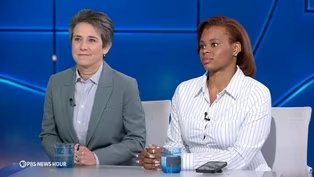
Amy Walter and Jasmine Wright on war's impact on midterms
Video has Closed Captions
Amy Walter and Jasmine Wright on the Iran war's lasting impact on midterm politics (6m 28s)
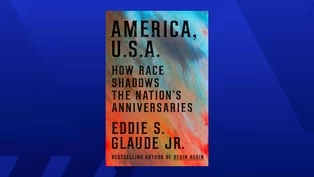
Book traces American celebration of freedom and denial of it
Video has Closed Captions
New book explores America's history of celebrating freedom while excluding millions (6m 56s)
Dermatologist explains benefits of new sunscreen ingredient
Video has Closed Captions
Dermatologist explains benefits of newly approved sunscreen ingredient (5m 45s)
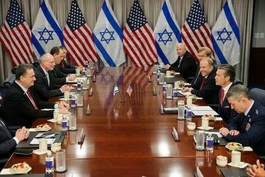
How Israelis are responding to Trump's Iran peace plan
Video has Closed Captions
How Israelis are responding to Trump's Iran peace plan (5m 14s)
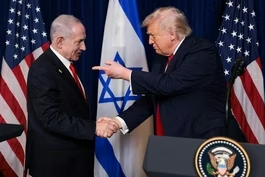
Iran deal a strategic defeat for Israel, Mideast expert says
Video has Closed Captions
U.S.-Iran deal a 'strategic defeat' for Israel, Middle East expert says (5m 2s)
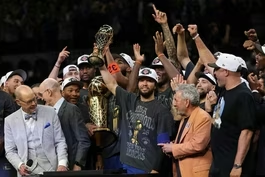
Monica McNutt on the wait for a Knicks championship
Video has Closed Captions
Monica McNutt reflects on the decades-long wait for a Knicks championship (5m 45s)
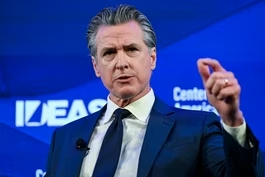
News Wrap: Newsom says Trump ordering DOJ to investigate him
Video has Closed Captions
News Wrap: Newsom says Trump ordering DOJ to investigate him and wife (7m 13s)
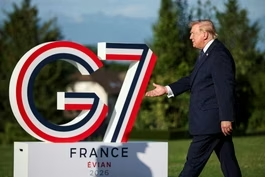
Trump hails Iran deal as G7 summit begins in Europe
Video has Closed Captions
Trump hails Iran deal as G7 summit begins in Europe (8m 58s)
Providing Support for PBS.org
Learn Moreabout PBS online sponsorship
- News and Public Affairs

Today's top journalists discuss Washington's current political events and public affairs.

- News and Public Affairs

FRONTLINE is investigative journalism that questions, explains and changes our world.


 New Episode
 New Episode
 New Episode




 New Episode
Support for PBS provided by:
Major corporate funding for the PBS News Hour is provided by BDO, BNSF, Consumer Cellular, American Cruise Lines, and Raymond James. Funding for the PBS NewsHour Weekend is provided by...