
More Than Medicine: Building Community Health
Special | 28m 41sVideo has Closed Captions
The history behind community healthcare in Northwest Ohio.
More Than Medicine: Building Community Health explores the history of community healthcare in Northwest Ohio through the story of Neighborhood Health Association. From the vision of Cordelia Martin to generations of healthcare advocates, the documentary reveals how communities fought to overcome barriers to care and why their work remains essential today.
Problems playing video? | Closed Captioning Feedback
Problems playing video? | Closed Captioning Feedback
Toledo Stories is a local public television program presented by WGTE
More Than Medicine: Building Community Health
Special | 28m 41sVideo has Closed Captions
More Than Medicine: Building Community Health explores the history of community healthcare in Northwest Ohio through the story of Neighborhood Health Association. From the vision of Cordelia Martin to generations of healthcare advocates, the documentary reveals how communities fought to overcome barriers to care and why their work remains essential today.
Problems playing video? | Closed Captioning Feedback
Where to Watch Toledo Stories
Toledo Stories is available to stream on pbs.org and the PBS app.
More than medicine.
Building.
Community health is made possible by the support of the Neighborhood Health Association and viewers like you.
Thank you.
In urban centers aroun the country, including Toledo, the health care deserts access was limited.
If you are poor and if you're black, it was more difficult to gain access to health care.
And this administration today.
Here and now, declares unconditional war on poverty in America.
If you take a look at any of the stats, any of the demographics, you will see that difficulty with untreatable illnesses are predominantly located in specific neighborhoods.
Providing that access and serving that individual would make the entire community a better place.
I some of us, I may be poor with I am.
Sometimes you have to do it at a community level.
You have to be in a place where people can connect with you.
Federally Qualified Health Centers F. S, more commonly referred to as community Health Centers, really are of the community and driven by the community because who knows the community needs better than the community members and selves.
So you can think about it as your family doctor, much more comprehensive, focuse on primary care and prevention, but it also is going to have a more holistic approach.
The federally qualifie Health Centers were established because there were so many people in communities that did not have health care and did not have access to health care.
That has an impact on this economy that people tend not to talk about.
It is far more expensive for someone to be treated in an emergency room than it is for them to be connected with a primary care doctor.
The intended role of community health centers is to act as a safety net.
It's to be there when no one else will be, to provide care to peopl who otherwise wouldn't get it, and to do it in an affordable way.
There were so many people in communities that did not have health care and did not have access to health care.
We saw mainstream healt care system really had forgotten our underserved area that do have health disparities and in likely a greater need, and certainly a more challenging time.
So many people were passing away from treatable illnesses, and I think I think that wa the impetus for so much of this.
The disparity in treatment outcomes was enough to make your stomach hurt.
Very.
Burst out of the war on poverty and the civil Rights movement era.
We started as a pilot program, as a matter of fact, in Mississippi and in Massachusetts.
Community health centers were modeled on something that was not happening here for us.
It was actually happening in a in a partite South Africa.
That was Jack Geiger.
Geiger had actually worked i apartheid South Africa and seen one in operation.
So a group of thought leaders came together, including some doctors, and said, we want to take medical care into these communities.
What I saw happen is that basic care was harder for the individual to access.
And so in the 1960s, after the civil rights movement, in particular, there were Model Cities programs that were started in the country.
We got this whole push to try and provide better housing, better social conditions for people.
And the Model Cities program was part of that.
Communities that were heavily populated, like Toledo, the biggest city in the region, started to think about how do you actually provide health services to people where they are.
In our community?
There really wasn't any health services for the people that lived there.
And my mom would walk us down to the health department on Washington Street to get our shots.
And that was the only way w could get our medical attention.
What sparked the need was that we had to g so far to get health services.
But that was the tim when mother began to work.
For.
Model cities.
When when the government brought in the programs and she was on the the committees to institute these programs into the community.
Martin Health Center was named after my mother.
Cordelia Martin was an amazing woman.
She was a social worker.
She lived in the central city.
She was in a neighborhood where people were not getting access to health care and suffering as a result of that.
And she and several of her neighbors decided to start a clinic that would serve people regardless of their ability to pay.
Our fathers doctor, John H. Coleman.
He practiced medicine in this community along with other black doctors.
So the responsibility of provision of health care rested in the hands of a few people.
People like my father, who felt strongly that health advocac and health access was important to the quality of a neighborhood and a person's life.
Harry Brown senior was my father.
My father's passion for community health care stemmed from his upbringing.
So when he had the opportunity to work with Martin, he wanted people, particularly peopl of our community, to have access to health care withou having to worry about the bills.
If we take a look at the pioneers here in our region were women like Daisy Smith.
One of the early black nurses in this community.
Aurora Gonzalez was a godmother for the whole Latino community across our region.
Mary Gregory, who was very vocal about all issues of public health.
I'm not in the community.
I'm in the street.
In the street now.
To me, that says a lot mor because we used to go anywhere.
You ask us to come, we would go.
Women like Mildred Bayer, who was the wife of our family doctor, she was so dedicated to medicine.
Our homeless healt care clinic is named after her.
She and her husband were absolutely committed to serving people who were unhoused.
Every black physician, every nurse in this city, every psychiatrist in the city who was African American worked in that clinic making sure that people could have access to care if they needed it., For the purpose of providing a place in a location where access to health care was granted.
And there was a stack hands approach in Toledo of multiple people that stacked hands said, we're going to do this.
And it happene in the name of Cordelia Martin.
The original health center was actually established in 1968, receiving its first set of federal dollars in 1969.
It was in shared space with Planned Parenthood in a in a blue building that was kind of up on a little bit of a hill.
The little blue house Kadir Martin was history for.
My mama, mom would say, if they didn't have it.
Well, we'll go to her.
She'll tell us what to do, how to do it.
I actually worked at Cradle Martin.
What I found were people who were devoted to the people they cared for and determined that whatever the situation, they were going to provide as best health care as they could for them, and whether they had to do it in a chanty or a mortar, I don't think matter to them.
What mattered to them were the people that they were caring for.
And slowly, over time, a network developed of neighborhood health clinics and these neighborhood health centers because they are distributed all throughout our region.
There are portal of entry.
The health center idea that had been embedded in the original model cities.
Legislation began to sprout up in neighborhood after neighborhood after neighborhood in all the big cities, not just Toledo.
I, stepson Nate Junior, had an accident.
And of course, when my husband moved here he didn't have health insurance.
And so fortunately for us, we were able to go to Cordelia Martin.
And it had gotten infected.
And thanks to the care that they gave him there and eventually having him admitted to the hospital for that possibly you know, saved him much more, injury to that leg.
So there's so many people go through those periods where they're unemployed, looking for a new job, underemployed, or with jobs that don't provide health insurance for them.
And if they're not places where you can go to receive health care, what would you do?
I think my father did realize that the work at Martin and the community work that he was a part of, along with others.
Was a city changer.
It was a life changer and that it would change forever, the cit and the people that lived in it.
I think it was one of the greatest facilities for our community.
A lot of the communit people weren't were drawn to it when they needed health services.
It was easier to go to the Martin Health Center than it was to go to some of the hospitals and other places.
You have reached th Cordelia Martin Health Center.
Our office is currently closed.
Please leave your name, telephone number and a brief message after the tone and someone from our office will return your call as soon as possible.
Thank you for calling th Cordelia Martin Health Center.
When I first.
Became involved with the organization, it was it was a mainstay in the community.
My very first day on the job, the IRS called and said that they were going to lock the door because there was a tax issue.
She was offered this position and the government was going to put padlock in h.r.
And she called them and said, give me time, give me time, and I can turn this around.
And they listen to her and they did.
And this was a risk.
This was a flier.
This was okay, I'm goin to leave a good, steady 9 to 5 and take over this organizatio and see if I can make it work.
I talked to my daughter, who was 12 at the time, and, I said, look, we can do this.
But if it goes badly, we won't be able to go to McDonald's anymore.
And she said you know, we can do this, mom.
And so I took the job.
Well in 1993 is when she took over.
And I do recall people saying, you know, there there's been difficulties, funding difficulties, board difficulties.
But if anybody could address that and grow the organization and gro professionally, it was Downey.
And we talked about her going there and she talked about the positives and negatives.
But I encouraged her because I know what her capacities are.
When I started the the feds were coming in monthly to look at our operation.
They don't do that anymore and they rarely did it then.
They only did it when a system was in real trouble.
And so my first year as executive director, they were coming in monthly to look at records and just review the operation.
Danny is focused.
She is driven in a is her life's work.
She she committed to it.
And when she commits her idea is to make it the best she can make it.
I really wanted to work in a place where I could see people affected by the work I wanted to see.
I wanted to to kno that we were providing services that really change lives on a in a fundamental way.
The first thing I needed to do, when I acquired the position, quite honestly, was to make sur that we were financially sound.
There was not much choice except to deal with those things first.
And so that's what we did.
We continued seeing patients during that time, but our outreach really needed some attention.
And so we began talking to the neighbors and talking to other organizations and making sure people kne that Cordelia Martin was there.
If they were, if they needed that care.
This is community health.
I live in.
This community.
I can walk.
To work if I want to.
I se my patients at the grocery store because you can't really treat someone unless you at least know their circumstances.
People aren't noncompliant with their medication.
They may not understand wh they need to take the medication or they can't afford the medication.
It was just a matter of listening to communities and, going to places where actually our mission directed us to go to.
Our growth is based primarily o the need for the neighborhood.
It's not based primaril on the number of patient visits to a particular site.
If our only location is downtown and you live way north, access isn't easy for you.
So we go way north.
And I think having those multi locations sends a message out to the community that hey we are here.
We welcome you.
Let us help you with your health concerns.
And that's always very important.
When I was a board president we did start to expand in the community and offer other services.
For example, we offered pharmacy services, which is important.
Very important to people so that they don't have to leave the medical center and try to find a pharmacy.
When you have a pharmacy right there, it's a lot easier for people.
Sometimes cut the cost of pharmaceuticals for our patients by more than half.
And it's it's it's the reason that's so important is that it's great to get to the doctor.
But if you can't get the medication that the doctor needs you to have, you know, you still have an issue, you still have a problem.
I have patients can't afford their their insulin with regular insurance.
Not only were we able to get them the medication they needed, but we were able to improve the quality of his life now and improve his length of life for later.
And it's all because not understanding how to manage his insulin and then not being able to afford his insulin.
For me, I think one of the most important things was provide transportation for her clients.
And, they could call so that they could be at their appointment and be there on time.
I don't see anything like that going on in Washington, D.C.. Patients.
A lot of time will get dismissed from a practice because they missed their appointment.
We will never dismiss a patient because they did not make their appointment.
Transportation is quite difficult for a lot of our patients.
A lot of our population, they they'll be late.
You've lost that opportunity and that provide will never schedule you again.
We don't do that here.
We will see you.
But here you feel comfortable.
You're walking in the door and they're willing to help you more.
So they're here for you.
They're making sure that you have an opportunity because you're a deserving human being, no matter what your circumstances are.
There are so many patients that I'll never forget.
However, this one individual really sticks out for me.
She.
Came in, was was very late for her appointment.
Very, very late.
And like, no, we need to see her.
She was hysterical.
She was in tears.
She was in liver failure.
And believe it or not, she did stop drinking and she was able for her to a couple of places and she was abl to get on the transplant list, and she got a liver transplant.
I didn't expect her to live.
And she's doing so well.
And, gives me chills thinking about it.
We run a wide variety of services in partnership with every hospital in this town.
If you want to talk about your nutrition, guess what?
We have a nutritionist on staff.
You need a ride to the senior center.
Our driver will come and pick you up.
If you found some lump in your breas and you're not sure what's going on, call us.
You an anchor person who will screen you and get you to the right facility or the right service.
My fellow Highlands, we have not faced an enem like we are facing today in 100.
And two years.
You have to go back to the 1918 influenza epidemic.
I don't know any other way to describe this but to say that we are at war.
Today we have 351 confirmed cases in Ohio, which, as we know and we have spoken of, is the tip of the iceberg of what we're seeing.
Covid was a game changer.
Covid caused us to recalibrate as an organization.
It taught us that you can always make a way out of no way.
When we didn't understand the transmissibility of this illness, when we didn't understand, how we were going to continue to provide care during this difficult time we found a way to get that done.
And we filled a lot of the gap that other organizations were not able to feel because of access.
We found ways to still serve the patients.
Even with the th the guidelines and restrictions.
We were open every single day of that Covid crisis.
And our folks showed up and we we got it done.
I was like, what's there?
Sorry about it.
That's the know how to use it.
You look fine.
I took pictures downtown.
Next time.
Can I help you?
Our providers, our docs, our nurses, our front desk staff.
They're there because they believe in the mission.
And they are their health care heroes, quite frankly.
I like to say not all heroes where capes.
And I say that about Community Health center.
All of our team members.
If these community health centers disappeared, our patients, first of all, they'd be usin the emergency rooms more often.
I believe a lot of them would be dying, sufferin ill effects from their diseases, amputations, heart attacks, strokes.
We would have food deserts, and then we would have also have health care deserts.
I shudde to think it would be horrible.
My mom was a patient at th Cordelia Martin Health Center.
That's where my mother passed away.
Is sitting in the waiting room.
I mean, we just thought it was the most fitting place for her to to to pass.
If she was sitting in the waiting room waiting on her appointment.
When you're standing on the shoulders of someone else, they have.
They have in so many ways, passed that torch on to you and giving you the challenge to make it better.
And I think we've made it better.
And that makes me proud.
I think my mother would be very proud of the advances that have been made within the system, and that she would still be just as proud today as she was back then.
Her name is associated with something so wonderful.
Good health.
Care changes communities.
It it it empowers communities.
If you are in the business of empowering people, you also want to b in the business of of empowering where they live.
It's part of what we take on as physicians, nurses and other people in the healthcare field.
Is that willingness to help others?
We don't judge.
That's for others.
We don't judge.
You're in front of us.
You're sick, human being.
We're going to be the best we can for you.
Rich or poor?
And that's a moral, ethical piece of who we are.
Take a breath.
A landmark in our community and has been there serving, almost since I can remember, but continues to be a viable part of our community.
Standing for women and men and boys and girls that need someone to stand for them and care for them.
The future is bright.
It's not going to come without challenges.
We will be successful.
Make sure our patients and communities are strong are healthy.
So I find a lot of hope i Ohio's community health centers.
More than medicine.
Building community health is made possible by the support of the Neighborhood Health Association and viewers like you.
Thank you.
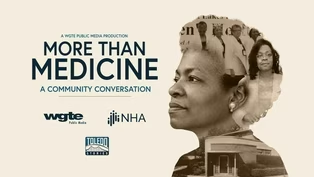 New
NewMore Than Medicine: A Community Conversation
Video has Closed Captions
Clip: Special | 43m 20s | Local healthcare leaders discuss community health, remaining barriers, and building trust. (43m 20s)
Providing Support for PBS.org
Learn Moreabout PBS online sponsorship New Episode
 New Episode
- News and Public Affairs

Top journalists deliver compelling original analysis of the hour's headlines.

 New Episode


 New Episode

 New Episode


Support for PBS provided by:
Toledo Stories is a local public television program presented by WGTE