John McGivern’s Main Streets
Pleasant Prairie and Mount Pleasant, Wisconsin
Season 5 Episode 2 | 26m 48sVideo has Closed Captions
Pleasant Prairie and Mount Pleasant live up to their names in southeastern Wisconsin.
Pleasant Prairie and Mount Pleasant in southeastern Wisconsin are aptly named. Discover a cheese castle, local farms, kringle, scenic nature and the world’s sixth-best pizza. Add stops like Bristol Renaissance Faire and Apple Holler, and you’ll have plenty of reasons to get off I-94.
Problems playing video? | Closed Captioning Feedback
Problems playing video? | Closed Captioning Feedback
John McGivern’s Main Streets is a local public television program presented by PBS Wisconsin
John McGivern’s Main Streets
Pleasant Prairie and Mount Pleasant, Wisconsin
Season 5 Episode 2 | 26m 48sVideo has Closed Captions
Pleasant Prairie and Mount Pleasant in southeastern Wisconsin are aptly named. Discover a cheese castle, local farms, kringle, scenic nature and the world’s sixth-best pizza. Add stops like Bristol Renaissance Faire and Apple Holler, and you’ll have plenty of reasons to get off I-94.
Problems playing video? | Closed Captioning Feedback
How to Watch John McGivern’s Main Streets
John McGivern’s Main Streets is available to stream on pbs.org and the free PBS App, available on iPhone, Apple TV, Android TV, Android smartphones, Amazon Fire TV, Amazon Fire Tablet, Roku, Samsung Smart TV, and Vizio.
Providing Support for PBS.org
Learn Moreabout PBS online sponsorship- John McGivern: I am in southeast Wisconsin, just steps away from Illinois.
- Announcer: Thanks to our underwriters.
- My father taught me that to make great bakery, you have to do it the right way.
O&H Danish Bakery, where kringle traditions begin.
- Together, doing good for 130 years.
Horicon Bank: It's the natural choice for community banking.
- There's no place like Oconomowoc.
Explore, play, shop, stay!
Visit Oconomowoc!
- Support for this program provided by Plum Media.
From first spark to final edit, it's all about bringing stories to life with purpose and precision.
- Announcer: Financial support has been provided by our friends at Greenfire, a construction management company, the friends of PBS Wisconsin, and the Friends of Main Streets.
- Announcer 2: If you haven't watched every episode of John McGivern's Main Streets, you can catch up because they're all available on YouTube, where you'll also find additional content never seen on the show.
John McGivern's Main Streets on PBS and on YouTube.
Great combination.
♪ 'Cause these are our Main Streets ♪ ♪ Something 'bout a hometown speaks to me ♪ ♪ There's nowhere else I'd rather be ♪ ♪ The heart and soul of community's right here ♪ ♪ On these Main Streets ♪ - I am at the Pleasant Prairie Premium Outlets.
Okay, I'm as surprised as you are.
There are 90 stores, 140,000 square feet of retail.
This is one of the places we pass all the time when we're on I-94.
So, this is gonna be a whole different kind of episode.
We're not gonna cover one community.
We're gonna cover a couple of areas.
It's gonna be, like, the travel corridor.
We're gonna be both in Racine and Kenosha County, about 30 miles south of Milwaukee, 60 miles north of Chicago, and it's bookended on the north by Mount Pleasant and on the south by Pleasant Prairie.
Let's call this episode "The Pleasant Cities."
Okay, again, as surprised as you are.
Emmy, we're in front of the Pleasant Prairie History Museum, which is a terrific place to really learn about the history of the area, but why would we do that when you're here?
And what's special about this episode for you is that you grew up not far from here at all.
- Emmy Fink: I definitely could throw a football to my parents' house.
- John: Oh, great.
Can you give me the history of this area?
- I sure can.
- John: Good.
- These two communities that we're talking about were agricultural communities before they became rest stops on the Green Bay trail, you know, the mail route between Green Bay and Chicago.
- Anything else you learned in this history museum?
- Yes, so there was a company called Laflin & Rand Powder Company here in Pleasant Prairie in 1911.
And one night, when their plant was closed, their gunpowder plant, there was a detonation of 260 tons of gunpowder and dynamite.
- John: No.
A lot of damage somewhere.
- Emmy: A lot of damage.
Well, thank goodness the plant was on hundreds of acres, and the plant was closed, so there weren't many workers there.
There were three people who did perish, but it flattened almost every building in this town.
- Remarkable, yeah.
- Emmy: Unbelievable.
- So, we're in front of the Pleasant Prairie Museum because we're covering Pleasant Prairie.
We're covering Mount Pleasant.
There's a lot of area to cover.
I think we should get going.
- There are pleasant views to see.
Follow, follow me.
- John: Yes, there are.
We're going to your mom's house?
- Emmy: Yeah, you wanna go see her?
- I'm gonna say three words: Mars Cheese Castle.
Excited!
Let's first talk about history.
Can we do that?
- Chris Ventura: Yeah.
- Natalie Broussard: My grandparents, Mario and Martha, founded the business in 1947.
And the name Mars is a conjunction of their names, Mario and Martha-- Mars'-- plural possessive.
- Chris: Right.
- What do people usually think?
- Outer space.
- Right.
[laughs] And it has nothing to do with that.
- No.
- Chris: So, our grandfather was a butcher by trade.
He had the foresight to start a cheese and sausage business.
- In 2011, we built the castle, and then in 2017, we expanded and doubled the footprint.
- This could be the Mars Cheese Shop or the Mars Cheese Palace.
Why is it Mars Cheese Castle?
- Chris: Our ancestors in Italy owned a castle on our grandfather's mother's side.
So, to him, to give people a castle to go into where they were treated like royalty and they could get quality Wisconsin products, was the ultimate.
- Natalie: Yeah.
- Chris: You know, to have people come in and say, "Wow, "I love that you guys are still here because my parents used to bring me here when I was a kid," it's an honor to be able to kind of bring this into the next generation.
- Good.
- Cheers.
- Cheers to you.
Are you surprised that I'm at the sample table?
Let's talk about what we have.
- Michael Ventura: 16-year-old cheddar.
- John: Is this about as long as it can go?
- Michael: They can go older than that, but when they start to get really, really old, they can kind of get a little bitter, so it's nice to-- - Like me!
[Michael laughs] - Michael: Honeybee goat Gouda.
- John: Oh, it's nice.
- Happy goats.
- Happy goats!
[both chuckle] Look at this.
This looks beautiful.
Fried curds.
- Natalie: Why don't you give that a try?
- John: Mmm.
- Natalie: It's really rewarding to be here and be working with family.
- You did good.
Your boys are good.
- Susan Ventura: Thank you.
- And your niece is great.
- And my niece is wonderful too.
- Yeah.
- Chris: Who knew people loved cheese so much?
How better could it be?
- Susan: All the cheese curds you could eat.
- John: Locals affectionately call this geodesic dwelling the Dome Home.
It was built in 1988 by a guy named Jack E. Thompson.
He was an author and a golf instructor, and an inventor of golf gadgets.
This is now an Airbnb that can host up to 16 people, and I swear, I have never seen anything like this in my life.
Take a look at the front yard.
It's a driving range.
Fore!
I'm at a farm in Mount Pleasant.
It's called Anarchy Acres, and this is Charlie Tennessen.
- Charlie Tennessen: Glad we got you out here.
- Thanks for talking to me.
- Some good city people out here.
- [chuckles] I love that.
- Charlie: Here, I try to grow as much of my food as possible.
I get probably 60% of my calories off the farm.
Potatoes and beans and stuff like that.
Carrots, tomatoes, peppers, and squash.
- You have three donkeys, miniature donkeys?
- Miniature donkeys, yeah.
Rosie, Cassie, and Sebastian.
- John: They're workers on this farm.
- Charlie: They work and they play and they live, just like I do.
Watch out, sweetie.
Be nice.
They're from the city.
They don't know.
[chuckles] And the donkeys also do the plowing.
- And they don't mind?
- I mean, once they're hitched up, they don't have a choice, but I think, you know... - They might mind.
- Charlie: They might mind.
Oh, wow, John.
- John: What?
- Charlie: This looks fantastic.
Look at that.
That is a lot of bees flying.
We should go in there right now, John, and get some honey.
- John: Well, you go ahead.
[both laugh] - Charlie: We can walk through the barn.
- John: Is wheat your-- the biggest crop that you grow?
- Charlie: Yeah, this is my cash crop.
These are bags of Red Fife wheat.
And I wanted to explore wheats, heritage wheats, and the wheats that I grow, the theme is it's all wheat that was grown in Wisconsin during the 19th century.
It's fun, I mean, it's geeky and it's fun.
- Yeah.
- And you get to eat it.
What really inspires me and what got the whole thing going is pizza.
So, I need to have all the ingredients for pizza out there.
So, that's why all the tomatoes and the peppers, so I can make a lot of pizza sauce, and-- But you asked about, you know, what my product is, and-- - John: Oh, yeah.
- Charlie: So, I have five varieties that I think I'm the only person in the world growing them.
- John: And there are enough people who want this?
- Charlie: Oh, it's been fantastic.
People really like it, they ask about it, but I'm interested in taste and beauty.
- John: You don't think we're judging?
What kind of wheat is that?
- Charlie: This is Haynes Bluestem, which is a hard red spring wheat.
All right.
- John: This looks delicious.
- Charlie: Here's the big test.
- John: Can I dig in here?
- Charlie: Give it a try.
- John: Thank you.
- Charlie: Yeah, you're the only person in the state of Wisconsin, besides me, eating a crust made out of Haynes Bluestem wheat right now.
- John: Well, it's good, it's delicious.
This is good pizza.
- It's an accessible lifestyle.
It's beautiful.
And I think, if it's done right, it's more responsible.
- John: So, Charlie, I'm just gonna say this, okay?
There's gotta be an easier way to do this.
- Of course there is, but is there a more meaningful way to do it?
- No doubt, yeah.
- Yeah.
- John: Thanks for talking to me.
- Emmy: Apple Holler isn't like every other apple orchard out there.
We'll lay it out by numbers for you.
30,000 trees on 78 acres that bear 50 different varieties of apples, peaches, and pears.
But let's get back to those peaches 'cause it's peach season.
These are called Saturn peaches.
How cute are they?
They're shaped like a donut!
People come from five states away just for these little peaches.
I see why.
Delicious!
But the best part?
They are open year-round, which means if a fall craving hits in the dead of winter, you can have one of these, their famous apple cider donuts.
Why, yes, I do want one right now.
Thank you!
Love this place!
- The first ren faire started about 60 years ago when a high school teacher wanted to make history fun.
It really began to take off when the elements of fantasy took place.
So, do you have any idea how many ren fairs there are in this country?
- There are over 200 ren fairs like this in the United States, but come on.
Are any of them as good as Bristol?
[chuckles] I don't think so.
- John: This is Bristol 1574.
- Julie McMillin: Correct.
- That's where we are today.
- Correct, so, in real life, the-- Queen Elizabeth visited the city of Bristol in the year 1574.
And so, we recreate a whole chapter of history around it.
- John: How many people will be here today, do you think?
- Oh, if I had to guess, about 15,000.
- Emmy: And 15,000 come to see about 1,000 performers.
That's how many cast members are here putting on shows.
Give us a sampling of what goes on here.
- Julie: So, at Bristol itself, we're 30 acres large with 16 different stages, and on those stages, you're going to see musicians, acrobats, comedians, sword fighting, jousting, everything that you can imagine.
We encourage our guests to come and play along as well.
We want people to embrace that spirit of play.
- Have you ever had your hand properly kissed?
- Emmy: No.
- Like that?
- Good morning.
- I have been told that you are in fact fully literate.
You can write as well as read.
- Half-literate.
[laughs] I'm fully literate.
[laughs] - Gertrude: All right then, you're mostly going to make your letters from the top to the bottom.
Very light pressure if you're going to go up, because otherwise the ink will spatter.
- Emmy: Oh.
- Gertrude: There, you see?
- Emmy: Yes.
Where's the Wite-Out?
Just in case.
[John chuckles] - Gertrude: You are a beginner at this.
- John: I am.
- Gertrude: And you are starting rather late in life to learn.
You are beyond eight years old.
- Old.
[laughs] - Gertrude: I will say, you are not blobbing it.
- I like this.
This is, like, very relaxing.
- I wanna see you do it.
Would you mind?
- No, not at all.
- John: Okay, good.
- Gertrude: I can write both your names and "Main Streets."
- Emmy: Okay, okay.
- John: Perfect.
- Emmy: That is pretty.
Gertrude, you are something.
- John: Yeah, you're good.
Gorgeous.
- Emmy: That's beautiful.
- Gertrude: Has it satisfied you?
- John: Completely.
- Gertrude: Excellent.
Well, you have completed your first course.
Another 10 or so, and you should be prepared.
- We'll be back... - Excellent well.
- ...next weekend.
- Excellent well.
- John: People talk about the turkey leg, and that's a staple here, yes?
- Julie: Absolutely.
Turkey leg is not from the Renaissance.
- Oh, it's not?
- No, it is not.
So, the turkey leg is a ren faire creation rather than a Renaissance creation.
- Ha, oh, look, I found you.
You weren't gonna share.
- John: So glad you found me.
- Emmy: What a stinker!
He was gonna eat this and leave the bone.
I know it, and I wanna try-- - My favorite part so far.
Another place we pass on our travels: Uline.
This is their 1.5 million-square-foot distribution center.
It's one of the largest warehouses in the country.
Pleasant Prairie has strategic location, which brought a lot of companies that we all know: Amazon, Eli Lilly, Rust-Oleum.
Good Midwestern work ethics-- That's why they're here.
We're at Putzmeister.
When I know I'm gonna talk to a CEO, I'm always like, "Oh, he's gonna--" You are, like, young.
Like, how did this happen again?
- Jason Talbot: Well, I'm almost 50, so I don't know if that counts for young.
- Are you?
You look good.
What happens here?
- Jim Flees: We make concrete pumps.
So, essentially, what our equipment does is, instead of doing the manual labor of having to haul the concrete from the mixer truck to wherever your final job is, we pump it.
- Putzmeister means what in German?
Help me.
- Mortar master.
- Mortar master.
And the history of this company.
When did this start, and who thought of this?
- This business started in the '50s.
It was founded by Karl Schlecht, the German inventor.
In 1994, this property started here in Wisconsin.
- Are there other Putzmeisters in the United States doing what you're doing?
- In the United States, this is our headquarters and our only manufacturing facility.
From here, we support customers from the tip of Canada all the way to the bottom of South America.
- John: It's right here?
- Jason: It's right here.
- John: Mount Pleasant, Wisconsin.
- Jason: That's it, all right here.
- How long does it take you to make one of these?
- Jim: So, from start to finish, you're looking at roughly about three weeks.
- John: Is it a niche sort of business?
- It is, absolutely, and you and your viewers will probably see machines like this driving down the road.
It's niche, but nonetheless, they are all over the country.
- John: Is there an area of the world that needs these much more than another area?
- Jason: I would say no.
I mean, it's across the board.
I mean, concrete is such a common material.
- Main use is if we do, like, high-rises, second story, parking structures, bridges, anything with an overpass.
I mean, they use them for driveways, sidewalks, foundations is huge.
You can use it for swimming pools, parking garages, anything you wanted.
So, this is the final finish area.
This is where they basically finish everything off.
They're putting everything on here.
What they do is the final vinyl.
Anything that gets put on gets done here before it goes out to get inspected, before it goes to the final delivery.
- This is amazing to me that this business, it touches my life every day.
- It does.
It's a foundational need for our society to be able to build roads and bridges and all that.
Very proud to be able to be part of a company that has a plant like this right in Wisconsin.
- This is unbelievable.
I get it now.
- This big building behind me is the largest municipal indoor recreation facility in the entire country.
It's called the Pleasant Prairie RecPlex, and it's basically the Mecca of youth sports.
It's 300,000 square feet of every court you can imagine.
There's ice rinks, an indoor water park, pools, you name it.
There's a lot going on in there.
- Come on, people, it's kringle.
I'm coming!
Who is "O" and who is "H?"
- Peter Olesen: Yeah, so O&H stands for Olesen and Holtz.
- Olesen and Holtz, sure.
- Peter: My great-great grandfather, 1949.
He had that opportunity with-- partner with a gentleman named Harvey Holtz to open O&H Danish Bakery on the north side of Racine.
- What are we gonna do today?
- We're here to make kringle.
- John: How long you been doing it?
- Eric Olesen: 55 years.
- John: 55 years?
What are we making today?
- We're making the Wisconsin kringle.
Three of the best flavors of Wisconsin: Wisconsin cream cheese, Wisconsin cranberries, and Door County cherries.
- Was kringle always a staple?
- Peter: You know, Racine was a very Danish town.
It was actually the biggest location of Danes outside of Denmark was right here in Racine.
So, of course, Danish bakeries and kringle comes with the culture.
We love it, we love to be a part of that.
- Eric: See, you almost got it.
- John: What happened?
So, this is your newest store?
- Peter: It's our newest location, yes, and now it's our flagship store.
We do all of our baking here.
So, this is, I would say, the epicenter of O&H.
- John: Some beautiful pastries and breads and cakes.
- Peter: We really help our customers get together with family and celebrate special time.
This is our cherry cranberry, and you can see the chunks.
We make every filling, everything from scratch.
- John: What's the most traditional?
- Peter: Most traditional flavor would probably be the almond.
- John: How many flavors do you have now?
- Peter: We probably make 15 to 18 different every day.
Throughout the year, we probably make 60 or 70 different flavors.
- John: Have you ever seen anyone worse at it?
[laughs] - We wouldn't tell.
- I'm going in the archives.
- There was a long pause!
Mailing these out?
- We've been shipping since the 1960s, and it's been over half our business since the '80s.
- John: Really?
- Peter: Yes.
- John: So, what's it like to live this legacy?
- Peter: It's an honor, a privilege, humbling to be able to take the charge.
Between my father, my uncles, my grandparents, they set us up for success by focusing on doing things the right way, commitment to quality... - John: Sure.
- Peter: ...and we have a great team.
We work hard, and it's not without a moment that we don't try to do a little bit better.
- John: Oh, I'm sure.
- Peter: That's one thing the Olesen family is.
And really, it's about helping our customers celebrate.
- John: Yeah.
- Peter: Come together.
Good team effort.
- Thank you so much.
Is there a trick to cutting this?
Is there a certain way to-- - You know, some like very large slices, some a little less.
Let's dig in.
- John: Lovely.
To you and O&H.
- Skoal.
- Thanks so much.
- Skoal.
- Skoal.
Mmm.
- Emmy: 20% of the land in Pleasant Prairie is protected land, and a lot of that land is right here in the Chiwaukee Prairie.
Now, it's 400 acres of completely untouched land, and it's been that way for hundreds of years.
So the name, Chiwaukee Prairie.
It's halfway between Chicago and Milwaukee.
And it became a National Natural Landmark back in 1973.
- John: We're at the Pritzker Military Museum & Library.
- April Smith-Miller: It opened about 20 years ago.
- John: 20 years ago.
- April: It was Colonel Jennifer Pritzker.
She had these collections, and they started to grow, and she felt that she wanted to share it with the public, and so that's why she opened up the museum.
We were originally located on Michigan Avenue in Chicago, but we needed more space.
So, we decided that we wanted to build this facility in Somers, Wisconsin.
The shape of the building is to represent the Higgins boat.
- John: The beach launcher.
- April: Yes, in World War II.
- John: Yeah, so that image that we see as they come to Normandy.
- April: Yes.
- John: This is what that's designed after.
- April: Exactly.
- John: Nice.
- April: Yes, this museum, what makes us unique is that it talks about the citizen soldier.
So, it gives you an intimate look into that individual.
We follow that whole story.
- John: So, I'm the son of a World War II veteran who saw action in the Philippines, and that's the generation of men who, like, never said a word about it.
Like, I didn't hear any of that from my father.
- So, that's what it's all about, is to share those stories.
- Lindsay Robbins: Antonia Alvarez served with the WAVES, the Women Accepted for Voluntary Emergency Service.
She was a writer and a translator, and we have here an example of one of the letters that she would have written to inform of a soldier's passing.
And the rest of this comes from the Charles Vann Collection.
These over here are navigational charts that were used for a bombing mission.
And you can actually see-- - And he kept these?
- Yes.
- April: Chaplain Frederick McDonald, he collected all these stained glasses from synagogues and chapels, and he gradually mailed it back to himself.
Desmond LaPlace, he wanted to serve, but he wasn't able to.
So, what he did is he wrote to the different generals, you know, high brass, and you have all these officials that wrote back to him.
You had Patton, you have Eleanor Roosevelt.
This is what came out of it.
- And they all wrote back to him?
- Yes, they wrote back to him.
We rotate our exhibits every four to six months.
It's constantly changing.
- Yeah.
- April: The bottom line is to tell the public about the citizen soldier.
- John: It speaks of such honor to these people who served too, doesn't it?
- April: It does, it does.
- John: Yeah.
One of the most stolen road signs in all of America is right here in Kenosha County: Bong Recreation Area.
If you don't know why it's stolen, you need to Google the word "bong" or talk to one of your grandkids.
The real question is, what is the area and who or what was it named after?
- The sign means Richard Bong State Recreation Area.
It's a state park and a nature preserve just 10 miles west of here, and it's named in honor of Major Richard Bong.
He was a native of Wisconsin, and he's considered to be World War II's top flying ace.
But here's my tip: Don't steal this sign.
Just go out to Bong for a great hike.
It's one of my family's favorites.
- I still have a question, though.
Like, was the smoking tool named after Richard Bong?
- I don't know!
We're on PBS!
This is for a cable show.
- Do you know this incredible pizza place in Mount Pleasant?
Okay, I have to admit, I had no idea it was in Mount Pleasant.
I'd always say, "Let's go eat Wells Brothers in Racine."
It's not.
It is in Mount Pleasant.
And if you haven't eaten here, you need to know that it's the sixth-best pizza in the world.
They said it was Racine too.
Come on.
Bill, I'm coming.
What are we doing?
- Bill Rivers: We're gonna make a pizza.
This is an old bakery roller.
It's been in the family here forever.
- It's old.
- Bill: That's how we get our pizza to be so thin.
So, this is old Chicago tavern-style pizza.
We had relatives in Illinois back in the '40s, and they came up and showed my grandma and my uncles how to do it.
Been the same ever since.
So, my grandfather and his brother had it in '21 until about early '40s, right after World War II.
And then, my uncle took over when he was 18.
So, I'm third generation in.
- Is there a generation coming up that's gonna take it over?
- My daughters are.
- Did you grow up knowing this is what-- no?
- Rebekah: I don't think we really thought that, yeah, that it would be us one day, but someone's gotta keep it going, and why not us?
- Liz Surendonk: So, now three girls will take it over.
- Rebekah: Yeah.
- John: Don't you love that?
- Bill: I do, I think it's great.
- John: No, it's such a good story.
- We were raised in a family with very strong women, right?
We had our great grandma and our grandma and Paula and all these people to kind of set the tone for us.
And so, now we're all very strong.
- John: Yeah.
- And, you know, take that as you will.
We're all, we all have-- [laughs] - It works out.
- Rebekah: It works, it works.
- Bill: The sausage is all made in house.
- John: From an old family recipe?
- Bill: Old family recipe.
- John: Lookit, you don't skimp either, do you?
- Bill: No, I tell all my employees when they put it on, make sure you give them enough.
Don't skimp on it because that's where all the flavor is.
We usually go through about 300 pounds a week.
- Is that right?
- Yeah.
We're only here five days, so it's a lot of pizzas.
The best mozz around.
Some places put a lot of cheese.
I was always taught from my uncles that you wanna see the pizza underneath it.
It's got little blisters on there.
That's good, then I know it's done.
And I'll let you cut it, John.
There's your weapon.
Now, we cut everything square.
- John: Nice, I love square.
- Bill: 'Cause that is the old Chicago tavern style.
My cook's been with me 19 years in July.
- John: Wow.
- Bill: Yeah.
And his wife Coco is over there.
She works for us too.
It's all family.
You know, we learned that a long time ago from my grandmother and my uncles.
You know, you gotta have family to make it go.
Just coming to work with my girls every day is such a blessing.
- John: Great.
- I love it.
I couldn't be more happy.
- Who cut that pizza?
- John: I did.
- Okay.
[all laugh] - Bill: Mangia.
- John: Mangia.
[Rebekah chuckles] - Bill: Thanks for coming in.
- John: Mm-hmm!
Take a look at that tree.
You think you're in my backyard?
No, we're at Georgie Porgie's treetop restaurant.
Does that look like a national chain?
But it's not.
It's definitely local.
They have two locations, one in Oak Creek and one here in Mount Pleasant.
So, there's a second-generation owner who said he really wanted it to feel nostalgic and feel like you're at an amusement park eatery.
Well, there sure has been a lot of eating in this episode.
I don't know.
I think I can.
I just-- I don't want you to watch me.
Okay, here we go.
[upbeat music] Emmy, why are you wearing a Mount Pleasant T-shirt and we're in Pleasant Prairie?
- Well, I wanted to bring the two communities together, but the T-shirt is extra special because my grandpa, Henry Rohner, was the town chairman of Mount Pleasant for 16 years.
- Come on.
How great is that?
You know what they say.
They say, "It's always pleasant in the prairie."
Yeah.
- So happy!
- I bet your grandpa would've said that too.
- Aw, yeah, he would've loved you.
♪ There's nowhere else I'd rather be ♪ ♪ The heart and soul of community's right here ♪ - One of the-- [groans] Again.
Loser.
- I am a loser.
Everyone knows it.
- Oh-ho-ho, my kingdom.
[chuckles] - Chi-- Chiwaukee, Chiwaukee, Chiwaukee.
[John laughs] Hold on, cut.
[laughs] - Announcer: Thanks to our underwriters.
- My father taught me that to make great bakery, you have to do it the right way.
O&H Danish Bakery, where kringle traditions begin.
- Together, doing good for 130 years.
Horicon Bank: It's the natural choice for community banking.
- There's no place like Oconomowoc.
Explore, play, shop, stay!
Visit Oconomowoc!
- Support for this program provided by Plum Media.
From first spark to final edit, it's all about bringing stories to life with purpose and precision.
- Announcer: Financial support has been provided by our friends at Greenfire, a construction management company, the Friends of PBS Wisconsin, and the Friends of Main Streets.
- Announcer 2: If you haven't watched every episode of John McGivern's Main Streets, you can catch up because they're all available on YouTube, where you'll also find additional content never seen on the show.
John McGivern's Main Streets on PBS and on YouTube.
Great combination.
- Sylvia!
[all laugh] Get the hell out of my pizza.
[laughs]
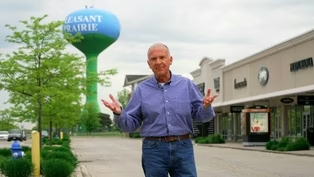
Preview - Pleasant Prairie and Mount Pleasant, Wisconsin
Preview: S5 Ep2 | 30s | Pleasant Prairie and Mount Pleasant live up to their names in southeastern Wisconsin. (30s)
Providing Support for PBS.org
Learn Moreabout PBS online sponsorship












Support for PBS provided by:
John McGivern’s Main Streets is a local public television program presented by PBS Wisconsin