
Rose Parade Floats and the History and Craft Behind Them
Clip: Season 8 Episode 4 | 3m 38sVideo has Closed Captions
Erik C. Andersen gives a behind the scenes look at Burbank’s 2026 Rose Parade float.
Erik C. Andersen brings us backstage for a first look at Burbank’s 2026 Rose Parade float. As a symbol of horticultural abundance, Burbank’s first float included a cornucopia of fruits and vegetables. Now, 111 years later, foraged bougainvillea, roses and other flowers are preserved using new methods able to protect up to 80% of their color.
Problems playing video? | Closed Captioning Feedback
Problems playing video? | Closed Captioning Feedback
Lost LA is a local public television program presented by PBS SoCal
Rose Parade Floats and the History and Craft Behind Them
Clip: Season 8 Episode 4 | 3m 38sVideo has Closed Captions
Erik C. Andersen brings us backstage for a first look at Burbank’s 2026 Rose Parade float. As a symbol of horticultural abundance, Burbank’s first float included a cornucopia of fruits and vegetables. Now, 111 years later, foraged bougainvillea, roses and other flowers are preserved using new methods able to protect up to 80% of their color.
Problems playing video? | Closed Captioning Feedback
How to Watch Lost LA
Lost LA is available to stream on pbs.org and the free PBS App, available on iPhone, Apple TV, Android TV, Android smartphones, Amazon Fire TV, Amazon Fire Tablet, Roku, Samsung Smart TV, and Vizio.
Providing Support for PBS.org
Learn Moreabout PBS online sponsorshipWe headed to a city-owned warehouse where work on Burbank's Rose Parade float was already underway.
[Sparking] ♪ Andersen: The float.
So, here it is in its current state.
Masters: It's quite a treat to see the innards of this thing.
This is all welded custom by hand-- Andersen: Yes.
Masters: Every year.
Andersen: Every year.
And welcome to our detailed deco area.
Masters: So, this is where the magic happens.
Andersen: Yeah.
This is where all the detail on the float start--happens.
Masters: And people will just bring in, donate things like this.
Andersen: Yeah.
I'm gonna have you help me prep this.
Masters: OK.
[Snip] So the trick with the silica gel is that it will dry it out, otherwise, it would lose most of its color.
Andersen: Right.
We're saving the color.
As the designer, I like the floats to feel very organic.
This year, the theme is "Best Day Ever."
Masters: Dinosaurs on a volcano.
Having a lot of fun, right?
I love it.
Andersen: We'll have waterfalls in the front.
There's gonna be real water.
There's gonna be lots of animation.
The volcano is gonna erupt fire and fireworks.
Masters: Nobody's ever seen this before.
You invented this.
Andersen: I mean-- Masters: But it's beautiful.
It's magical.
Andersen: And you say that, right?
Masters: Right.
And you can kind of imagine that this might have existed in prehistoric times, right?
Andersen: Probably not.
[Laughter] Masters: So, even if the bougainvillea is new-- that's an innovation-- there's nothing new about foraging in the local community for Rose Parade material.
Andersen: No.
Our first float in 1914, called "Dragon Cornucopia," that's exactly what they did.
People had their gardens with their roses.
And also Burbank was agricultural.
So, they picked the watermelons and the melons and the-- and the pumpkins and stuff like that.
And that was the cornucopia.
So, they themed the float after what they brought in from the community.
Masters: So, when Burbank started participating in the Rose Parade, we're talking about a different era.
You still had probably wildflowers all around, but those bloomed in the spring.
And by the time winter rolled around, there probably wasn't a lot of color.
Roses, maybe?
Andersen: Roses was one because everybody had their rose gardens back then.
Masters: Yeah.
Andersen: And then the very rich had, of course, a whole bunch of stuff that they could snip.
We used on the first float, because there was a lot of green, there were a lot of tree leaves.
The back of it was, um, grasses that were grown locally, maybe even from the L.A.
River.
All the vegetables on the front of the float, all the fruits that were on the front of the float, you know, they were showing how much we were growing in the valley at the time.
Masters: Of course, the San Fernando Valley was one giant farm or ranch.
Andersen: Right, exactly.
So, they had a lot of stuff they could pull onto the floats.
Masters: So, 100 years ago, the San Fernando Valley was completely different.
Andersen: All agriculture.
Masters: It was all agriculture.
Yeah, either farming or ranching, maybe some scattered settlements.
Andersen: I think they wanted to show them off on their buggies.
You know, at the time-- Masters: The very first.
Andersen: Yeah, they were horse-drawn buggies.
And then they started having these covered cars, when cars started coming in the parades, and then it became floats.
Masters: And some of these people, because they were the sort of aristocratic elite, they were essentially just wintering in Pasadena, and they had their houses-- Andersen: The Wrigley Mansion, being donated to the Tournament of Roses.
That was the, I think, their winter home.
Masters: And that sort of goes back to the Rose Parade's origins.
For some of these people, it was a way to celebrate that, "Hey, we're in this amazing climate," and it's really one of the few places in the country like that all throughout the year, Andersen: I think so, yeah, definitely.
Video has Closed Captions
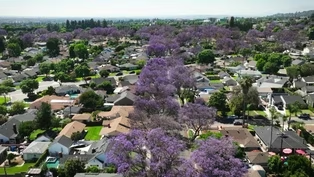
Clip: S8 Ep4 | 3m 50s | LA Times’ Gustavo Arellano and Julia Wick debate the controversial Jacaranda tree. (3m 50s)
Providing Support for PBS.org
Learn Moreabout PBS online sponsorship









Support for PBS provided by:
Lost LA is a local public television program presented by PBS SoCal